Thank you for visiting SNEWPapers!
Sign up free
Editorial
July 29, 1904
The Idaho Republican
Blackfoot, Bingham County, Idaho
What is this article about?
The editorial explores the American phrase 'Cheer up, the worst is yet to come' as a blend of philosophy and humor, characterized by fatalistic irony. It contrasts this with European critiques, including G.K. Chesterton's views on its lack of sympathy and reverence, preferring Bret Harte over Mark Twain.
Clipping
OCR Quality
95%
Excellent
Full Text
The Worst to Come
By the Editor of Collier's Weekly
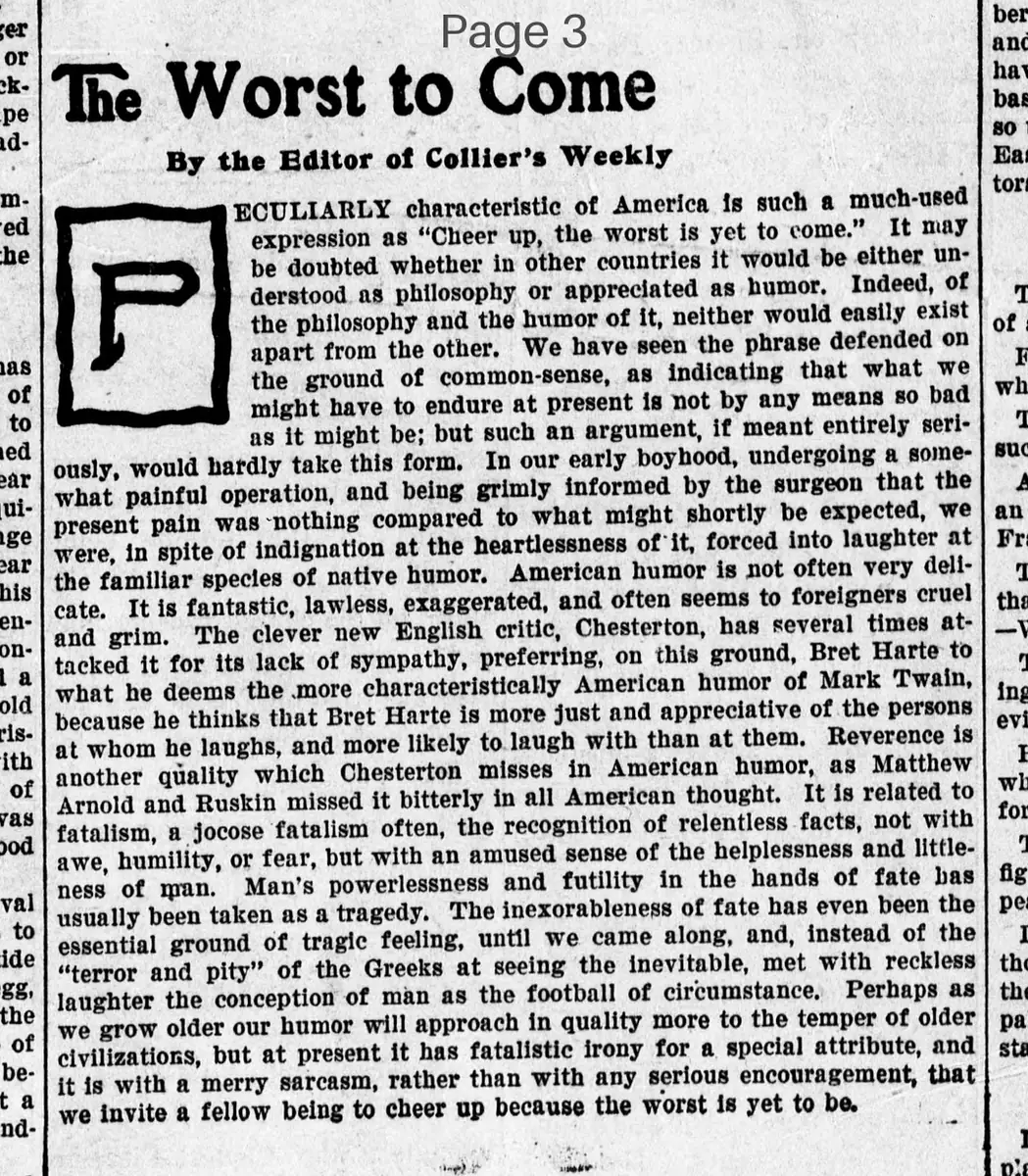
Peculiarly characteristic of America is such a much-used expression as "Cheer up, the worst is yet to come." It may be doubted whether in other countries it would be either understood as philosophy or appreciated as humor. Indeed, of the philosophy and the humor of it, neither would easily exist apart from the other. We have seen the phrase defended on the ground of common-sense, as indicating that what we might have to endure at present is not by any means so bad as it might be; but such an argument, if meant entirely seriously, would hardly take this form. In our early boyhood, undergoing a some-what painful operation, and being grimly informed by the surgeon that the present pain was nothing compared to what might shortly be expected, we were, in spite of indignation at the heartlessness of it, forced into laughter at the fantastic, lawless, exaggerated, and often seems to foreigners cruel and grim. The clever new English critic, Chesterton, has several times attacked it for its lack of sympathy, preferring, on this ground, Bret Harte to what he deems the more characteristically American humor of Mark Twain, because he thinks that Bret Harte is more just and appreciative of the persons at whom he laughs, and more likely to laugh with than at them. Reverence is another quality which Chesterton misses in American humor, as Matthew Arnold and Ruskin missed it bitterly in all American thought. It is related to awe, humility, or fear, but with an amused sense of the helplessness and littleness of man. Man's powerlessness and futility in the hands of fate has usually been taken as a tragedy. The inexorableness of fate has even been the essential ground of tragic feeling, until we came along, and, instead of the "terror and pity" of the Greeks at seeing the inevitable, met with reckless laughter the conception of man as the football of circumstance. Perhaps as we grow older our humor will approach in quality more to the temper of older civilizations, but at present it has fatalistic irony for a special attribute, and it is with a merry sarcasm, rather than with any serious encouragement, that we invite a fellow being to cheer up because the worst is yet to be.
By the Editor of Collier's Weekly
Peculiarly characteristic of America is such a much-used expression as "Cheer up, the worst is yet to come." It may be doubted whether in other countries it would be either understood as philosophy or appreciated as humor. Indeed, of the philosophy and the humor of it, neither would easily exist apart from the other. We have seen the phrase defended on the ground of common-sense, as indicating that what we might have to endure at present is not by any means so bad as it might be; but such an argument, if meant entirely seriously, would hardly take this form. In our early boyhood, undergoing a some-what painful operation, and being grimly informed by the surgeon that the present pain was nothing compared to what might shortly be expected, we were, in spite of indignation at the heartlessness of it, forced into laughter at the fantastic, lawless, exaggerated, and often seems to foreigners cruel and grim. The clever new English critic, Chesterton, has several times attacked it for its lack of sympathy, preferring, on this ground, Bret Harte to what he deems the more characteristically American humor of Mark Twain, because he thinks that Bret Harte is more just and appreciative of the persons at whom he laughs, and more likely to laugh with than at them. Reverence is another quality which Chesterton misses in American humor, as Matthew Arnold and Ruskin missed it bitterly in all American thought. It is related to awe, humility, or fear, but with an amused sense of the helplessness and littleness of man. Man's powerlessness and futility in the hands of fate has usually been taken as a tragedy. The inexorableness of fate has even been the essential ground of tragic feeling, until we came along, and, instead of the "terror and pity" of the Greeks at seeing the inevitable, met with reckless laughter the conception of man as the football of circumstance. Perhaps as we grow older our humor will approach in quality more to the temper of older civilizations, but at present it has fatalistic irony for a special attribute, and it is with a merry sarcasm, rather than with any serious encouragement, that we invite a fellow being to cheer up because the worst is yet to be.
What sub-type of article is it?
Satire
What keywords are associated?
American Humor
Fatalistic Irony
G.K. Chesterton
Cultural Philosophy
Mark Twain
What entities or persons were involved?
Editor Of Collier's Weekly
G.K. Chesterton
Bret Harte
Mark Twain
Matthew Arnold
Ruskin
Editorial Details
Primary Topic
American Humor And Philosophy
Stance / Tone
Reflective Appreciation Of Ironic Fatalism
Key Figures
Editor Of Collier's Weekly
G.K. Chesterton
Bret Harte
Mark Twain
Matthew Arnold
Ruskin
Key Arguments
American Phrase 'Cheer Up, The Worst Is Yet To Come' Embodies Philosophy And Humor
Lacks Sympathy And Reverence Critiqued By Chesterton
Contrasts With European Tragic Views Of Fate
American Humor Treats Fate With Reckless Laughter
May Evolve Toward Older Civilizations' Temper