Thank you for visiting SNEWPapers!
Sign up free
Literary
April 6, 1939
The Coolidge Examiner
Coolidge, Pinal County, Arizona
What is this article about?
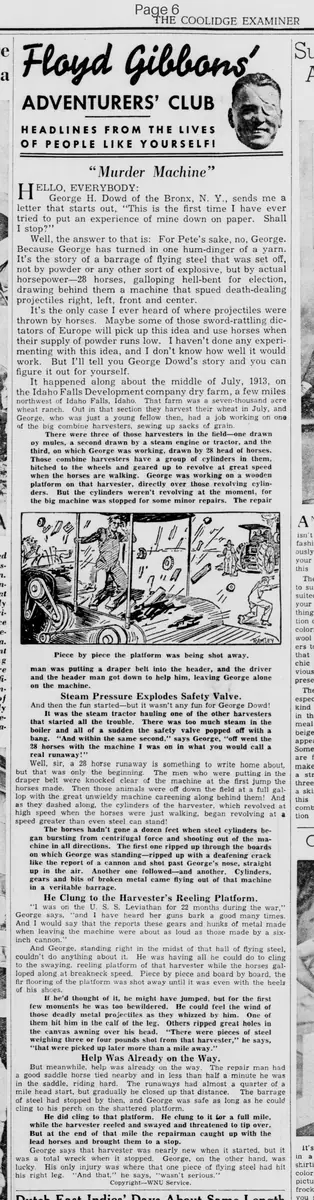
In 1913, on an Idaho wheat farm, young George H. Dowd experiences a dramatic runaway when 28 horses bolt a combine harvester after a nearby steam tractor's safety valve explodes. Revolving cylinders burst, firing steel projectiles like cannon fire, but Dowd clings to the platform for a mile until rescued, sustaining only a minor leg injury.
Clipping
OCR Quality
98%
Excellent
Full Text
THE COOLIDGE EXAMINER
Floyd Gibbons
ADVENTURERS' CLUB
HEADLINES FROM
THE LIVES
OF PEOPLE
LIKE
YOURSELF
"Murder Machine"
HELLO, EVERYBODY:
George H. Dowd of the Bronx, N. Y., sends me a letter that starts out, This is the first time I have ever tried to put an experience of mine down on paper. Shall I stop
Well, the answer to that is: For Pete's sake, no, George.
Because George has turned in one hum-dinger of a yarn.
It's the story of a barrage of flying steel that was set off,
not by powder or any other sort of explosive, but by actual
horsepower--28 horses, galloping hell-bent for election,
drawing behind them a machine that spued death-dealing
projectiles right, left, front and center.
It's the only case I ever heard of where projectiles were
thrown by horses. Maybe some of those sword-rattling dic-
tators of Europe will pick up this idea and use horses when
their supply of powder runs low. I haven't done any experi-
menting with this idea, and I don't know how well it would
work. But I'll tell you George Dowd's story and you can
figure it out for yourself.
It happened along about the middle of July, 1913, on
the Idaho Falls Development company dry farm, a few miles
northwest of Idaho Falls. Idaho. That farm was a seven-thousand acre
wheat ranch. Out in that section they harvest their wheat in July, and
George, who was just a young fellow then, had a job working on one
of the big combine harvesters, sewing up sacks of grain.
There were three of those harvesters in the field-one drawn
by mules, a second drawn by a steam engine or tractor, and the
third, on which George was working, drawn by 28 head of horses.
Those combine harvesters have a group of cylinders in them,
hitched to the wheels and geared up to revolve at great speed
when the horses are walking. George was working on a wooden
platform on that harvester, directly over those revolving cylin-
ders. But the cylinders weren't revolving at the moment, for
the big machine was stopped for some minor repairs. The repair
man was putting a draper belt into the header, and the driver
and the header man got down to help him, leaving George alone
on the machine.
Steam Pressure Explodes Safety Valve.
And then the fun started-but it wasn't any fun for George Dowd!
It was the steam tractor hauling one of the other harvesters
that started all the trouble. There was too much steam in the
boiler and all of a sudden the safety valve popped off with a
bang. "And within the same second," says George, "off went the
28 horses with the machine I was on in what you would call a
real runaway!"
Well, sir, a 28 horse runaway is something to write home about,
but that was only the beginning.
The men who were putting in the draper belt were knocked clear of the machine at the first jump the
horses made. Then those animals were off down the field at a full gal-
lop with the great unwieldy machine careening along behind them! And
as they dashed along. the cylinders of the harvester. which revolved at
high speed when the horses were just walking, began revolving at a
speed greater than even steel can stand!
The horses hadn't gone a dozen feet when steel cylinders be-
gan bursting from centrifugal force and shooting out of the ma-
chine in all directions. The first one ripped up through the boards
on which George was standing-ripped up with a deafening crack
like the report of a cannon and shot past George's nose, straight
up in the air. Another one followed-and another. Cylinders,
gears and bits of broken metal came fiying out of that machine
in a veritable barrage.
He Clung to the Harvester's Reeling Platform.
"I was on the U. S. S. Leviathan for 22 months during the war,"
George says,
"and I have heard her guns bark a good many times.
And I would say that the reports these gears and hunks of metal made
when leaving the machine were about as loud as those made by a six-
inch cannon.'
And George, standing right in the midst of that hail of flying steel,
couldn't do anything about it. He was having all he could do to cling
to the swaying. reeling platform of that harvester while the horses gal-
loped along at breakneck speed. Piece by piece and board by board, the
fir flooring of the platform was shot away until it was even with the heels
of his shoes.
If he'd thought of it, he might have jumped, but for the first
few moments he was too bewildered. He could feel the wind of
those deadly metal projectiles as they whizzed by him. One of
them hit him in the calf of the leg. Others ripped great holes in
the canvas awning over his head.
"There were pieces of steel
weighing three or four pounds shot from that harvester," he says,
"that were picked up later more than a mile away."
Help Was Already on the Way.
But meanwhile, help was already on the way. The repair man had
a good saddle horse tied nearby and in less than half a minute he was
in the saddle, riding hard. The runaways had almost a quarter of a
mile head start, but gradually he closed up that distance. The barrage
of steel had stopped by then, and George was safe as long as he could
cling to his perch on the shattered platform.
He did cling to that platform. He clung to it for a full mile,
while the harvester reeled and swayed and threatened to tip over.
But at the end of that mile the repairman caught up with the
lead horses and brought them to a stop.
George says that harvester was nearly new when it started, but it
was a total wreck when it stopped. George, on the other hand, was
lucky. His only injury was where that one piece of flying steel had hit
his right leg.
"And that," he says, "wasn't serious."
Copyright-WNU Service.
Floyd Gibbons
ADVENTURERS' CLUB
HEADLINES FROM
THE LIVES
OF PEOPLE
LIKE
YOURSELF
"Murder Machine"
HELLO, EVERYBODY:
George H. Dowd of the Bronx, N. Y., sends me a letter that starts out, This is the first time I have ever tried to put an experience of mine down on paper. Shall I stop
Well, the answer to that is: For Pete's sake, no, George.
Because George has turned in one hum-dinger of a yarn.
It's the story of a barrage of flying steel that was set off,
not by powder or any other sort of explosive, but by actual
horsepower--28 horses, galloping hell-bent for election,
drawing behind them a machine that spued death-dealing
projectiles right, left, front and center.
It's the only case I ever heard of where projectiles were
thrown by horses. Maybe some of those sword-rattling dic-
tators of Europe will pick up this idea and use horses when
their supply of powder runs low. I haven't done any experi-
menting with this idea, and I don't know how well it would
work. But I'll tell you George Dowd's story and you can
figure it out for yourself.
It happened along about the middle of July, 1913, on
the Idaho Falls Development company dry farm, a few miles
northwest of Idaho Falls. Idaho. That farm was a seven-thousand acre
wheat ranch. Out in that section they harvest their wheat in July, and
George, who was just a young fellow then, had a job working on one
of the big combine harvesters, sewing up sacks of grain.
There were three of those harvesters in the field-one drawn
by mules, a second drawn by a steam engine or tractor, and the
third, on which George was working, drawn by 28 head of horses.
Those combine harvesters have a group of cylinders in them,
hitched to the wheels and geared up to revolve at great speed
when the horses are walking. George was working on a wooden
platform on that harvester, directly over those revolving cylin-
ders. But the cylinders weren't revolving at the moment, for
the big machine was stopped for some minor repairs. The repair
man was putting a draper belt into the header, and the driver
and the header man got down to help him, leaving George alone
on the machine.
Steam Pressure Explodes Safety Valve.
And then the fun started-but it wasn't any fun for George Dowd!
It was the steam tractor hauling one of the other harvesters
that started all the trouble. There was too much steam in the
boiler and all of a sudden the safety valve popped off with a
bang. "And within the same second," says George, "off went the
28 horses with the machine I was on in what you would call a
real runaway!"
Well, sir, a 28 horse runaway is something to write home about,
but that was only the beginning.
The men who were putting in the draper belt were knocked clear of the machine at the first jump the
horses made. Then those animals were off down the field at a full gal-
lop with the great unwieldy machine careening along behind them! And
as they dashed along. the cylinders of the harvester. which revolved at
high speed when the horses were just walking, began revolving at a
speed greater than even steel can stand!
The horses hadn't gone a dozen feet when steel cylinders be-
gan bursting from centrifugal force and shooting out of the ma-
chine in all directions. The first one ripped up through the boards
on which George was standing-ripped up with a deafening crack
like the report of a cannon and shot past George's nose, straight
up in the air. Another one followed-and another. Cylinders,
gears and bits of broken metal came fiying out of that machine
in a veritable barrage.
He Clung to the Harvester's Reeling Platform.
"I was on the U. S. S. Leviathan for 22 months during the war,"
George says,
"and I have heard her guns bark a good many times.
And I would say that the reports these gears and hunks of metal made
when leaving the machine were about as loud as those made by a six-
inch cannon.'
And George, standing right in the midst of that hail of flying steel,
couldn't do anything about it. He was having all he could do to cling
to the swaying. reeling platform of that harvester while the horses gal-
loped along at breakneck speed. Piece by piece and board by board, the
fir flooring of the platform was shot away until it was even with the heels
of his shoes.
If he'd thought of it, he might have jumped, but for the first
few moments he was too bewildered. He could feel the wind of
those deadly metal projectiles as they whizzed by him. One of
them hit him in the calf of the leg. Others ripped great holes in
the canvas awning over his head.
"There were pieces of steel
weighing three or four pounds shot from that harvester," he says,
"that were picked up later more than a mile away."
Help Was Already on the Way.
But meanwhile, help was already on the way. The repair man had
a good saddle horse tied nearby and in less than half a minute he was
in the saddle, riding hard. The runaways had almost a quarter of a
mile head start, but gradually he closed up that distance. The barrage
of steel had stopped by then, and George was safe as long as he could
cling to his perch on the shattered platform.
He did cling to that platform. He clung to it for a full mile,
while the harvester reeled and swayed and threatened to tip over.
But at the end of that mile the repairman caught up with the
lead horses and brought them to a stop.
George says that harvester was nearly new when it started, but it
was a total wreck when it stopped. George, on the other hand, was
lucky. His only injury was where that one piece of flying steel had hit
his right leg.
"And that," he says, "wasn't serious."
Copyright-WNU Service.
What sub-type of article is it?
Prose Fiction
What themes does it cover?
Agriculture Rural
Death Mortality
What keywords are associated?
Runaway Horses
Combine Harvester
Flying Steel
Idaho Farm
Wheat Harvest
1913 Accident
Barrage Projectiles
What entities or persons were involved?
George H. Dowd As Told To Floyd Gibbons
Literary Details
Title
"Murder Machine"
Author
George H. Dowd As Told To Floyd Gibbons
Subject
Personal Account Of A 1913 Runaway Harvester Accident On An Idaho Wheat Farm
Form / Style
Narrative Prose Recounting A Thrilling Near Death Experience
Key Lines
"And Within The Same Second," Says George, "Off Went The 28 Horses With The Machine I Was On In What You Would Call A Real Runaway!"
"I Was On The U. S. S. Leviathan For 22 Months During The War," George Says, "And I Have Heard Her Guns Bark A Good Many Times. And I Would Say That The Reports These Gears And Hunks Of Metal Made When Leaving The Machine Were About As Loud As Those Made By A Six Inch Cannon.'
"There Were Pieces Of Steel Weighing Three Or Four Pounds Shot From That Harvester," He Says, "That Were Picked Up Later More Than A Mile Away."