Thank you for visiting SNEWPapers!
Sign up free
Story
December 10, 1825
Edwardsville Spectator
Edwardsville, Madison County, Illinois
What is this article about?
Article from the American Farmer on managing fruit trees, focusing on trimming techniques for apples and peaches, preventing peach tree worms with protective boxes, and improving fruit quality through thinning and cultivation. Authored by Robert Sinclair.
Clipping
OCR Quality
95%
Excellent
Full Text
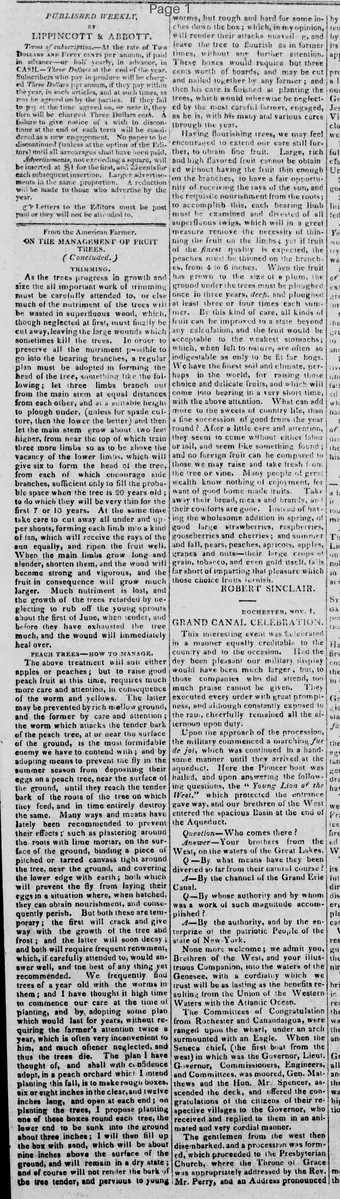
From the American Farmer.
ON THE MANAGEMENT OF FRUIT TREES.
(Concluded.)
TRIMMING.
As the trees progress in growth and size the all important work of trimming must be carefully attended to, or else much of the nutriment of the trees will be wasted in superfluous wood, which, though neglected at first, must finally be cut away, leaving the large wounds which sometimes kill the trees. In order to preserve all the nutriment possible to go into the bearing branches, a regular plan must be adopted in forming the head of the tree, something like the following; let three limbs branch out from the main stem at equal distances from each other, and at a suitable height to plough under, (unless for spade culture, then the lower the better) and then let the main stem grow about two feet higher, from near the top of which train three more limbs so as to be above the vacancy of the lower limbs, which will give six to form the head of the tree, from each of which encourage side branches, sufficient only to fill the probable space when the tree is 20 years old; to do which they will be very thin for the first 7 or 10 years. At the same time take care to cut away all under and upper shoots, forming each limb into a kind of fan, which will receive the rays of the sun equally, and ripen the fruit well.
When the main limbs grow long and slender, shorten them, and the wood will become strong and vigorous, and the fruit in consequence will grow much larger. Much nutriment is lost, and the growth of the trees retarded by neglecting to rub off the young sprouts about the first of June, when tender, and before they have exhausted the tree much, and the wound will immediately heal over.
PEACH TREES—HOW TO MANAGE.
The above treatment will suit either apples or peaches; but to raise good peach fruit at this time, requires much more care and attention, in consequence of the worm and yellows. The latter may be prevented by rich mellow ground, and the former by care and attention; the worm which attacks the tender bark of the peach tree, at or near the surface of the ground, is the most formidable enemy we have to contend with; and by adopting means to prevent the fly in the summer season from depositing their eggs on a peach tree, near the surface of the ground, until they reach the tender bark of the roots of the tree on which they feed, and in time entirely destroy the same. Many ways and means have lately been recommended to prevent their effects; such as plastering around the roots with lime mortar, on the surface of the ground, binding a piece of pitched or tarred canvass tight around the tree, near the ground, and covering the lower edge with earth; both which will prevent the fly from laying their eggs in a situation where, when hatched, they can obtain nourishment, and consequently perish. But both these are temporary; the first will crack and give way with the growth of the tree and frost; and the latter will soon decay; and both will require frequent renewal, which, if carefully attended to, would answer well, and the best of any thing yet recommended. We frequently find trees of a year old with the worms in them; and I have thought it high time to commence our care at the time of planting, and by adopting some plan which would last for years, without requiring the farmer's attention twice a year, which is often very inconvenient to him, and much oftener neglected, and thus the trees die. The plan I have thought of, and shall with confidence adopt, in a peach orchard which I intend planting this fall, is to make rough boxes, six or eight inches in the clear, and twelve inches long, and open at each end; on planting the trees, I propose planting one of these boxes round each tree, the lower end to be sunk into the ground about three inches; I will then fill up the box with sand, which will be about nine inches above the surface of the ground, and will remain in a dry state; and of course will not render the bark of the tree tender, and pervious to young worms, but rough and hard for some inches down the box; which, in my opinion, will render their attacks unavailing, and leave the tree to flourish as in former times, without any further attention.
These boxes would require but three cents worth of boards, and may be cut and nailed together by any farmer; and then his care is finished at planting the trees, which would otherwise be neglected by the most careful farmer, engaged, as he is, with his many and various cares through the year.
Having flourishing trees, we may feel encouraged to extend our care still further, to obtain fine fruit. Large, rich and high flavored fruit cannot be obtained without having the fruit thin enough on the branches, to have a fair opportunity of receiving the rays of the sun, and the requisite nourishment from the roots; to accomplish this, each bearing limb must be examined and divested of all superfluous twigs, which will in a great measure remove the necessity of thinning the fruit on the limbs; yet if fruit of the finest quality is expected, the peaches must be thinned on the branches, from 4 to 6 inches. When the fruit has grown to the size of a plum, the ground under the trees must be ploughed once in three years, deep, and ploughed at least three or four times each summer. By this kind of care, all kinds of fruit can be improved to a state beyond any calculation, and the fruit would be acceptable to the weakest stomachs; which, when left to nature, are often so indigestible as only to be fit for hogs.
We have the finest soil and climate, perhaps in the world, for raising those choice and delicate fruits, and which will come into bearing in a very short time, with the above attention. What can add more to the sweets of country life, than a fine succession of good fruits the year round? After a little care and attention, they seem to come without either labor or toil, and seem like something found; and no foreign fruit can be compared to those we may raise and take fresh from the tree or vine. Many people of great wealth know nothing of enjoyment, for want of good home made fruits. Take away their bread, meat and brandy, and their comforts are gone. Instead of having the wholesome addition in spring, of good large strawberries, raspberries, gooseberries and cherries; and summer and fall, pears, peaches, apricots, apples, grapes and nuts—their large crops of grain, tobacco, and even gold itself, falls far short of imparting that pleasure which those choice fruits furnish.
ROBERT SINCLAIR.
ON THE MANAGEMENT OF FRUIT TREES.
(Concluded.)
TRIMMING.
As the trees progress in growth and size the all important work of trimming must be carefully attended to, or else much of the nutriment of the trees will be wasted in superfluous wood, which, though neglected at first, must finally be cut away, leaving the large wounds which sometimes kill the trees. In order to preserve all the nutriment possible to go into the bearing branches, a regular plan must be adopted in forming the head of the tree, something like the following; let three limbs branch out from the main stem at equal distances from each other, and at a suitable height to plough under, (unless for spade culture, then the lower the better) and then let the main stem grow about two feet higher, from near the top of which train three more limbs so as to be above the vacancy of the lower limbs, which will give six to form the head of the tree, from each of which encourage side branches, sufficient only to fill the probable space when the tree is 20 years old; to do which they will be very thin for the first 7 or 10 years. At the same time take care to cut away all under and upper shoots, forming each limb into a kind of fan, which will receive the rays of the sun equally, and ripen the fruit well.
When the main limbs grow long and slender, shorten them, and the wood will become strong and vigorous, and the fruit in consequence will grow much larger. Much nutriment is lost, and the growth of the trees retarded by neglecting to rub off the young sprouts about the first of June, when tender, and before they have exhausted the tree much, and the wound will immediately heal over.
PEACH TREES—HOW TO MANAGE.
The above treatment will suit either apples or peaches; but to raise good peach fruit at this time, requires much more care and attention, in consequence of the worm and yellows. The latter may be prevented by rich mellow ground, and the former by care and attention; the worm which attacks the tender bark of the peach tree, at or near the surface of the ground, is the most formidable enemy we have to contend with; and by adopting means to prevent the fly in the summer season from depositing their eggs on a peach tree, near the surface of the ground, until they reach the tender bark of the roots of the tree on which they feed, and in time entirely destroy the same. Many ways and means have lately been recommended to prevent their effects; such as plastering around the roots with lime mortar, on the surface of the ground, binding a piece of pitched or tarred canvass tight around the tree, near the ground, and covering the lower edge with earth; both which will prevent the fly from laying their eggs in a situation where, when hatched, they can obtain nourishment, and consequently perish. But both these are temporary; the first will crack and give way with the growth of the tree and frost; and the latter will soon decay; and both will require frequent renewal, which, if carefully attended to, would answer well, and the best of any thing yet recommended. We frequently find trees of a year old with the worms in them; and I have thought it high time to commence our care at the time of planting, and by adopting some plan which would last for years, without requiring the farmer's attention twice a year, which is often very inconvenient to him, and much oftener neglected, and thus the trees die. The plan I have thought of, and shall with confidence adopt, in a peach orchard which I intend planting this fall, is to make rough boxes, six or eight inches in the clear, and twelve inches long, and open at each end; on planting the trees, I propose planting one of these boxes round each tree, the lower end to be sunk into the ground about three inches; I will then fill up the box with sand, which will be about nine inches above the surface of the ground, and will remain in a dry state; and of course will not render the bark of the tree tender, and pervious to young worms, but rough and hard for some inches down the box; which, in my opinion, will render their attacks unavailing, and leave the tree to flourish as in former times, without any further attention.
These boxes would require but three cents worth of boards, and may be cut and nailed together by any farmer; and then his care is finished at planting the trees, which would otherwise be neglected by the most careful farmer, engaged, as he is, with his many and various cares through the year.
Having flourishing trees, we may feel encouraged to extend our care still further, to obtain fine fruit. Large, rich and high flavored fruit cannot be obtained without having the fruit thin enough on the branches, to have a fair opportunity of receiving the rays of the sun, and the requisite nourishment from the roots; to accomplish this, each bearing limb must be examined and divested of all superfluous twigs, which will in a great measure remove the necessity of thinning the fruit on the limbs; yet if fruit of the finest quality is expected, the peaches must be thinned on the branches, from 4 to 6 inches. When the fruit has grown to the size of a plum, the ground under the trees must be ploughed once in three years, deep, and ploughed at least three or four times each summer. By this kind of care, all kinds of fruit can be improved to a state beyond any calculation, and the fruit would be acceptable to the weakest stomachs; which, when left to nature, are often so indigestible as only to be fit for hogs.
We have the finest soil and climate, perhaps in the world, for raising those choice and delicate fruits, and which will come into bearing in a very short time, with the above attention. What can add more to the sweets of country life, than a fine succession of good fruits the year round? After a little care and attention, they seem to come without either labor or toil, and seem like something found; and no foreign fruit can be compared to those we may raise and take fresh from the tree or vine. Many people of great wealth know nothing of enjoyment, for want of good home made fruits. Take away their bread, meat and brandy, and their comforts are gone. Instead of having the wholesome addition in spring, of good large strawberries, raspberries, gooseberries and cherries; and summer and fall, pears, peaches, apricots, apples, grapes and nuts—their large crops of grain, tobacco, and even gold itself, falls far short of imparting that pleasure which those choice fruits furnish.
ROBERT SINCLAIR.
What sub-type of article is it?
Agricultural Advice
Horticultural Guide
What keywords are associated?
Fruit Tree Trimming
Peach Tree Management
Worm Prevention
Thinning Fruit
Agricultural Care
What entities or persons were involved?
Robert Sinclair
Story Details
Key Persons
Robert Sinclair
Story Details
Provides detailed instructions on trimming fruit trees to form a balanced head with six main limbs, removing superfluous shoots, and managing peach trees against worms using protective sand-filled boxes at planting. Emphasizes thinning fruit and regular plowing for quality produce, highlighting benefits of home-grown fruits.