Thank you for visiting SNEWPapers!
Sign up free
The Virginia Gazette
Richmond, Williamsburg, Richmond County, Virginia
What is this article about?
Detailed account of the Battle of Falkirk on January 17, 1746, where Lt. Gen. Hawley's government forces engaged Jacobite rebels. Due to a storm and some units fleeing, the army retreated in order to Linlithgow, leaving some cannon behind. Rebel losses reported as considerable; government side had about 300 missing.
Merged-components note: Continuation of the detailed account of the Battle of Falkirk from the London Gazette, with text directly connecting across pages.
Clippings
1 of 2
OCR Quality
Full Text
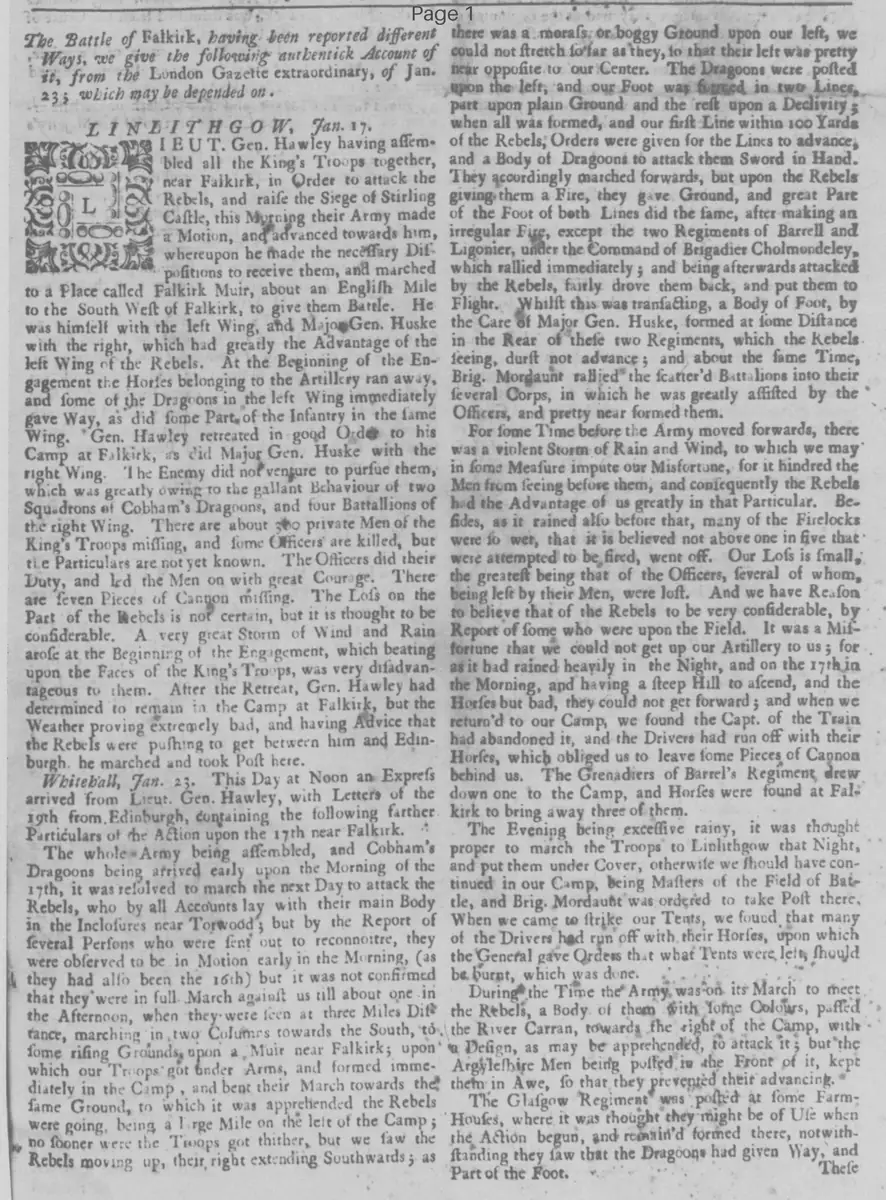
LINLITHGOW, Jan. 17.
Lt. Gen. Hawley having assembled all the King's Troops together, near Falkirk, in Order to attack the Rebels, and raise the Siege of Stirling Castle, this Morning their Army made a Motion, and advanced towards him, whereupon he made the necessary Dispositions to receive them, and marched to a Place called Falkirk Muir, about an English Mile to the South West of Falkirk, to give them Battle.
He was himself with the left Wing, and Major Gen. Huske with the right, which had greatly the Advantage of the left Wing of the Rebels. At the Beginning of the Engagement the Horses belonging to the Artillery ran away, and some of the Dragoons in the left Wing immediately gave Way, as did some Part of the Infantry in the same Wing.
Gen. Hawley retreated in good Order to his Camp at Falkirk, as did Major Gen. Huske with the right Wing. The Enemy did not venture to pursue them, which was greatly owing to the gallant Behaviour of two Squadrons of Cobham's Dragoons, and four Battalions of the right Wing.
There are about 300 private Men of the King's Troops missing, and some Officers are killed, but the Particulars are not yet known. The Officers did their Duty, and led the Men on with great Courage.
There are eleven Pieces of Cannon missing. The Loss on the Part of the Rebels is not certain, but it is thought to be considerable.
A very great Storm of Wind and Rain arose at the Beginning of the Engagement, which beating upon the Faces of the King's Troops, was very disadvantageous to them. After the Retreat, Gen. Hawley had determined to remain in the Camp at Falkirk, but the Weather proving extremely bad, and having Advice that the Rebels were pushing to get between him and Edinburgh, he marched and took Post here.
Whitehall, Jan. 23.
This Day at Noon an Express arrived from Lieut. Gen. Hawley, with Letters of the 19th from Edinburgh, containing the following farther Particulars of the Action upon the 17th near Falkirk.
The whole Army being assembled, and Cobham's Dragoons being arrived early upon the Morning of the 17th, it was resolved to march the next Day to attack the Rebels, who by all Accounts lay with their main Body in the Inclosures near Torwood; but by the Report of several Persons who were sent out to reconnoitre, they were observed to be in Motion early in the Morning, (as they had also been the 16th) but it was not confirmed that they were in full March against us till about one in the Afternoon, when they were seen at three Miles Distance, marching in two Columns towards the South, to some rising Grounds, upon a Muir near Falkirk; upon which our Troops got under Arms, and formed immediately in the Camp, and bent their March towards the same Ground, to which it was apprehended the Rebels were going, being a large Mile on the left of the Camp; no sooner were the Troops got thither, but we saw the Rebels moving up, their right extending Southwards;
as there was a morass or boggy Ground upon our left, we could not stretch so far as they, so that their left was pretty near opposite to our Center. The Dragoons were posted upon the left, and our Foot was formed in two Lines, part upon plain Ground and the rest upon a Declivity; when all was formed, and our first Line within 100 Yards of the Rebels, Orders were given for the Lines to advance and a Body of Dragoons to attack them Sword in Hand.
They accordingly marched forwards, but upon the Rebels giving them a Fire, they gave Ground, and great Part of the Foot of both Lines did the same, after making an irregular Fire, except the two Regiments of Barrel and Ligonier, under the Command of Brigadier Cholmondeley, which rallied immediately; and being afterwards attacked by the Rebels, fairly drove them back, and put them to Flight.
Whilst this was transacting, a Body of Foot, by the Care of Major Gen. Huske, formed at some Distance in the Rear of these two Regiments, which the Rebels seeing, durst not advance; and about the same Time, Brig. Mordaunt rallied the scatter'd Battalions into their several Corps, in which he was greatly assisted by the Officers, and pretty near formed them.
For some Time before the Army moved forwards, there was a violent Storm of Rain and Wind, to which we may in some Measure impute our Misfortune, for it hindered the Men from seeing before them, and consequently the Rebels had the Advantage of us greatly in that Particular.
Besides, as it rained also before that, many of the Firelocks were so wet, that it is believed not above one in five that were attempted to be fired, went off.
Our Loss is small, the greatest being that of the Officers, several of whom, being left by their Men, were lost. And we have Reason to believe that of the Rebels to be very considerable, by Report of some who were upon the Field.
It was a Misfortune that we could not get up our Artillery to us; for as it had rained heavily in the Night, and on the 17th in the Morning, and having a steep Hill to ascend, and the Horses but bad, they could not get forward; and when we return'd to our Camp,we found the Capt. of the Train had abandoned it, and the Drivers had run off with their Horses, which obliged us to leave some Pieces of Cannon behind us.
The Grenadiers of Barrel's Regiment drew down one to the Camp, and Horses were found at Falkirk to bring away three of them.
The Evening being excessive rainy, it was thought proper to march the Troops to Linlithgow that Night, and I put them under Cover, otherwise we should have continued in our Camp, being Masters of the Field of Battle, and Brig. Mordaunt was ordered to take Post there.
When we came to strike our Tents, we found that many of the Drivers had run off with their Horses, upon which the General gave Orders that what Tents were left, should be burnt, which was done.
During the Time the Army was on its March to meet the Rebels, a Body of them with some Colours, passed the River Carron, towards the right of the Camp, with a Design, as may be apprehended, to attack it; but the Argyle-shire Men being posted in the Front of it, kept them in Awe, so that they prevented their advancing.
The Glasgow Regiment was posted at some Farm-Houses, where it was thought they might be of Use when the Action begun, and remain'd formed there, notwithstanding they saw that the Dragoons had given Way, and Part of the Foot.
These Letters also add, that it had been resolved that the Army should remain at Linlithgow, whither it had retreated upon the 17th at Night; but, upon Examination, it was found that the Troops had no Powder that would take Fire, from the excessive Rain for 24 Hours before; and thereupon Resolution was taken, upon the 18th in the Morning, to march to Edinburgh and the Places adjacent, where the whole Army arrived that Afternoon about four o'Clock.
Edinburgh, Jan. 19. The Rebels by all Accounts lost many more Men than the King's Forces, and could not improve the Advantages they had at the Beginning of the Action, but were driven back by, and fled before a Handful of our Army, and we remained Masters of the Field: tho', by the Inclemency of the Weather, and Want of Provisions Night coming on, our Army were obliged to march to Linlithgow, and thereby abandon what Cannon and Tents they could not find Horses to carry off.
Sir Robert Monroe is wounded and taken Prisoner. Of the Rebels, Lochiel, Ld. Perth, and his Brother, are said to be wounded, and Lochiel's Brother is killed, and a Major, Macdonald, taken Prisoner.
Just now about 31 of our Officers, who were taken Prisoners at the Battle of Preston, being all that were at Glasgow, Cupar and Leslie, and who were delivered by armed Parties of his Majesty's loyal Subjects in the Neighbourhood of the Places, have been brought hither by a Detachment of those Parties.
What sub-type of article is it?
What keywords are associated?
What entities or persons were involved?
Where did it happen?
Foreign News Details
Primary Location
Falkirk
Event Date
January 17
Key Persons
Outcome
king's troops: about 300 private men missing, some officers killed, eleven pieces of cannon lost. rebels: considerable losses, lochiel and lord perth wounded, lochiel's brother killed, major macdonald taken prisoner. government forces retreated to linlithgow due to weather.
Event Details
Lt. Gen. Hawley assembled King's troops near Falkirk to attack rebels and relieve Stirling Castle. Rebels advanced, leading to battle on Falkirk Muir. Left wing dragoons and infantry gave way after artillery horses fled; right wing held firm. Storm disadvantaged King's troops, wetting firelocks. Army retreated in order, remaining masters of the field but abandoning some cannon and tents. Later marched to Edinburgh due to lack of powder.