Thank you for visiting SNEWPapers!
Sign up free
The Jeffersonian
Stroudsburg, Monroe County, Pennsylvania
What is this article about?
Pennsylvania Supreme Court opinion affirming the murder convictions of William Brooks and Charles Orme for killing brothers Thomas and Theodore Brodhead during a pursuit after a bar robbery in Monroe County. The court rules the private citizens' arrest was lawful and the killings malicious, not manslaughter.
Merged-components note: Continuous text of the Supreme Court opinion on the Brodhead murder case.
Clipping
OCR Quality
Full Text
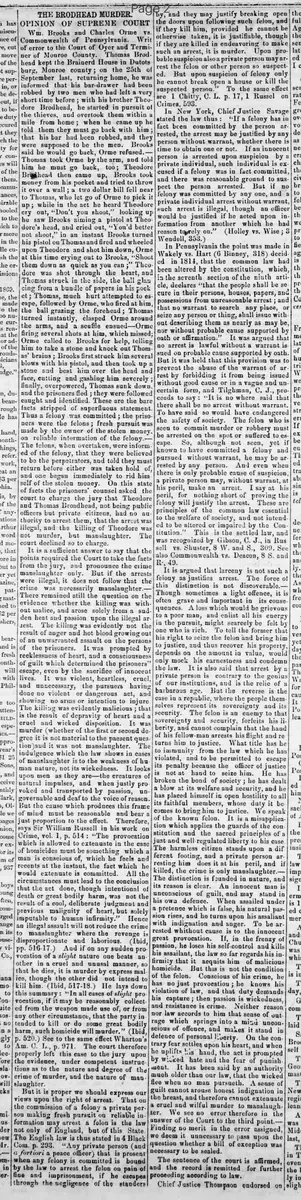
OPINION OF SUPREME COURT
Wm. Brooks and Charles Orme vs. Commonwealth of Pennsylvania. Writ of error to the Court of Oyer and Terminer of Monroe County. Thomas Brodhead kept the Brainerd House in Dutotsburg, Monroe county; on the 25th of September last, returning home, he was informed that his bar-drawer had been robbed by two men who had left a very short time before: with his brother Theodore Brodhead, he started in pursuit of the thieves, and overtook them within a mile from home; when he came up he told them they must go back with him that his bar had been robbed, and they were supposed to be the men. Brooks said he would go back, Orme refused. Thomas took Orme by the arm, and told him he must go back, too; Theodore Brodhead then came up, Brooks took money from his pocket and tried to throw it over a wall; a two dollar bill fell near to Thomas, who let go of Orme to pick it up; while in the act he heard Theodore cry out, "Don't you shoot," looking up he saw Brooks aiming a pistol at Theodore's head, and cried out, "You'd better not shoot," in an instant Brooks turned his pistol on Thomas and fired and wheeled upon Theodore and shot him down, Orme at this time crying out to Brooks, "Shoot them down as quick as you can;" Theodore was shot through the heart, and Thomas struck in the side, the ball glancing from a bundle of papers in his pocket; Thomas, much hurt attempted to escape, followed by Orme, who fired at him, the ball grazing the forehead; Thomas turned instantly, clasped Orme around the arms, and a scuffle ensued—Orme firing several shots at him, which missed: Orme called to Brooks for help, telling him to take a stone and knock out Thomas' brains; Brooks first struck him several blows with his pistol, and then took up a stone and beat him over the head and face, cutting and gashing him severely; finally, overpowered, Thomas sunk down, and the prisoners fled; they were followed caught and identified. These are the bare facts stripped of superfluous statement Thus a felony was committed; the prisoners were the felons; fresh pursuit was made by the owner of the stolen money, on reliable information of the felony. The felons, when overtaken, were informed of the felony, that they were believed to be the perpetrators, and told they must return before either was taken hold of, and one began immediately to rid himself of the stolen money. On this state of facts the prisoners' counsel asked the court to charge the jury that Theodore and Thomas Brodhead, not being public officers but private citizens, had no authority to arrest them, that the arrest was illegal, and the killing of Theodore was not murder, but manslaughter. The court declined so to charge.
It is a sufficient answer to say that the points required the Court to take the facts from the jury, and pronounce the crime manslaughter only. But if the arrests were illegal, it does not follow that the crime was necessarily manslaughter. There remained still the question on the evidence whether the killing was without malice, and arose solely from a sudden heat and passion upon the illegal arrest. The killing was evidently not the result of anger and hot blood growing out of an unwarranted assault on the persons of the prisoners. It was prompted by recklessness of heart, and a consciousness of guilt which determined the prisoners' escape, even by the sacrifice of innocent lives. It was violent, heartless, cruel, and unnecessary, the pursuers having done no violent or dangerous act, and showing no arms or intention to injure. The killing was evidently malicious; that is the result of depravity of heart and a cruel and wicked disposition. It was murder (whether of the first or second degree it is not material to the present question) and it was not manslaughter. The indulgence which the law shows in cases of manslaughter is to the weakness of human nature, not its wickedness. It looks upon men as they are—the creatures of natural impulses, and when justly provoked and transported by passion, ungovernable and deaf to the voice of reason. But the cause which produces this frame of mind must be reasonable and bear a just proportion to the effect. Therefore, says Sir William Russell in his work on Crime, vol. 1. p. 514: "The provocation which is allowed to extenuate in the case of homicides must be something which a man is conscious of, which he feels and resents at the instant, the fact which he would extenuate is committed. All the circumstances must lead to the conclusion that the act done, though intentional of death or great bodily harm, was not the result of a cool, deliberate judgment and previous malignity of heart, but solely imputable to human infirmity." Hence an illegal assault will not reduce the crime to manslaughter where the revenge is disproportionate and laborious.(Ibid, pp. 516-17.) And if on any sudden provocation of a slight nature one beats another in a cruel and unusual manner, so that he dies, it is murder by express malice, though the other did not intend to kill him. (Ibid, 517-18.) He lays down this summary: "In all cases of slight provocation, if it may be reasonably collected from the weapon made use of, or from any other circumstance, that the party intended to kill or do some great bodily harm, such homicide will murder." (Ibid. p. 520.) See to the same effect Wharton's Am. C. L., p. 971. The court therefore properly left this case to the jury upon the evidence, under competent instructions as to the nature and degree of the crime of murder, and the nature of manslaughter.
But it is proper we should express our views upon the right of arrest. That on the commission of a felony a private person making fresh pursuit on reliable information may arrest a felon is the law not only of England, but of this State. The English law is thus stated in 4 Black. Com. p. 293. "Any private person (and a fortiori a peace officer) that is present when any felony is committed is bound by the law to arrest the felon on pain of fine and imprisonment, if he escapes through the negligence of the standers by, and they may justify breaking open the doors upon following such felon, and if they kill him, provided he cannot be otherwise taken, it is justifiable, though if they are killed in endeavoring to make such an arrest, it is murder. Upon probable suspicion also a private person may arrest the felon or other person so suspected. But upon suspicion of felony only he cannot break open a house or kill the suspected person." To the same effect see 1 Chitty, C. L. p. 17, 1 Russel on Crimes, 593.
In New York, Chief Justice Savage stated the law thus: "If a felony has in fact been committed by the person arrested, the arrest may be justified by any person without warrant, whether there is time to obtain one or not. If an innocent person is arrested upon suspicion by a private individual, such individual is excused if a felony was in fact committed, and there was reasonable ground to suspect the person arrested. But if no felony was committed by any one, and a private individual arrest without warrant, such arrest is illegal, though an officer would be justified if he acted upon information from another which he had reason to rely on." (Holley vs. Wise; 3 Wendell, 353.)
In Pennsylvania the point was made in Wakely vs. Hart (6 Binney, 318) decided in 1814, that the common law had been altered by the constitution, which, in the seventh section of the ninth article, declares "that the people shall be secure in their persons, houses, papers, and possessions from unreasonable arrest; and that no warrant to search any place, or seize any person or thing, shall issue without describing them as nearly as may be, nor without probable cause supported by oath or affirmation. It was argued that no arrest is lawful without a warrant issued on probable cause supported by oath. But it was held that this provision was to prevent the abuse of the warrant of arrest by forbidding it from being issued without good cause or in a vague and uncertain form, and Tilghman, C. J., proceeds to say: "It is no where said that there shall be no arrest without warrant. To have said so would have endangered the safety of society. The felon who is seen to commit murder or robbery must be arrested on the spot or suffered to escape. So, although not seen, yet if known to have committed a felony and pursued without warrant, he may be arrested by any person. And even when there is only probable cause of suspicion, a private person may, without warrant, at his peril, make an arrest. I say at his peril, for nothing short of proving the felony will justify the arrest. These are principles of the common law essential to the welfare of society, and not intended to be altered or impaired by the Constitution." This is the settled law, and was recognized by Gibson, C. J., in Russell vs. Shuster, 8 W. and S., 309. See also Commonwealth vs. Deacon, 8 S. and R., 49.
It is argued that larceny is not such a felony as justifies arrest. The force of this distinction is not discoverable. Though sometimes a light offence, it is often grave and important in its consequences. A loss which would be grievous to a poor man, and enlist all his energy in the pursuit, might scarcely be felt by one who is rich. To tell the former that his right to seize the felon and bring him to justice, and thus recover his property, depends on the amount in value, would only mock his earnestness and condemn the law. It is also said that arrest by a private person is contrary to the genius of our institutions, and is the relic of a barbarous age. But the reverse is the case in a republic, where the people themselves represent its sovereignty and its security. The felon is an enemy to that sovereignty and security, forfeits his liberty, and cannot complain that the hand of his fellow-man arrests his flight and returns him to justice. What title has he to immunity from the law which he has violated, and to be permitted to escape its penalty because the officer of justice is not at hand to seize him. He has broken the bond of society; he has dealt a blow at its welfare and security, and he has placed himself in open hostility to all its faithful members, whose duty it becomes to bring him to justice. We speak of the known felon. It is a misapplication which applies the guards of the constitution and the sacred principles of a just and well-regulated liberty to his case. The harmless citizen stands upon a different footing, and a private person arresting him does it at his peril, and if killed, the crime is only manslaughter. The distinction is founded in nature, and its reason is clear. An innocent man is unconscious of guilt, and may stand in his own defence. When assailed under a pretence which is false, his natural passion rises, and he turns upon his assailant with indignation and anger. To be arrested without cause is to the innocent great provocation. If, in the frenzy of passion, he loses his self-control and kills his assailant, the law so far regards his infirmity that it acquits him of malicious homicide. But this is not the condition of the felon. Conscious of his crime, he has no just provocation; he knows his violation of law, and that duty demands his capture; then passion is wickedness, and resistance is crime. Neither reason nor law accords to him that sense of outrage which springs into a mind unconscious of offence, and makes it stand in defence of personal liberty. On the contrary fear settles upon his heart, and when he uplifts his hand, the act is prompted by wicked hate and the fear of punishment. It has been said by an authority much older than our law, that the wicked flee when no man pursueth. A sense of guilt cannot arouse honest indignation in the breast, and therefore cannot extenuate a cruel and wilful murder to manslaughter.
We see no error therefore in the answer of the Court to the third point. Finding no merit in the error assigned, we deem it unnecessary to pass upon the question whether a bill of exception was necessary to be sealed.
The sentence of the court is affirmed, and the record is remitted for further proceeding according to law.
Chief Justice Thompson endorsed on the back of the foregoing opinion: "I fully concur in the reasons of my brother Agnew for affirming the judgment in the court below on the very points presented and argued. To that portion relating to private arrests, I am not prepared to assent, nor yet fully to dissent, but I concur in the result determined on."
What sub-type of article is it?
What themes does it cover?
What keywords are associated?
What entities or persons were involved?
Where did it happen?
Story Details
Key Persons
Location
Monroe County, Pennsylvania
Event Date
25th Of September Last
Story Details
Thomas and Theodore Brodhead pursued and confronted Brooks and Orme after a robbery at Brainerd House. The suspects shot and beat the brothers, killing Theodore and severely injuring Thomas. The Supreme Court affirmed the murder convictions, ruling the private arrest lawful for felony and the killings malicious.