Thank you for visiting SNEWPapers!
Sign up free
Richmond Enquirer
Richmond, Richmond County, Virginia
What is this article about?
A letter from an American in London (Sept. 18, 1821) reflects on Europe's politics: Radical unrest in Britain suppressed; Bourbons stable in France post-Napoleon; Spanish revolution falters over church lands; Italian revolts premature; Greek uprising against Turks likely leads to war, per Charleston Patriot reprint.
Merged-components note: Continuation of the letter to the editor from the Charleston Patriot on the political state of Europe; relabeling the second component from foreign_news to letter_to_editor as it fits the overall content.
Clippings
1 of 2
OCR Quality
Full Text
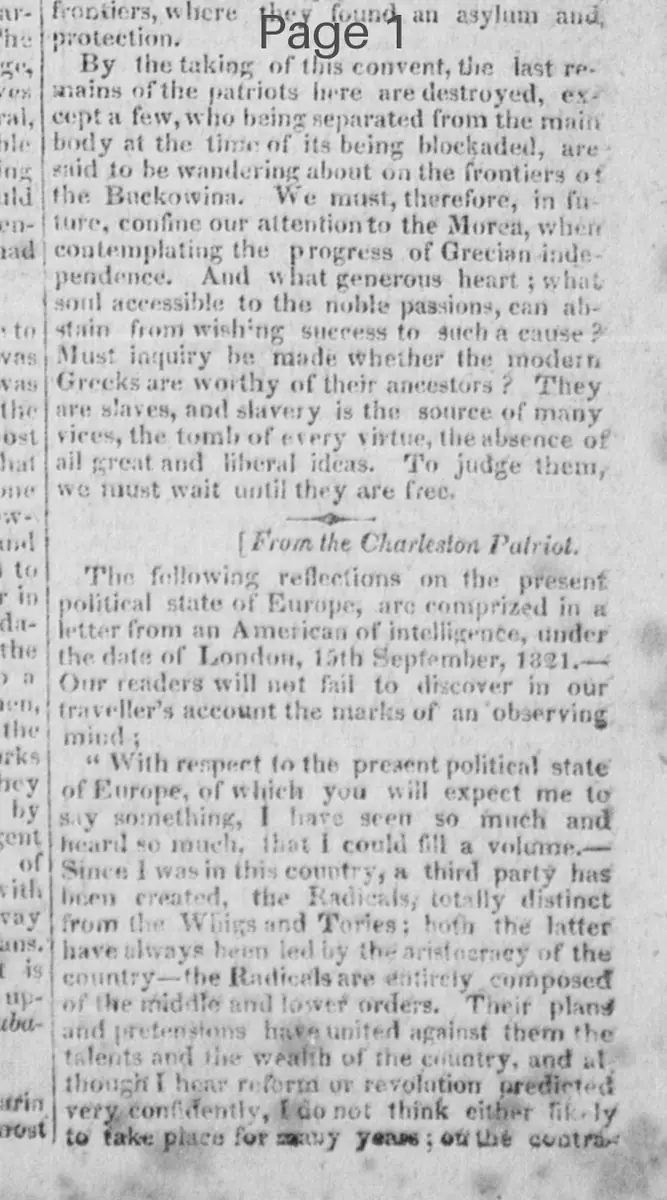
The following reflections on the present political state of Europe, are comprised in a letter from an American of intelligence, under the date of London, 18th September, 1821.—Our readers will not fail to discover in our traveller's account the marks of an observing mind;
"With respect to the present political state of Europe, of which you will expect me to say something, I have seen so much and heard so much, that I could fill a volume.—Since I was in this country, a third party has been created, the Radicals, totally distinct from the Whigs and Tories: both the latter have always been led by the aristocracy of the country—the Radicals are entirely composed of the middle and lower orders. Their plans and pretensions have united against them the talents and the wealth of the country, and although I hear reform or revolution predicted very confidently, I do not think either likely to take place for many years; on the contrary—
By the feeble attempts of the Radicals afford
a pretext to strengthen the arm of government,
and their quarrels with the military deprive
them of their only prospect of success. The
death of the Queen has deprived them of a rallying point and the King is becoming more
popular. The administration feel so secure
that they have reduced the army and adopted
a system of economy which extends to every
branch of the revenue except to the reduction
of what we think useless pensions, but
which are necessary to support ministers in
their places.
The Commerce and Manufactures of
this country are in a flourishing state, and the
vast accumulation of wealth, in this Island
must be seen to be credited. It was said long
ago, "The nation that commands the seas
will command the commerce of the world, the
nation that possesses that commerce will command the riches of the world, and possessed
of such wealth will command the world itself." Of the vast means of this nation, it
would be endless to speak. The organization
of the military and naval establishments is perfect. From policy the party in power, the
Tories, are disposed to be friendly to us; the
Whigs and Radicals are openly hostile to us.
I found France rapidly rising from the
effects of the last disastrous war. The subdivision of property, the interest felt by every
man in the soil he cultivates has given a stimulus to industry, and prodigious resources
of the country have developed themselves
since the peace. The Bourbons are I am
persuaded more firmly seated on the throne
than even they themselves merit. They have
six years of possession with all the strength
derived from the placemen and pensioners
with whom they have surrounded themselves.
The death of Napoleon adds to their security. His adherents have no longer a rallying point. Those of them who looked forward to place or employment at Court will
join the Bourbons; those who were honest
will join the advocates of the charter. The
liberal party lost their power by the assassination of the Duke de Berri. That act justified harsh measures and strengthened the arm
of despotism. Nothing will shake the throne
of the Bourbons but the absurd pretensions of
the Ultra-Royalists, who would return to the
age of Louis the fourteenth, and the extreme
desire of remaining quietly in possession at
any cost, which is constantly evinced by the King.
Of Spain I had heard enough to confirm
my former opinion that their revolution is far
from finished. They have committed some
errors which must involve them in confusion—the greatest appears to have been the confiscation and sale of the church lands. It was
supposed that this measure affecting only the
beneficial clergy would have been well received by the lower order of priests, especially
by the mendicant orders who were favourably disposed to the revolution. They, however, consider that measure as a prelude to
the total destruction of religious orders, and
have made common cause with the higher clergy. Speaking with an enlightened Spaniard
on the radical defects of the Constitution,
the little power given to the Executive and the
Legislative authority being vested in one body, he apologized for the first by saying, that
if the King had more than the shadow of power granted to him by the constitution, they
would have all been sent to the galleys in three
weeks, and defended the other on the principle
of our countryman Franklin.
The Spaniards appear to have fomented
the revolutionary spirit in Italy, and to have
occasioned that premature movement in Naples and Sardinia. The people of Milan wisely
wished to wait for a war on the continent:
had they done so and made one simultaneous
movement, how different would have been the
result. The revolutionary movement in Italy
occasioned great alarm at Paris, when the
Revolutionists and Liberals published immediately the Constitution of 1791, and disseminated copies throughout all France.
The movement in Greece appears to have
been occasioned altogether by the insufferable oppression of the Turks and the intrigues
and money of Ali Pasha. It was unexpected
by Russia, and rather too soon for the views
of that cabinet. It has surprised me that the
other great powers, especially this (Great
Britain) should not have acted in concert with
Russia, so as to have acquired a right to a division of the spoil, and to have prevented that
power from becoming more formidable, which
cannot be done otherwise without involving
Great Britain in an expensive war, which they
are extremely anxious to avoid. The refusal
of the Turks to accept the ultimatum of
the Emperor appears highly absurd. The
opinion in this country appears to be, that
there will be no war; but in France it is deemed inevitable. For my own part, I hope and
believe that there will be a war. The freedom
of the Greeks would be some consolation
for the failure in Italy, and if these great powers have not some occupation, they will
pounce upon Spain and Portugal. I had a
great deal to say about the state of Germany,
where the revolutionary spirit exists in a
strong degree, but I must postpone it for the
next letter."
What sub-type of article is it?
What themes does it cover?
What keywords are associated?
Letter to Editor Details
Main Argument
the letter offers observations on europe's 1821 political situation, highlighting radical challenges in britain met with government strength, bourbon stability in france, revolutionary setbacks in spain due to church land policies, failed movements in italy, and the greek uprising against turkish oppression, with hopes for war to secure greek freedom.
Notable Details