Thank you for visiting SNEWPapers!
Sign up free
Letter to Editor
May 21, 1956
The Augusta Courier
Augusta, Richmond County, Georgia
What is this article about?
A descendant of New England abolitionists shares family history with Black figures like Frederick Douglass, then argues against Supreme Court-mandated school integration, favoring segregation to preserve racial distinctions, drawing parallels to South Africa's apartheid.
Clipping
OCR Quality
98%
Excellent
Full Text
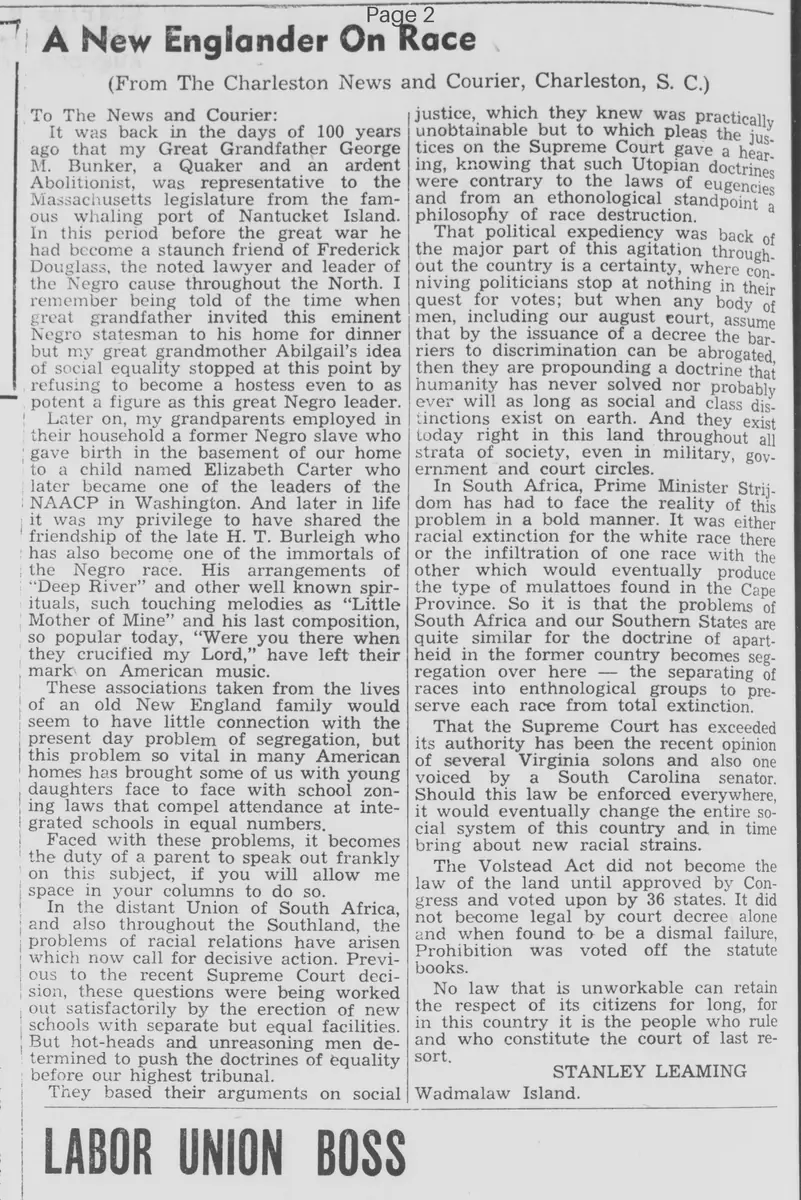
A New Englander On Race
(From The Charleston News and Courier, Charleston, S. C.)
To The News and Courier:
It was back in the days of 100 years ago that my Great Grandfather George M. Bunker, a Quaker and an ardent Abolitionist, was representative to the Massachusetts legislature from the famous whaling port of Nantucket Island.
In this period before the great war he had become a staunch friend of Frederick Douglass, the noted lawyer and leader of the Negro cause throughout the North. I remember being told of the time when great grandfather invited this eminent Negro statesman to his home for dinner but my great grandmother Abigail's idea of social equality stopped at this point by refusing to become a hostess even to as potent a figure as this great Negro leader.
Later on, my grandparents employed in their household a former Negro slave who gave birth in the basement of our home to a child named Elizabeth Carter who later became one of the leaders of the NAACP in Washington. And later in life it was my privilege to have shared the friendship of the late H. T. Burleigh who has also become one of the immortals of the Negro race. His arrangements of "Deep River" and other well known spirituals, so touching melodies as "Little Mother of Mine" and his last composition, so popular today, "Were you there when they crucified my Lord," have left their mark on American music.
These associations taken from the lives of an old New England family would seem to have little connection with the present day problem of segregation, but this problem so vital in many American homes has brought some of us with young daughters face to face with school zoning laws that compel attendance at integrated schools in equal numbers.
Faced with these problems, it becomes the duty of a parent to speak out frankly on this subject, if you will allow me space in your columns to do so.
In the distant Union of South Africa, and also throughout the Southland, the problems of racial relations have arisen which now call for decisive action. Previous to the recent Supreme Court decision, these questions were being worked out satisfactorily by the erection of new schools with separate but equal facilities.
But hot-heads and unreasoning men determined to push the doctrines of equality before our highest tribunal.
They based their arguments on social justice, which they knew was practically unobtainable but to which pleas the justices on the Supreme Court gave a hearing, knowing that such Utopian doctrines were contrary to the laws of eugenics and from an ethnological standpoint a philosophy of race destruction.
That political expediency was back of the major part of this agitation throughout the country is a certainty, where conniving politicians stop at nothing in their quest for votes; but when any body of men, including our august court, assume that by the issuance of a decree the barriers to discrimination can be abrogated, then they are propounding a doctrine that humanity has never solved nor probably ever will as long as social and class distinctions exist on earth. And they exist today right in this land throughout all strata of society, even in military, government and court circles.
In South Africa, Prime Minister Strijdom has had to face the reality of this problem in a bold manner. It was either racial extinction for the white race there or the infiltration of one race with the other which would eventually produce the type of mulattoes found in the Cape Province. So it is that the problems of South Africa and our Southern States are quite similar for the doctrine of apartheid in the former country becomes segregation over here the separating of races into ethnological groups to preserve each race from total extinction.
That the Supreme Court has exceeded its authority has been the recent opinion of several Virginia solons and also one voiced by a South Carolina senator.
Should this law be enforced everywhere, it would eventually change the entire social system of this country and in time bring about new racial strains.
The Volstead Act did not become the law of the land until approved by Congress and voted upon by 36 states. It did not become legal by court decree alone and when found to be a dismal failure, Prohibition was voted off the statute books.
No law that is unworkable can retain the respect of its citizens for long, for in this country it is the people who rule and who constitute the court of last resort.
STANLEY LEAMING
Wadmalaw Island.
(From The Charleston News and Courier, Charleston, S. C.)
To The News and Courier:
It was back in the days of 100 years ago that my Great Grandfather George M. Bunker, a Quaker and an ardent Abolitionist, was representative to the Massachusetts legislature from the famous whaling port of Nantucket Island.
In this period before the great war he had become a staunch friend of Frederick Douglass, the noted lawyer and leader of the Negro cause throughout the North. I remember being told of the time when great grandfather invited this eminent Negro statesman to his home for dinner but my great grandmother Abigail's idea of social equality stopped at this point by refusing to become a hostess even to as potent a figure as this great Negro leader.
Later on, my grandparents employed in their household a former Negro slave who gave birth in the basement of our home to a child named Elizabeth Carter who later became one of the leaders of the NAACP in Washington. And later in life it was my privilege to have shared the friendship of the late H. T. Burleigh who has also become one of the immortals of the Negro race. His arrangements of "Deep River" and other well known spirituals, so touching melodies as "Little Mother of Mine" and his last composition, so popular today, "Were you there when they crucified my Lord," have left their mark on American music.
These associations taken from the lives of an old New England family would seem to have little connection with the present day problem of segregation, but this problem so vital in many American homes has brought some of us with young daughters face to face with school zoning laws that compel attendance at integrated schools in equal numbers.
Faced with these problems, it becomes the duty of a parent to speak out frankly on this subject, if you will allow me space in your columns to do so.
In the distant Union of South Africa, and also throughout the Southland, the problems of racial relations have arisen which now call for decisive action. Previous to the recent Supreme Court decision, these questions were being worked out satisfactorily by the erection of new schools with separate but equal facilities.
But hot-heads and unreasoning men determined to push the doctrines of equality before our highest tribunal.
They based their arguments on social justice, which they knew was practically unobtainable but to which pleas the justices on the Supreme Court gave a hearing, knowing that such Utopian doctrines were contrary to the laws of eugenics and from an ethnological standpoint a philosophy of race destruction.
That political expediency was back of the major part of this agitation throughout the country is a certainty, where conniving politicians stop at nothing in their quest for votes; but when any body of men, including our august court, assume that by the issuance of a decree the barriers to discrimination can be abrogated, then they are propounding a doctrine that humanity has never solved nor probably ever will as long as social and class distinctions exist on earth. And they exist today right in this land throughout all strata of society, even in military, government and court circles.
In South Africa, Prime Minister Strijdom has had to face the reality of this problem in a bold manner. It was either racial extinction for the white race there or the infiltration of one race with the other which would eventually produce the type of mulattoes found in the Cape Province. So it is that the problems of South Africa and our Southern States are quite similar for the doctrine of apartheid in the former country becomes segregation over here the separating of races into ethnological groups to preserve each race from total extinction.
That the Supreme Court has exceeded its authority has been the recent opinion of several Virginia solons and also one voiced by a South Carolina senator.
Should this law be enforced everywhere, it would eventually change the entire social system of this country and in time bring about new racial strains.
The Volstead Act did not become the law of the land until approved by Congress and voted upon by 36 states. It did not become legal by court decree alone and when found to be a dismal failure, Prohibition was voted off the statute books.
No law that is unworkable can retain the respect of its citizens for long, for in this country it is the people who rule and who constitute the court of last resort.
STANLEY LEAMING
Wadmalaw Island.
What sub-type of article is it?
Persuasive
Political
Provocative
What themes does it cover?
Social Issues
Politics
What keywords are associated?
Segregation
School Integration
Supreme Court Decision
Racial Preservation
Apartheid
South Africa
Frederick Douglass
Naacp
What entities or persons were involved?
Stanley Leaming, Wadmalaw Island
To The News And Courier
Letter to Editor Details
Author
Stanley Leaming, Wadmalaw Island
Recipient
To The News And Courier
Main Argument
the supreme court overreached by mandating school integration, which threatens racial preservation; segregation, like south africa's apartheid, is necessary to maintain distinct ethnological groups and avoid race extinction.
Notable Details
Family History With George M. Bunker And Frederick Douglass
Elizabeth Carter As Naacp Leader
Friendship With H. T. Burleigh And His Musical Compositions
Comparison To South Africa's Apartheid And Prime Minister Strijdom
Reference To Volstead Act And Prohibition