Thank you for visiting SNEWPapers!
Sign up free
Editorial
January 6, 1818
The Rhode Island American, And General Advertiser
Providence, Providence County, Rhode Island
What is this article about?
Abstract of a congressional report arguing for the constitutionality of federal funding for roads and canals with state consent, countering President Monroe's opposition, emphasizing post roads, military needs, commerce, and general welfare provisions. (214 characters)
Clipping
OCR Quality
95%
Excellent
Full Text
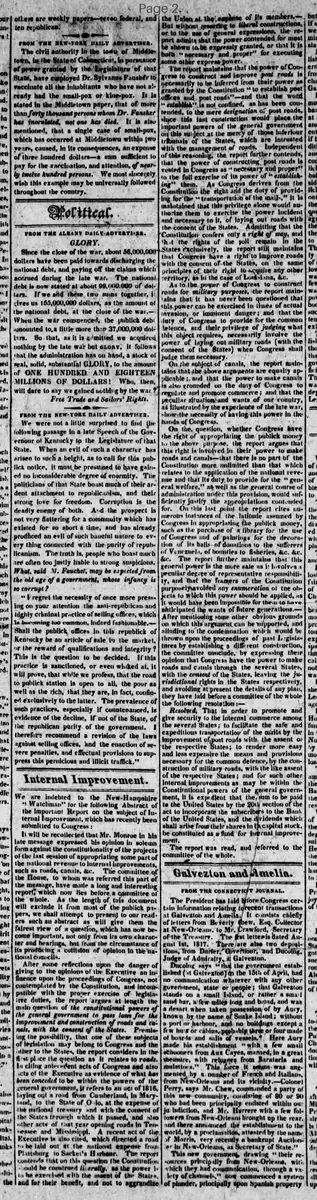
Internal Improvement.
We are indebted to the New-Hampshire Watchman for the following Abstract of the important Report on the subject of Internal Improvement, which has recently been submitted to Congress :
It will be recollected that Mr. Monroe in his late message expressed his opinion in solemn form against the constitutionality of the projects of the last session of appropriating some part of the national revenue to internal improvements, such as roads, canals, &c. This committee of the House, to whom was referred this part of the message, have made a long and interesting report, which now lies before, a committee of the whole. As the length of this document will exclude it from most of the publick papers, we shall attempt to present to our readers such an abstract as will give them the fairest view of a question, which has now become important, not only from its own character and bearings. but from the circumstance of its producing a collision of opinion in the national councils.
"After some reflections upon the danger of giving to the opinions of the Executive an influence upon the proceedings of Congress, not contemplated by the Constitution, and incompatible with the proper exercise of legislative duties, the report argues at length the main question of the constitutional powers of the general government to pass laws for the improvement and construction of roads and canals, with the consent of the States. Premising the possibility, that one of these subjects of legislation may belong to Congress and the other to the States, the report considers in the first place the question as it relates to roads. In citing antecedent acts of Congress and also acts of the Executive as evidence of what has been conceded to be within the powers of the general government, it refers to an act of 1816, laying out a road from Cumberland, in Maryland, to the State of Ohio, at the expense of the national treasury and with the consent of the States through which it passed, and also other acts of that year opening roads in Tennessee and Mississippi. A recent act of the Executive is also cited, which directed a road to be laid out at the national expense from Plattsburg to Sacket's Harbour. The report contends that on this question the Constitution should be construed liberally. as the power is to be exercised with the assent of the States, and for their benefit, and not to aggrandize the Union at the expense of its members.
But without resorting to liberal constructions, or to the use of general expressions, the report admits that the power contended for must be shown to be expressly granted, or that it is both "necessary and proper" for executing some other express power. The report maintains that the power of Congress to construct and improve post roads is necessarily to be inferred from their power as granted by the Constitution " to establish post offices and post roads"—and that the word " establish" is not confined, as has been contended, to the mere designation of post roads, since this last construction would place the important powers of the general government on this subject at the mercy of those inferior tribunals of the States, which are intrusted with the management of roads. Independent of this reasoning, the report further contends, that the power of constructing. post roads is vested in Congress as " necessary and proper" to the full exercise of its power of " establishing" them. As Congress derives from the Constitution the right and the duty of providing for the " transportation of the mails." it is maintained that this privilege alone would authorize them to exercise the power incident and necessary to it, of laying out roads with the consent of the States. Admitting that the Constitution confers only a right of way, and that the rights of the soil remain in the States exclusively, the report still maintains that Congress have a right to improve roads with the consent of the States, on the same principles of. their right to acquire any other territory, in the case of Louisiana, &c.
As to the power of Congress to construct roads for military purposes, the report maintains that it has never been questioned that this power can be exercised in time of actual invasion, or imminent danger; and that the duty of Congress to provide for the common defence, and their privilege of judging what this object requires, necessarily involve the power of laying out military roads (with the consent of the States) when Congress shall judge them necessary.
On the subject of canals, the report maintains that-the above arguments are equally applicable; and, that the power to make canals is also grounded on the duty of Congress to regulate and promote commerce; and that the peculiar situation and wants of our country. as illustrated by the experience of the late war, show the necessity of having this power in the hands of Congress.
On the. question, whether Congress have the right of appropriating the publick money to the above purpose, the report argues that this right is involved in their power to' make roads and canals—that there is no part of the Constitution more unlimited than that which relates to the application of the national revenue and that its duty. to provide for the " general welfare," as well as the general course of administration under this provision, would sufficiently justify the appropriations contended for. On this last point the report cites numerous instances of the latitude assumed by Congress in appropriating the publick money, such as the purchase of a library for the use of Congress and of paintings for the decoration of its halls of donations to the sufferers of Venezuela, of bounties to fisheries, &c. &c. The report further maintains that this general power is the more safe as it involves a peculiar degree'of representative responsibility, and that the framers of the Constitution purposely avoided any enumeration of the objects to which this power should be applied, as it would have been impossible for them to have anticipated the wants of future generations. After mentioning some other obvious grounds on which this argument can be supported, and alluding to the condemnation which would be thrown upon the proceedings of past Legislatures by establishing a different construction, the committee conclude, by expressing their opinion that Congress have the power to make roads and canals through the several States, with the consent of the States, leaving the jurisdictional rights in the States respectively. and avoiding at present the details of any plan, they have laid before a committee of the whole the following resolution:—
Resolved, That in order to promote and give security to the internal commerce among the several States; to facilitate the safe and expeditious transportation of the mails by the improvement of post roads with the assent of the respective States; to render more easy and less expensive the means and provisions necessary for the common defence, by the construction of military roads, with the like assent of the respective States; and for such other internal improvements as may be within the Constitutional powers of the general government, it is expedient that the sum to be paid to the United States by the 20th section of the act to incorporate the subscribers to the Bank of the United States. and the dividends which shall arise from their shares in its capital stock, be constituted as a fund for internal improvement.
The report was read, and referred to the committee of the whole,
We are indebted to the New-Hampshire Watchman for the following Abstract of the important Report on the subject of Internal Improvement, which has recently been submitted to Congress :
It will be recollected that Mr. Monroe in his late message expressed his opinion in solemn form against the constitutionality of the projects of the last session of appropriating some part of the national revenue to internal improvements, such as roads, canals, &c. This committee of the House, to whom was referred this part of the message, have made a long and interesting report, which now lies before, a committee of the whole. As the length of this document will exclude it from most of the publick papers, we shall attempt to present to our readers such an abstract as will give them the fairest view of a question, which has now become important, not only from its own character and bearings. but from the circumstance of its producing a collision of opinion in the national councils.
"After some reflections upon the danger of giving to the opinions of the Executive an influence upon the proceedings of Congress, not contemplated by the Constitution, and incompatible with the proper exercise of legislative duties, the report argues at length the main question of the constitutional powers of the general government to pass laws for the improvement and construction of roads and canals, with the consent of the States. Premising the possibility, that one of these subjects of legislation may belong to Congress and the other to the States, the report considers in the first place the question as it relates to roads. In citing antecedent acts of Congress and also acts of the Executive as evidence of what has been conceded to be within the powers of the general government, it refers to an act of 1816, laying out a road from Cumberland, in Maryland, to the State of Ohio, at the expense of the national treasury and with the consent of the States through which it passed, and also other acts of that year opening roads in Tennessee and Mississippi. A recent act of the Executive is also cited, which directed a road to be laid out at the national expense from Plattsburg to Sacket's Harbour. The report contends that on this question the Constitution should be construed liberally. as the power is to be exercised with the assent of the States, and for their benefit, and not to aggrandize the Union at the expense of its members.
But without resorting to liberal constructions, or to the use of general expressions, the report admits that the power contended for must be shown to be expressly granted, or that it is both "necessary and proper" for executing some other express power. The report maintains that the power of Congress to construct and improve post roads is necessarily to be inferred from their power as granted by the Constitution " to establish post offices and post roads"—and that the word " establish" is not confined, as has been contended, to the mere designation of post roads, since this last construction would place the important powers of the general government on this subject at the mercy of those inferior tribunals of the States, which are intrusted with the management of roads. Independent of this reasoning, the report further contends, that the power of constructing. post roads is vested in Congress as " necessary and proper" to the full exercise of its power of " establishing" them. As Congress derives from the Constitution the right and the duty of providing for the " transportation of the mails." it is maintained that this privilege alone would authorize them to exercise the power incident and necessary to it, of laying out roads with the consent of the States. Admitting that the Constitution confers only a right of way, and that the rights of the soil remain in the States exclusively, the report still maintains that Congress have a right to improve roads with the consent of the States, on the same principles of. their right to acquire any other territory, in the case of Louisiana, &c.
As to the power of Congress to construct roads for military purposes, the report maintains that it has never been questioned that this power can be exercised in time of actual invasion, or imminent danger; and that the duty of Congress to provide for the common defence, and their privilege of judging what this object requires, necessarily involve the power of laying out military roads (with the consent of the States) when Congress shall judge them necessary.
On the subject of canals, the report maintains that-the above arguments are equally applicable; and, that the power to make canals is also grounded on the duty of Congress to regulate and promote commerce; and that the peculiar situation and wants of our country. as illustrated by the experience of the late war, show the necessity of having this power in the hands of Congress.
On the. question, whether Congress have the right of appropriating the publick money to the above purpose, the report argues that this right is involved in their power to' make roads and canals—that there is no part of the Constitution more unlimited than that which relates to the application of the national revenue and that its duty. to provide for the " general welfare," as well as the general course of administration under this provision, would sufficiently justify the appropriations contended for. On this last point the report cites numerous instances of the latitude assumed by Congress in appropriating the publick money, such as the purchase of a library for the use of Congress and of paintings for the decoration of its halls of donations to the sufferers of Venezuela, of bounties to fisheries, &c. &c. The report further maintains that this general power is the more safe as it involves a peculiar degree'of representative responsibility, and that the framers of the Constitution purposely avoided any enumeration of the objects to which this power should be applied, as it would have been impossible for them to have anticipated the wants of future generations. After mentioning some other obvious grounds on which this argument can be supported, and alluding to the condemnation which would be thrown upon the proceedings of past Legislatures by establishing a different construction, the committee conclude, by expressing their opinion that Congress have the power to make roads and canals through the several States, with the consent of the States, leaving the jurisdictional rights in the States respectively. and avoiding at present the details of any plan, they have laid before a committee of the whole the following resolution:—
Resolved, That in order to promote and give security to the internal commerce among the several States; to facilitate the safe and expeditious transportation of the mails by the improvement of post roads with the assent of the respective States; to render more easy and less expensive the means and provisions necessary for the common defence, by the construction of military roads, with the like assent of the respective States; and for such other internal improvements as may be within the Constitutional powers of the general government, it is expedient that the sum to be paid to the United States by the 20th section of the act to incorporate the subscribers to the Bank of the United States. and the dividends which shall arise from their shares in its capital stock, be constituted as a fund for internal improvement.
The report was read, and referred to the committee of the whole,
What sub-type of article is it?
Infrastructure
Constitutional
Economic Policy
What keywords are associated?
Internal Improvements
Roads
Canals
Constitutionality
Post Roads
Military Roads
Commerce
State Consent
What entities or persons were involved?
Mr. Monroe
Congress
Committee Of The House
States
Editorial Details
Primary Topic
Constitutionality Of Federal Internal Improvements For Roads And Canals
Stance / Tone
Supportive Of Congressional Powers With State Consent
Key Figures
Mr. Monroe
Congress
Committee Of The House
States
Key Arguments
Executive Opinions Should Not Unduly Influence Congress
Power To Construct Roads Inferred From Establishing Post Offices And Post Roads
Construction Of Post Roads Necessary And Proper For Mail Transportation
Military Roads Authorized For Common Defense With State Consent
Canals Grounded In Regulating Commerce And War Experience
Appropriation Of Public Money Justified For General Welfare
Historical Precedents Support Broad Revenue Application