Thank you for visiting SNEWPapers!
Sign up free
Letter to Editor
January 17, 1828
The Litchfield County Post
Litchfield, Litchfield County, Connecticut
What is this article about?
A New-Englander critiques Henry Clay's pamphlet defending his pre-election support for John Quincy Adams and denying any office bargain, arguing Clay's actions betrayed public trust and that evidence from associates is unreliable.
Clipping
OCR Quality
98%
Excellent
Full Text
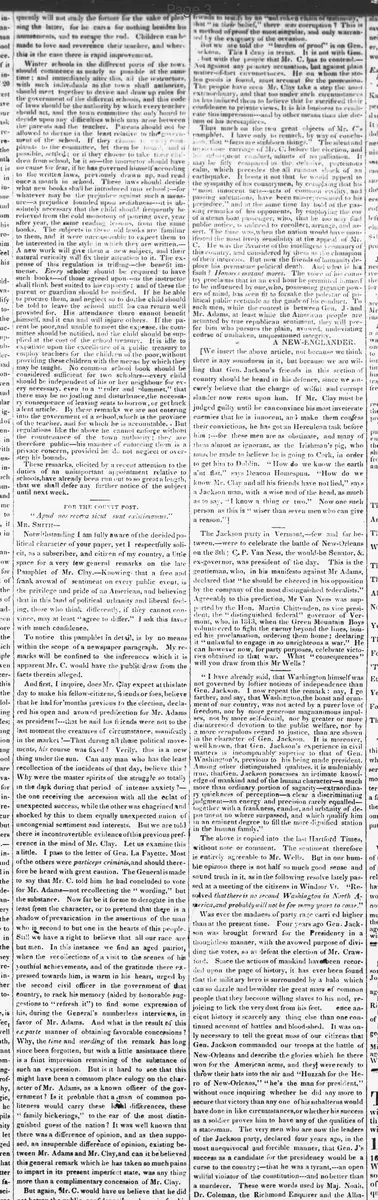
FOR THE COUNTY POST.
"Apud nos revera sicut sunt exislimamus."
MR. SMITH—
Notwithstanding I am fully aware of the decided political character of your paper, yet I respectfully solicit, as a subscriber, and citizen of my country, a little space for a very few general remarks on the late Pamphlet of Mr. Clay.—Knowing that a free and frank avowal of sentiment on every public event, is the privilege and pride of an American, and believing that in this land of political urbanity and liberal feeling, those who think differently, if they cannot convince, may at least "agree to differ." I ask this favor with much confidence.
To notice this pamphlet in detail, is by no means within the scope of a newspaper paragraph. My remarks will be confined to the inferences which it is apparent Mr. C. would have the public draw from the facts therein alleged.
And first, I inquire, does Mr. Clay expect at this late day to make his fellow-citizens, friends or foes, believe that he had for months previous to the election, declared his open and avowed predilection for Mr. Adams as president?—that he and his friends were not to the last moment the creatures of circumstance, manifestly in the market?—That during all those political movements, his course was fixed? Verily, this is a new thing under the sun. Can any man who has the least recollection of the incidents of that day, believe this? Why were the master spirits of the struggle so totally in the dark during that period of intense anxiety?—the one receiving the accession with all the eclat of unexpected success, while the other was chagrined and shocked by this to them equally unexpected union of uncongenial sentiment and interests. But we are told there is incontrovertible evidence of this previous preference in the mind of Mr. Clay. Let us examine this a little. I pass to the letter of Gen. La Fayette. Most of the others were particeps criminis, and should therefore be heard with great caution. The General is made to say that Mr. C. told him he had concluded to vote for Mr. Adams—not recollecting the "wording," but the substance. Now far be it for me to derogate in the least from the character, or to pretend that there is a shadow of prevarication in the assertions of the man who is second to but one in the hearts of this people. Still we have a right to believe that all our race are but men. In this instance we find an aged patriot, when the recollections of a visit to the scenes of his youthful achievements, and of the gratitude there expressed towards him, is warm in his heart, urged by the second civil officer in the government of that country, to rack his memory (aided by honorable suggestions to "refresh it") to find some expression of his, during the General's numberless interviews, in favor of Mr. Adams. And what is the result of this ex parte manner of obtaining favorable concessions? Why, the time and wording of the remark has long since been forgotten, but with a little assistance there is a faint impression remaining of the substance of such an expression. But is it hard to see that this might have been a common place eulogy on the character of Mr. Adams, as a known officer of the government? Is it probable that a man of common politeness would carry these high differences, these "family bickerings," to the ear of the most distinguished guest of the nation? It was well known that there was a difference of opinion, and as then supposed, an insuperable difference of opinion, existing between Mr. Adams and Mr. Clay, and can it be believed this general remark which he has taken so much pains to impart in its present imperfect state, was any thing more than a complimentary concession of Mr. Clay.
But again, Mr. C. would have us believe that he did not betray the public confidence by a bargain for his present office. And what is his evidence on this point? Why, from almost every member of his own party, he has a most unequivocal declaration of their ignorance of any such motive, and of their disbelief of the assumption—throwing at once the "burden of proof" on his vile calumniator. But stop. In politics the candor of all men, if not to be suspected, may at least be examined. And who are these persons who so willingly offer their testimony on Mr. C's behalf? Are they not the very men implicated in the transaction? Those who must stand or fall with him in this affair? And are they not "speaking two words for themselves and one for Mr. Clay?" Is it forgotten that influence on others is the great distinction between individual statesmen? And in common jurisprudence it is allowed to culprits to face their accusation with impunity, friends to testify how an "unbroken chain of testimony" that "in their belief," there was corruption! This is a method of proof the most singular, and only warranted by the exigency of the occasion.
But we are told the "burden of proof" is on Gen. Jackson. This I deny in terms. It is not with Gen. Jackson, but with the people that Mr. C. has to contend.—Not against any precursory accusation, but against plain matter-of-fact circumstances. He on whom the stolen goods is found, must account for the possession. The people have seen Mr. Clay take a step the most extraordinary, and that too under such circumstances as has induced them to believe that he sacrificed their confidence to private views. It is his business to eradicate this impression—and by other means than the dictum of his accomplices.
Thus much on the two great objects of Mr. C's pamphlet. I have only to remark, by way of conclusion that "facts are stubborn things." The silent and morose carriage of Mr. C. before the election, and his subsequent conduct, admits of no palliation. It may be fitly compared to the delusive, portentous calm, which precedes the all ruinous shock of an earthquake. It boots it not that he would impel to the sympathy of his countrymen, by complaining that his "most innocent acts—acts of common civility, and passing salutations, have been mis-represented to his prejudice." and at the same time lay hold of the passing remarks of his opponents, by employing the ear of a steamboat passenger, who, that he too may find public notice, is induced to recollect, arrange, and assert. The time was, when the nation would have manifested the most lively sensibility at the appeal of Mr. C. He was the favorite of the intelligent yeomanry of this country, and considered by them as the champion of their interests. But now the friends of humanity deplore his premature political death. And what is his fault? Honores mutant mores. The voice of his country proclaims that in an evil hour he permitted himself to be influenced by one, who, possessing gigantic powers of mind, has seen fit to forsake the polestar of political public rectitude as the guide of his conduct. To such men, while the contest is between Gen. J. and Mr. Adams, at least while the American people are actuated by true republican sentiment, they will prefer him who pursues the plain, avowed, undeviating course of unshaken, unquestioned integrity.
A NEW-ENGLANDER.
"Apud nos revera sicut sunt exislimamus."
MR. SMITH—
Notwithstanding I am fully aware of the decided political character of your paper, yet I respectfully solicit, as a subscriber, and citizen of my country, a little space for a very few general remarks on the late Pamphlet of Mr. Clay.—Knowing that a free and frank avowal of sentiment on every public event, is the privilege and pride of an American, and believing that in this land of political urbanity and liberal feeling, those who think differently, if they cannot convince, may at least "agree to differ." I ask this favor with much confidence.
To notice this pamphlet in detail, is by no means within the scope of a newspaper paragraph. My remarks will be confined to the inferences which it is apparent Mr. C. would have the public draw from the facts therein alleged.
And first, I inquire, does Mr. Clay expect at this late day to make his fellow-citizens, friends or foes, believe that he had for months previous to the election, declared his open and avowed predilection for Mr. Adams as president?—that he and his friends were not to the last moment the creatures of circumstance, manifestly in the market?—That during all those political movements, his course was fixed? Verily, this is a new thing under the sun. Can any man who has the least recollection of the incidents of that day, believe this? Why were the master spirits of the struggle so totally in the dark during that period of intense anxiety?—the one receiving the accession with all the eclat of unexpected success, while the other was chagrined and shocked by this to them equally unexpected union of uncongenial sentiment and interests. But we are told there is incontrovertible evidence of this previous preference in the mind of Mr. Clay. Let us examine this a little. I pass to the letter of Gen. La Fayette. Most of the others were particeps criminis, and should therefore be heard with great caution. The General is made to say that Mr. C. told him he had concluded to vote for Mr. Adams—not recollecting the "wording," but the substance. Now far be it for me to derogate in the least from the character, or to pretend that there is a shadow of prevarication in the assertions of the man who is second to but one in the hearts of this people. Still we have a right to believe that all our race are but men. In this instance we find an aged patriot, when the recollections of a visit to the scenes of his youthful achievements, and of the gratitude there expressed towards him, is warm in his heart, urged by the second civil officer in the government of that country, to rack his memory (aided by honorable suggestions to "refresh it") to find some expression of his, during the General's numberless interviews, in favor of Mr. Adams. And what is the result of this ex parte manner of obtaining favorable concessions? Why, the time and wording of the remark has long since been forgotten, but with a little assistance there is a faint impression remaining of the substance of such an expression. But is it hard to see that this might have been a common place eulogy on the character of Mr. Adams, as a known officer of the government? Is it probable that a man of common politeness would carry these high differences, these "family bickerings," to the ear of the most distinguished guest of the nation? It was well known that there was a difference of opinion, and as then supposed, an insuperable difference of opinion, existing between Mr. Adams and Mr. Clay, and can it be believed this general remark which he has taken so much pains to impart in its present imperfect state, was any thing more than a complimentary concession of Mr. Clay.
But again, Mr. C. would have us believe that he did not betray the public confidence by a bargain for his present office. And what is his evidence on this point? Why, from almost every member of his own party, he has a most unequivocal declaration of their ignorance of any such motive, and of their disbelief of the assumption—throwing at once the "burden of proof" on his vile calumniator. But stop. In politics the candor of all men, if not to be suspected, may at least be examined. And who are these persons who so willingly offer their testimony on Mr. C's behalf? Are they not the very men implicated in the transaction? Those who must stand or fall with him in this affair? And are they not "speaking two words for themselves and one for Mr. Clay?" Is it forgotten that influence on others is the great distinction between individual statesmen? And in common jurisprudence it is allowed to culprits to face their accusation with impunity, friends to testify how an "unbroken chain of testimony" that "in their belief," there was corruption! This is a method of proof the most singular, and only warranted by the exigency of the occasion.
But we are told the "burden of proof" is on Gen. Jackson. This I deny in terms. It is not with Gen. Jackson, but with the people that Mr. C. has to contend.—Not against any precursory accusation, but against plain matter-of-fact circumstances. He on whom the stolen goods is found, must account for the possession. The people have seen Mr. Clay take a step the most extraordinary, and that too under such circumstances as has induced them to believe that he sacrificed their confidence to private views. It is his business to eradicate this impression—and by other means than the dictum of his accomplices.
Thus much on the two great objects of Mr. C's pamphlet. I have only to remark, by way of conclusion that "facts are stubborn things." The silent and morose carriage of Mr. C. before the election, and his subsequent conduct, admits of no palliation. It may be fitly compared to the delusive, portentous calm, which precedes the all ruinous shock of an earthquake. It boots it not that he would impel to the sympathy of his countrymen, by complaining that his "most innocent acts—acts of common civility, and passing salutations, have been mis-represented to his prejudice." and at the same time lay hold of the passing remarks of his opponents, by employing the ear of a steamboat passenger, who, that he too may find public notice, is induced to recollect, arrange, and assert. The time was, when the nation would have manifested the most lively sensibility at the appeal of Mr. C. He was the favorite of the intelligent yeomanry of this country, and considered by them as the champion of their interests. But now the friends of humanity deplore his premature political death. And what is his fault? Honores mutant mores. The voice of his country proclaims that in an evil hour he permitted himself to be influenced by one, who, possessing gigantic powers of mind, has seen fit to forsake the polestar of political public rectitude as the guide of his conduct. To such men, while the contest is between Gen. J. and Mr. Adams, at least while the American people are actuated by true republican sentiment, they will prefer him who pursues the plain, avowed, undeviating course of unshaken, unquestioned integrity.
A NEW-ENGLANDER.
What sub-type of article is it?
Persuasive
Political
Provocative
What themes does it cover?
Politics
Morality
What keywords are associated?
Henry Clay
John Quincy Adams
Andrew Jackson
Presidential Election
Political Bargain
Public Confidence
Lafayette Letter
Corruption Accusations
What entities or persons were involved?
A New Englander.
Mr. Smith
Letter to Editor Details
Author
A New Englander.
Recipient
Mr. Smith
Main Argument
the writer challenges henry clay's pamphlet claims of prior support for adams and no office bargain, asserting that clay's actions indicate betrayal of public trust, lafayette's testimony is unreliable, and associates' defenses are self-serving; the burden of proof lies with clay to dispel public suspicions.
Notable Details
Questions Lafayette's Recollection Of Clay's Statement
Accuses Clay Of Political Bargaining
Compares Clay's Pre Election Behavior To An Earthquake's Calm
Latin Quotes: 'Apud Nos Revera Sicut Sunt Exislimamus.' And 'Honores Mutant Mores.'