Thank you for visiting SNEWPapers!
Sign up free
The Virginia Gazette
Williamsburg, Virginia
What is this article about?
On January 28, a ferry scow carrying nine people and four horses from New Jersey to Staten Island was driven ashore by a sudden northwest wind, stranding them on a marsh island. Exposed to extreme cold, a boy and Mr. William Cornelius George died of exposure; three horses perished. Survivors suffered severe frostbite and were rescued the next morning.
Clipping
OCR Quality
Full Text
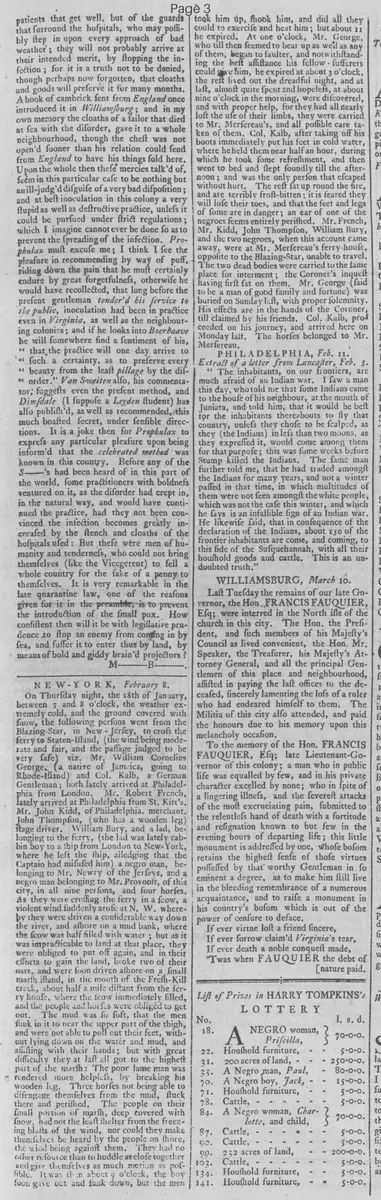
On Thursday night, the 28th of January, between 7 and 8 o'clock, the weather extremely cold, and the ground covered with snow, the following persons went from the Blazing-Star, in New-Jersey, to cross the ferry to Staten-Island, (the wind being moderate and fair, and the passage judged to be very safe) viz. Mr. William Cornelius George, (a native of Jamaica, going to Rhode-Island) and Col. Kalb, a German Gentleman: both lately arrived at Philadelphia from London. Mr. Robert French. Lately arrived at Philadelphia from St. Kitt's. Mr. John Kidd, of Philadelphia, merchant. John Thompson, (who has a wooden leg) stage driver. William Bury, and a lad, belonging to the ferry, (the lad was lately cabin boy to a ship from London to New-York, where he left the ship, alleging that the Captain had misused him) a negro man, belonging to Mr. Newry of the Jerseys, and a negro man belonging to Mr. Provoost, of this city, in all nine persons, and four horses. As they were crossing, the ferry in a scow, a violent wind suddenly arose at N. W. whereby they were driven a considerable way down the river, and ashore on a mud bank, where the scow was half filled with water; but as it was impracticable to land at that place, they were obliged to put off again, and in their efforts to gain the land, broke two of their oars, and were soon driven ashore on a small marsh island, in the mouth of the Fresh-Kill creek, about half a mile distant from the ferry house, where the scow immediately filled, and the people and horses were obliged to get out. The mud was so soft, that the men sunk in it to near the upper part of the thigh, and were not able to pull out their feet, without lying down on the water and mud, and assisting with their hands; but with great difficulty they at last all got to the highest part of the marsh: The poor lame man was rendered more helpless, by breaking his wooden leg. Three horses not being able to disengage themselves from the mud, stuck there and perished. The people on their small portion of marsh, deep covered with snow, had not the least shelter from the freezing blasts of the wind, nor could they make themselves be heard by the people on shore, the wind being against them. They had no other resource than to huddle as close together and give themselves as much motion as possible. It was then about 8 o'clock, the boy soon gave out and sunk down, but the men took him up, shook him, and did all they could to exercise and heat him; but about 11 he expired. At one o'clock, Mr. George, who till then seemed to bear up as well as any of them, began to falter, and notwithstanding the best assistance his fellow-sufferers could give him, he expired at about 3 o'clock, the rest lived out the dreadful night, and at last, almost quite spent and hopeless, at about nine o'clock in the morning, were discovered, and with proper help, for they had all nearly lost the use of their limbs, they were carried to Mr. Mersereau's, and all possible care taken of them. Col. Kalb, after taking off his boots immediately put his feet in cold water, where he held them near half an hour, during which he took some refreshment, and then went to bed and slept soundly till the afternoon; and was the only person that escaped without hurt. The rest sat up round the fire, and are terribly frost-bitten; it is feared they will lose their toes, and that the feet and legs of some are in danger; an ear of one of the negroes seems entirely perished. Mr. French, Mr. Kidd, John Thompson, William Bury, and the two negroes, when this account came away, were at Mr. Mersereau's ferry-house, opposite to the Blazing-Star, unable to travel. The two dead bodies were carried to the same place for interment: the Coroner's inquest having first sat on them. Mr. George (said to be a man of good family and fortune) was buried on Sunday last, with proper solemnity. His effects are in the hands of the Coroner, till claimed by his friends. Col. Kalb, proceeded on his journey, and arrived here on Monday last. The horses belonged to Mr. Mersereau.
What sub-type of article is it?
What keywords are associated?
What entities or persons were involved?
Where did it happen?
Domestic News Details
Primary Location
New Jersey To Staten Island Ferry
Event Date
Thursday Night, The 28th Of January
Key Persons
Outcome
two deaths from exposure (a boy and mr. william cornelius george); three horses perished; survivors severely frost-bitten, some at risk of losing toes or more; bodies interred after coroner's inquest; mr. george buried with solemnity.
Event Details
A ferry scow with nine persons and four horses was driven by a sudden northwest wind onto a mud bank, then to a marsh island in Fresh-Kill creek where it filled with water. Stranded in extreme cold and snow, the group endured the night without shelter; the boy died around 11 PM, Mr. George at 3 AM; others rescued next morning and treated at Mr. Mersereau's.