Thank you for visiting SNEWPapers!
Sign up free
Alexandria Daily Gazette, Commercial & Political
Alexandria, Virginia
What is this article about?
Diplomatic correspondence in 1811 between US Secretary of State James Monroe and British Minister Augustus J. Foster addressing British protests on behalf of Spain against US occupation of West Florida and potential actions in East Florida, with US justifications based on historical claims from the Louisiana Purchase and unredressed injuries from Spain.
Clipping
OCR Quality
Full Text
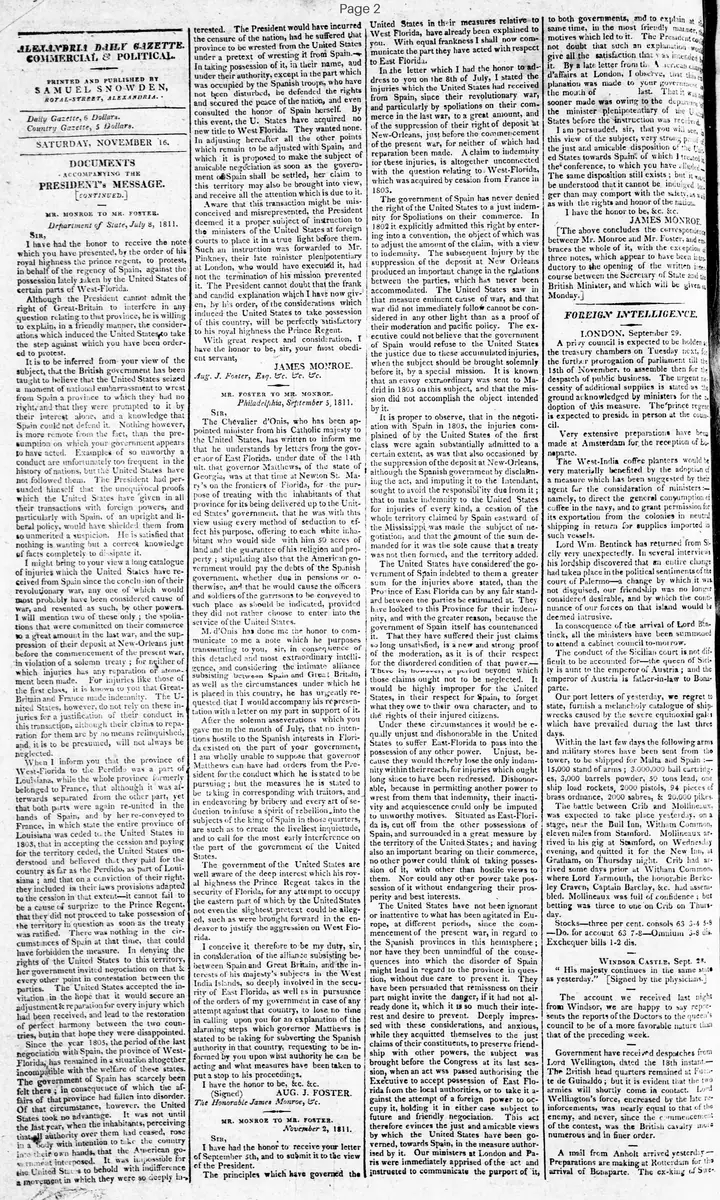
ACCOMPANYING THE
PRESIDENT'S MESSAGE.
[CONTINUED.]
MR. MONROE TO MR. FOSTER.
Department of State, July 8, 1811.
SIR,
I have had the honor to receive the note which you have presented, by the order of his royal highness the prince regent, to protest, in behalf of the regency of Spain, against the possession lately taken by the United States of certain parts of West-Florida.
Although the President cannot admit the right of Great-Britain to interfere in any question relating to that province, he is willing to explain, in a friendly manner, the considerations which induced the United States to take the step against which you have been ordered to protest.
It is to be inferred from your view of the subject, that the British government has been taught to believe that the United States seized a moment of national embarrassment to wrest from Spain a province to which they had no right, and that they were prompted to it by their interest alone, and a knowledge that Spain could not defend it. Nothing however, is more remote from the fact, than the presumption on which your government appears to have acted. Examples of so unworthy a conduct are unfortunately too frequent in the history of nations, but the United States have not followed them. The President had persuaded himself that the unequivocal proofs which the United States have given in all their transactions with foreign powers, and particularly with Spain, of an upright and liberal policy, would have shielded them from so unmerited a suspicion. He is satisfied that nothing is wanting but a correct knowledge of facts completely to dissipate it.
I might bring to your view a long catalogue of injuries which the United States have received from Spain since the conclusion of their revolutionary war, any one of which would most probably have been considered cause of war, and resented as such, by other powers.
I will mention two of these only: the spoliations that were committed on their commerce of a great amount in the last war, and the suppression of their deposit at New-Orleans just before the commencement of the present war, in violation of a solemn treaty; for neither of which injuries has any reparation or atonement been made. For injuries like those of the first class, it is known to you that Great-Britain and France made indemnity. The United States, however, do not rely on these injuries for a justification of their conduct in this transaction, although their claims to reparation for them are by no means relinquished, and, it is to be presumed, will not always be neglected.
When I inform you that the province of West-Florida to the Perdido was a part of Louisiana, while the whole province formerly belonged to France, that although it was afterwards separated from the other part, yet that both parts were again re-united in the hands of Spain, and by her re-conveyed to France, in which state the entire province of Louisiana was ceded to the United States in 1803, that in accepting the cession and paying for the territory ceded, the United States understood and believed that they paid for the country as far as the Perdido, as part of Louisiana; and that on a conviction of their right, they included in their laws provisions adapted to the cession in that extent—it cannot fail to be a cause of surprise to the Prince Regent, that they did not proceed to take possession of the territory in question as soon as the treaty was ratified. There was nothing in the circumstances of Spain at that time, that could have forbidden the measure. In denying the rights of the United States to this territory, her government invited negotiation on that subject & every other point in contestation between the parties. The United States accepted the invitation, in the hope that it would secure an adjustment & reparation for every injury which had been received, and lead to the restoration of perfect harmony between the two countries, but in that hope they were disappointed.
Since the year 1805, the period of the last negotiation with Spain, the province of West-Florida, has remained in a situation altogether incompatible with the welfare of these states. The government of Spain has scarcely been felt there; in consequence of which the affairs of that province had fallen into disorder. Of that circumstance, however, the United States took no advantage. It was not until the last year, when the inhabitants, perceiving that all authority over them had ceased, rose in a body with intention to take the country into their own hands, that the American government interposed. It was impossible for the United States to behold with indifference a movement in which they were so deeply interested. The President would have incurred the censure of the nation, had he suffered that province to be wrested from the United States under a pretext of wresting it from Spain. In taking possession of it, in their name, and under their authority, except in the part which was occupied by the Spanish troops, who have not been disturbed, he defended the rights and secured the peace of the nation, and even consulted the honor of Spain herself. By this event, the U. States have acquired no new title to West Florida. They wanted none. In adjusting hereafter all the other points which remain to be adjusted with Spain, and which it is proposed to make the subject of amicable negotiation as soon as the government of Spain shall be settled, her claim to this territory may also be brought into view, and receive all the attention which is due to it.
Aware that this transaction might be misconceived and misrepresented, the President deemed it a proper subject of instruction to the ministers of the United States at foreign courts to place it in a true light before them. Such an instruction was forwarded to Mr. Pinkney, their late minister plenipotentiary at London, who would have executed it, had not the termination of his mission prevented it. The President cannot doubt that the frank and candid explanation which I have now given, by his order, of the considerations which induced the United States to take possession of this country, will be perfectly satisfactory to his royal highness the Prince Regent.
With great respect and consideration,
I have the honor to be, sir, your most obedient servant,
JAMES MONROE.
Aug. J. Foster, Esq. &c. to Gt. Br.
MR. FOSTER TO MR. MONROE.
Philadelphia, September 5, 1811.
SIR,
The Chevalier d'Onis, who has been appointed minister from his Catholic majesty to the United States, has written to inform me that he understands by letters from the governor of East Florida, under date of the 14th ult. that governor Matthews, of the state of Georgia, was at that time at Newton St. Mary's on the frontiers of Florida, for the purpose of treating with the inhabitants of that province for its being delivered up to the United States' government, that he was with this view using every method of seduction to effect his purpose, offering to each white inhabitant who would side with him 50 acres of land and the guarantee of his religion and property; stipulating also that the American government would pay the debts of the Spanish government, whether due in pensions or otherwise, and that he would cause the officers and soldiers of the garrisons to be conveyed to such place as should be indicated, provided they did not rather choose to enter into the service of the United States.
M. d'Onis has done me the honor to communicate to me a note which he purposes transmitting to you, sir, in consequence of this detached and most extraordinary intelligence, and considering the intimate alliance subsisting between Spain and Great Britain, as well as the circumstances under which he is placed in this country, he has urgently requested that I would accompany his representation with a letter on my part in support of it.
After the solemn asseverations which you gave me in the month of July, that no intentions hostile to the Spanish interests in Florida existed on the part of your government, I am wholly unable to suppose that governor Matthews can have had orders from the President for the conduct which he is stated to be pursuing; but the measures he is stated to be taking in corresponding with traitors, and in endeavoring by bribery and every art of seduction to infuse a spirit of rebellion into the subjects of the king of Spain in those quarters, are such as to create the liveliest inquietude, and to call for the most early interference on the part of the government of the United States.
The government of the United States are well aware of the deep interest which his royal highness the Prince Regent takes in the security of Florida, for any attempt to occupy the eastern part of which by the United States not even the slightest pretext could be alleged, such as were brought forward in the endeavor to justify the aggression on West Florida.
I conceive it therefore to be my duty, sir, in consideration of the alliance subsisting between Spain and Great Britain, and the interests of his majesty's subjects in the West India Islands, so deeply involved in the security of East Florida, as well as in pursuance of the orders of my government in case of any attempt against that country, to lose no time in calling upon you for an explanation of the alarming steps which governor Matthews is stated to be taking for subverting the Spanish authority in that country, requesting to be informed by you upon what authority he can be acting and what measures have been taken to put a stop to his proceedings.
I have the honor to be, &c. &c.
(Signed)
AUG. J. FOSTER.
The Honorable James Monroe, &c.
MR. MONROE TO MR. FOSTER.
November 2, 1811.
SIR,
I have had the honor to receive your letter of September 5th, and to submit it to the view of the President.
The principles which have governed the United States in their measures relative to West Florida, have already been explained to you. With equal frankness I shall now communicate the part they have acted with respect to East Florida.
In the letter which I had the honor to address to you on the 8th of July, I stated the injuries which the United States had received from Spain, since their revolutionary war, and particularly by spoliations on their commerce in the last war, to a great amount, and of the suppression of their right of deposit at New-Orleans, just before the commencement of the present war, for neither of which had reparation been made. A claim to indemnity for these injuries, is altogether unconnected with the question relating to West-Florida, which was acquired by cession from France in 1803.
The government of Spain has never denied the right of the United States to a just indemnity for spoliations on their commerce. In 1802 it explicitly admitted this right by entering into a convention, the object of which was to adjust the amount of the claim, with a view to indemnity. The subsequent injury by the suppression of the deposit at New Orleans produced an important change in the relations between the parties, which has never been accommodated. The United States saw in that measure eminent cause of war, and that war did not immediately follow cannot be considered in any other light than as a proof of their moderation and pacific policy. The executive could not believe that the government of Spain would refuse to the United States the justice due to these accumulated injuries, when the subject should be brought solemnly before it, by a special mission. It is known that an envoy extraordinary was sent to Madrid in 1805 on this subject, and that the mission did not accomplish the object intended by it.
It is proper to observe, that in the negotiation with Spain in 1805, the injuries complained of by the United States of the first class were again substantially admitted to a certain extent, as was that also occasioned by the suppression of the deposit at New-Orleans, although the Spanish government by disclaiming the act, and imputing it to the Intendant, sought to avoid the responsibility due from it; that to make indemnity to the United States for injuries of every kind, a cession of the whole territory claimed by Spain eastward of the Mississippi was made the subject of negotiation, and that the amount of the sum demanded for it was the sole cause that a treaty was not then formed, and the territory added.
The United States have considered the government of Spain indebted to them a greater sum for the injuries above stated, than the Province of East Florida can by any fair standard between the parties be estimated at. They have looked to this Province for their indemnity, and with the greater reason, because the government of Spain itself has countenanced it. That they have suffered their just claims so long unsatisfied, is a new and strong proof of the moderation, as it is of their respect for the disordered condition of that power. There is, however, a period beyond which those claims ought not to be neglected. It would be highly improper for the United States, in their respect for Spain, to forget what they owe to their own character, and to the rights of their injured citizens.
Under these circumstances it would be equally unjust and dishonorable in the United States to suffer East-Florida to pass into the possession of any other power. Unjust, because they would thereby lose the only indemnity within their reach, for injuries which ought long since to have been redressed. Dishonorable, because in permitting another power to wrest from them that indemnity, their inactivity and acquiescence could only be imputed to unworthy motives. Situated as East-Florida is, cut off from the other possessions of Spain, and surrounded in a great measure by the territory of the United States; and having also an important bearing on their commerce, no other power could think of taking possession of it, with other than hostile views to them. Nor could any other power take possession of it without endangering their prosperity and best interests.
The United States have not been ignorant or inattentive to what has been agitated in Europe, at different periods, since the commencement of the present war, in regard to the Spanish provinces in this hemisphere; nor have they been unmindful of the consequences into which the disorder of Spain might lead in regard to the province in question, without due care to prevent it. They have been persuaded that remissness on their part might invite the danger, if it had not already done it, which it is so much their interest and desire to prevent. Deeply impressed with these considerations, and anxious, while they acquitted themselves to the just claims of their constituents, to preserve friendship with other powers, the subject was brought before the Congress at its last session, when an act was passed authorising the Executive to accept possession of East Florida from the local authorities, or to take it against the attempt of a foreign power to occupy it, holding it in either case subject to future and friendly negotiation. This act therefore evinces the just and amicable views by which the United States have been governed, towards Spain, in the measure authorised by it. Our ministers at London and Paris were immediately apprised of the act and instructed to communicate the purport of it to both governments, and to explain at the same time, in the most friendly manner, the motives which led to it. The President cannot doubt that such an explanation would give all the satisfaction that was intended by it. By a late letter from the American chargé d'affaires at London, I observe, that this explanation was made to your government the mouth of last. That it was not sooner made was owing to the departure of the minister plenipotentiary of the United States before the instruction was received.
I am persuaded, sir, that you will see, in this view of the subject, very strong proof of the just and amicable disposition of the United States towards Spain, of which I treated in the conference, to which you have alluded. The same disposition still exists; but it must be understood that it cannot be indulged longer than may comport with the safety, as well as with the rights and honor of the nation.
I have the honor to be, &c. &c.
JAMES MONROE.
[The above concludes the correspondence between Mr. Monroe and Mr. Foster, and embraces the whole of it, with the exception of three notes, which appear to have been introductory to the opening of the written intercourse between the Secretary of State and the British Minister, and which will be given on Monday.]
What sub-type of article is it?
What keywords are associated?
What entities or persons were involved?
Where did it happen?
Foreign News Details
Primary Location
West Florida
Event Date
July 8 To November 2, 1811
Key Persons
Outcome
us took possession of west florida except spanish-occupied parts; authorized to accept or take east florida; diplomatic explanations provided to britain; no new titles acquired, subject to future negotiation with spain.
Event Details
Monroe responds to British protest against US seizure of West Florida, explaining it as rightful part of Louisiana ceded in 1803 and responding to local uprising; details US injuries from Spain including spoliations and New Orleans deposit suppression. Foster reports on Governor Matthews' alleged seduction of East Florida inhabitants for US takeover. Monroe justifies US interest in East Florida as indemnity for Spanish injuries, notes 1811 congressional act authorizing possession, and affirms amicable intentions toward Spain.