Thank you for visiting SNEWPapers!
Sign up free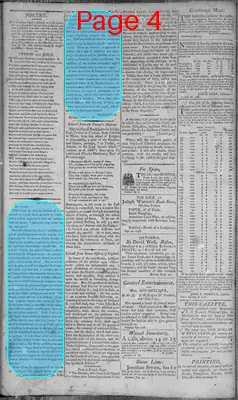
Letter to Editor
October 8, 1798
The Gazette
Portland, Cumberland County, Maine
What is this article about?
A teacher defends corporal punishment in public schools as necessary for managing unruly students like truants and Jacobins, contrasting it with private schools and criticizing idealistic abolition proposals. Signed Pedagogus from Portland, October 3, 1798.
Clipping
OCR Quality
98%
Excellent
Full Text
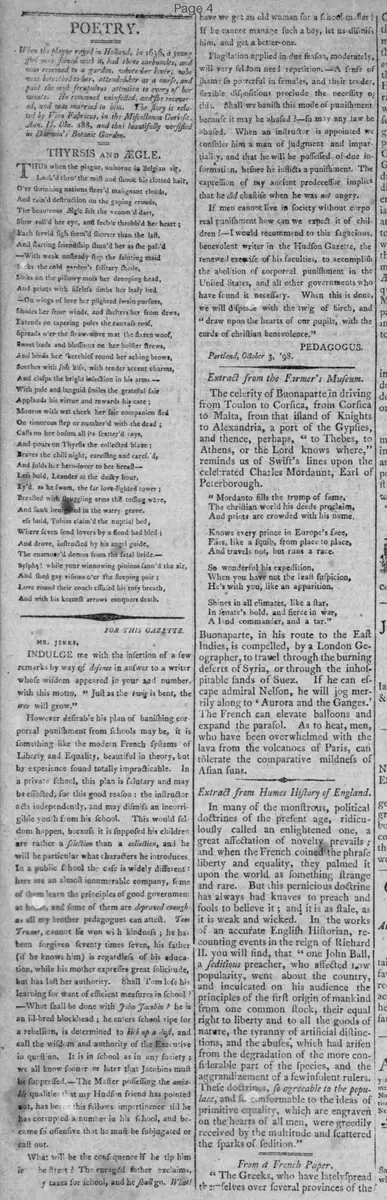
FOR THIS GAZETTE.
MR. JERKS,
INDULGE me with the insertion of a few remarks by way of defence in answer to a writer whose wisdom appeared in your 22d number, with this motto, "as the twig is bent, the tree will grow."
However desirable his plan of banishing corporeal punishment from schools may be, it is something like the modern French systems of Liberty and Equality, beautiful in theory, but by experience found totally impracticable. In a private school, this plan is salutary and may be effected, on this good reason: the instructor acts independently, and may dismiss an incorrigible youth from his school. This would seldom happen, because it is supposed his children are rather a selection than a collection, and he will be particular what characters he introduces. In a public school the case is widely different: here are an almost innumerable company, some of them learn the principles of good government at home, and some of them are depraved enough as all my brother pedagogues can attest. Tom Truant, cannot be won with kindness: he has been forgiven seventy times seven, his father (if he knows him) is regardless of his education, while his mother expresses great solicitude, but has lost her authority. Shall Tom lose his learning for want of efficient measures in school? -What shall be done with our Jacobin? he is an ill-bred blockhead; he enters school ripe for a rebellion, is determined to kick up a dust, and call the wisdom and authority of the Executive in question. It is in school as in any society; we all know sooner or later that Jacobins must be suppressed.-The Master possessing the amiable qualities that my Hudson friend has pointed out, has borne this fellow's impertinence till he has corrupted a number in his school, and became so offensive that he must be subjugated or cast out.
What will be the consequence if he tip him or he strike? The enraged father exclaims, I pay taxes for school, and he shall go. What! have we got an old woman for a school master! If he cannot manage such a boy, let us dismiss him, and get a better one.
Flagellation applied in due season, moderately, will very seldom need repetition.--A sense of Shame so powerful in females, and their tender, flexible dispositions preclude the necessity of this. Shall we banish this mode of punishment because it may be abused?--so may any law be abused. When an instructor is appointed we consider him a man of judgment and impartiality, and that he will be possessed of due information, before he inflicts a punishment. The expression of my ancient predecessor implies that he did chasten when he was not angry.
If men cannot live in society without corporeal punishment how can we expect it of children?--I would recommend to this sagacious, benevolent writer in the Hudson Gazette, the renewed exercise of his faculties, to accomplish the abolition of corporeal punishment in the United States, and all other governments who have found it necessary. When this is done, we will dispense with the twig of birch, and "draw upon the hearts of our pupils, with the cords of christian benevolence."
PEDAGOGUS.
Portland, October 3, '98.
MR. JERKS,
INDULGE me with the insertion of a few remarks by way of defence in answer to a writer whose wisdom appeared in your 22d number, with this motto, "as the twig is bent, the tree will grow."
However desirable his plan of banishing corporeal punishment from schools may be, it is something like the modern French systems of Liberty and Equality, beautiful in theory, but by experience found totally impracticable. In a private school, this plan is salutary and may be effected, on this good reason: the instructor acts independently, and may dismiss an incorrigible youth from his school. This would seldom happen, because it is supposed his children are rather a selection than a collection, and he will be particular what characters he introduces. In a public school the case is widely different: here are an almost innumerable company, some of them learn the principles of good government at home, and some of them are depraved enough as all my brother pedagogues can attest. Tom Truant, cannot be won with kindness: he has been forgiven seventy times seven, his father (if he knows him) is regardless of his education, while his mother expresses great solicitude, but has lost her authority. Shall Tom lose his learning for want of efficient measures in school? -What shall be done with our Jacobin? he is an ill-bred blockhead; he enters school ripe for a rebellion, is determined to kick up a dust, and call the wisdom and authority of the Executive in question. It is in school as in any society; we all know sooner or later that Jacobins must be suppressed.-The Master possessing the amiable qualities that my Hudson friend has pointed out, has borne this fellow's impertinence till he has corrupted a number in his school, and became so offensive that he must be subjugated or cast out.
What will be the consequence if he tip him or he strike? The enraged father exclaims, I pay taxes for school, and he shall go. What! have we got an old woman for a school master! If he cannot manage such a boy, let us dismiss him, and get a better one.
Flagellation applied in due season, moderately, will very seldom need repetition.--A sense of Shame so powerful in females, and their tender, flexible dispositions preclude the necessity of this. Shall we banish this mode of punishment because it may be abused?--so may any law be abused. When an instructor is appointed we consider him a man of judgment and impartiality, and that he will be possessed of due information, before he inflicts a punishment. The expression of my ancient predecessor implies that he did chasten when he was not angry.
If men cannot live in society without corporeal punishment how can we expect it of children?--I would recommend to this sagacious, benevolent writer in the Hudson Gazette, the renewed exercise of his faculties, to accomplish the abolition of corporeal punishment in the United States, and all other governments who have found it necessary. When this is done, we will dispense with the twig of birch, and "draw upon the hearts of our pupils, with the cords of christian benevolence."
PEDAGOGUS.
Portland, October 3, '98.
What sub-type of article is it?
Persuasive
Ethical Moral
Informative
What themes does it cover?
Education
Morality
What keywords are associated?
Corporal Punishment
School Discipline
Public Schools
Private Schools
Education Reform
Jacobins
Flagellation
Birch Twig
What entities or persons were involved?
Pedagogus.
Mr. Jerks,
Letter to Editor Details
Author
Pedagogus.
Recipient
Mr. Jerks,
Main Argument
corporal punishment is essential in public schools to discipline incorrigible students like truants and jacobins, as it is impractical to abolish unlike in private schools, and should be applied judiciously rather than banned due to potential abuse.
Notable Details
Compares Abolition To French Liberty And Equality
References 'Tom Truant' And 'Jacobin' As Unruly Students
Alludes To Biblical Forgiveness 'Seventy Times Seven'
Cites Predecessor: Chasten When Not Angry
Satirical Tone Toward Critic's Benevolence