Thank you for visiting SNEWPapers!
Sign up free
The Virginia Gazette
Richmond, Williamsburg, Richmond County, Virginia
What is this article about?
In a House of Lords debate, Lord Sandwich defends the improved state of the British navy, highlighting readiness against potential French and Spanish threats in American waters, with 17 ships of the line at home and proposals for augmentation. Duke of Richmond challenges the sufficiency and French assurances.
Clipping
OCR Quality
Full Text
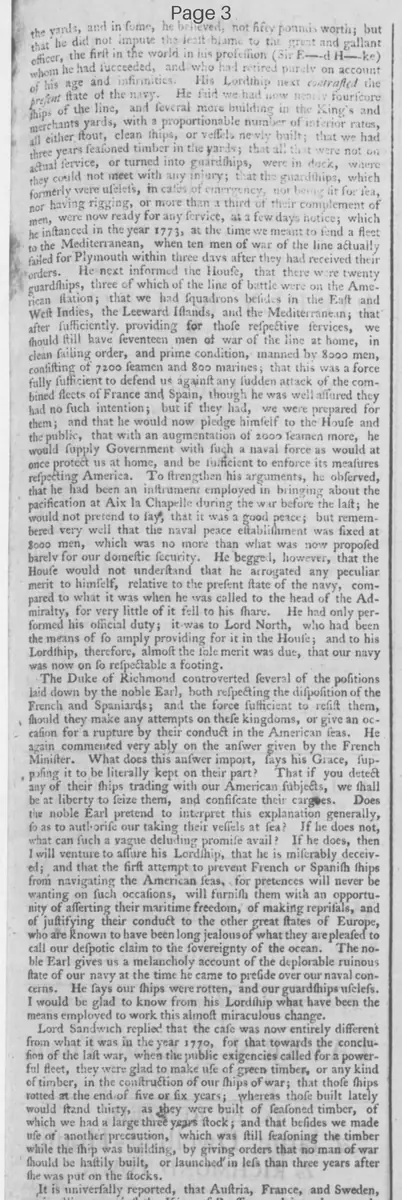
The Duke of Richmond controverted several of the positions laid down by the noble Earl, both respecting the disposition of the French and Spaniards; and the force sufficient to resist them, should they make any attempts on these kingdoms, or give an occasion for a rupture by their conduct in the American seas. He again commented very ably on the answer given by the French Minister. What does this answer import, says his Grace, supposing it to be literally kept on their part? That if you detect any of their ships trading with our American subjects, we shall be at liberty to seize them, and confiscate their cargoes. Does the noble Earl pretend to interpret this explanation generally, so as to authorize our taking their vessels at sea? If he does not, what can such a vague deluding promise avail? If he does, then I will venture to assure his Lordship, that he is miserably deceived; and that the first attempt to prevent French or Spanish ships from navigating the American seas, for pretences will never be wanting on such occasions, will furnish them with an opportunity of asserting their maritime freedom, of making reprisals, and of justifying their conduct to the other great states of Europe, who are known to have been long jealous of what they are pleased to call our despotic claim to the sovereignty of the ocean. The noble Earl gives us a melancholy account of the deplorable ruinous state of our navy at the time he came to preside over our naval concerns. He says our ships were rotten, and our guardships useless. I would be glad to know from his Lordship what have been the means employed to work this almost miraculous change.
Lord Sandwich replied that the case was now entirely different from what it was in the year 1770, for that towards the conclusion of the last war, when the public exigencies called for a powerful fleet, they were glad to make use of green timber, or any kind of timber, in the construction of our ships of war; that those ships rotted at the end of five or six years; whereas those built lately would stand thirty, as they were built of seasoned timber, of which we had a large three years stock; and that besides we made use of another precaution, which was still seasoning the timber while the ship was building, by giving orders that no man of war should be hastily built, or launched in less than three years after she was put on the stocks.
What sub-type of article is it?
What keywords are associated?
What entities or persons were involved?
Where did it happen?
Foreign News Details
Primary Location
American Seas
Key Persons
Outcome
pledge for naval augmentation of 2000 seamen to protect home and enforce measures in america; navy improved with seasoned timber ships lasting 30 years.
Event Details
Lord Sandwich describes the improved state of the British navy since 1770, with 20 guardships, squadrons in various stations, and 17 ships of the line ready at home manned by 8000 men, sufficient against France and Spain. He pledges further augmentation for America. Duke of Richmond questions French assurances on trade with America and the navy's transformation. Sandwich explains use of seasoned timber.