Thank you for visiting SNEWPapers!
Sign up free
Literary
August 7, 1840
Southern Christian Advocate
Charleston, Charleston County, South Carolina
What is this article about?
An essay on the custom of decorating graves with flowers, highlighting its ancient origins, emotional significance, and examples from various cultures, beginning with a poem by Mrs. Hemans lamenting the dead.
Clipping
OCR Quality
95%
Excellent
Full Text
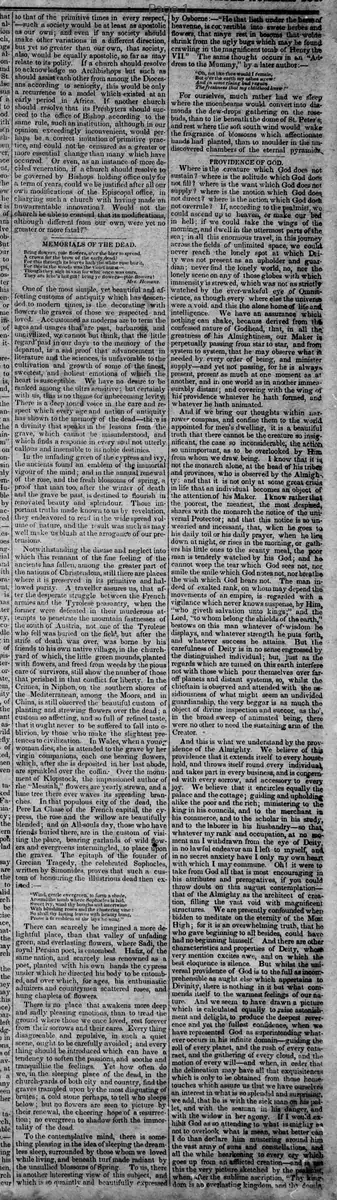
MEMORIALS OF THE DEAD.
Bring flowers, pale flowers, o'er the bier to spread.
A crown for the brow of the early dead!
For this through its leaves hath the white rose burst
For this in the woods was the violet nursed
Though they sigh in vain for what once was ours,
They are love's last gift! bring ye flowers pale flowers!
-- Mrs. Hemans.
One of the most simple, yet beautiful and affecting customs of antiquity which has descended to modern times, is the decorating with flowers the graves of those we respected and loved. Accustomed as moderns are to term the ages and usages that are past, barbarous, and uncivilized, we cannot but think, that the little regard paid in our days to the memory of the departed, is a sad proof that advancement in literature and the sciences, is unfavorable to the cultivation and growth of some of the finest, sweetest, and holiest emotions of which the heart is susceptible. We have no desire to be ranked among the ultra sensitive: but certainly with us, this is no theme for unbecoming levity. There is a deep toned voice in the care and respect which every age and nation of antiquity has shown to the memory of the dead--there is a divinity that speaks in the lessons from the grave, which cannot be misunderstood, and which finds a response in every soul not utterly callous and insensible to its noble destinies.
In the unfading green of the cypress and ivy, the ancients found an emblem of the immortal vigour of the mind; and in the annual renewal of the rose, and the fresh blossoms of spring, a proof that man too, after the winter of death and the grave be past, is destined to flourish in renovated beauty and splendour. Those important truths made known to us by revelation. they endeavored to read in the wide spread volume of nature, and the result was such as may well make us blush at the arrogance of our pretensions.
Notwithstanding the disuse and neglect into which this remnant of the fine feeling of the ancients has fallen, among the greater part of the nations of Christendom, still there are places where it is preserved in its primitive and hallowed purity. A traveller assures us, that after the desperate struggle between the French armies and the Tyrolese peasantry, when the former were defeated in their murderous attempts to penetrate the mountain fastnesses of the south of Austria. not one of the Tyrolese who fell was buried on the field. but after the strife of death was over, was borne by his friends to his own native village, in the church-yard of which, the little green mounds, planted with flowers, and freed from weeds by the pious care of survivors, still show the number of those that perished in that conflict for liberty. In the Crimea, in Niphon, on the southern shores of the Mediterranean, among the Moors, and in China, is still observed the beautiful custom of planting and strewing flowers over the dead; a custom so affecting, and so full of refined taste, that it ought never to be suffered to fall into oblivion, by those who make the slightest pretences to civilization. In Wales, when a young woman dies, she is attended to the grave by her virgin companions, each one bearing flowers, which, after she is deposited in her last abode, are sprinkled over the coffin. Over the monument of Klopstock, the impassioned author of the "Messiah," flowers are yearly strewn, and a lime tree there ever waves its spreading branches. In that populous city of the dead, the Pere La Chaise of the French capital, the cypress, the rose and the willow are beautifully blended; and on All-souls day, those who have friends buried there, are in the custom of visiting the place, bearing garlands of wild flowers and evergreens intermingled, to place upon the graves. The epitaph of the founder of Grecian Tragedy, the celebrated Sophocles. written by Simonides, proves that such a custom of honouring the illustrious dead then existed :--
"Wind, gentle evergreen, to form a shade
Around the tomb where Sophocles is laid.
Sweet ivy, wind thy boughs and intertwine
With blushing roses and the clustering vine:
So shall thy lasting leaves with beauty hung,
Prove a fit emblem of the lays he sung."
There can scarcely be imagined a more delightful place, than that valley of unfading green, and everlasting flowers, where Sadi, the royal Persian poet, is entombed. Hafiz, of the same nation, and scarcely less renowned as a poet, planted with his own hands the cypress under which he directed his body to be entombed, and over which, for ages, his enthusiastic admirers and countrymen scattered roses, and hung chaplets of flowers,
There is no place that awakens more deep and sadly pleasing emotions, than to tread the ground where those we once loved, rest forever from their sorrows and their cares. Every thing disagreeable and repulsive, in such a quiet scene, ought to be carefully avoided; and every thing should be introduced which can have a tendency to soften the passions, and soothe and tranquillise the feelings. Yet how often do we, in the sleeping place of the dead, in the church-yards of both city and country, find the graves trampled upon by the most disgusting of brutes; a cold stone perhaps, to tell who sleeps below; but no flowers are seen to picture by their renewal, the cheering hope of a resurrection; no evergreen to shadow forth the immortality of the dead.
To the contemplative mind, there is something pleasing in the idea of sleeping the dreamless sleep, surrounded by those whom we loved while living, and beneath turf made radiant by the unsullied blossoms of Spring. To us, there is another interesting view of this subject, and which is so quaintly and beautifully expressed by Osborne:-"He that lieth under the herne of heavenne, is coryertible into swete herbes and flowers, that maye rest in bosoms that wolde shrink from the ugly bugs which may be found crawling in the magnificent tomb of Henry the VII." The same thought occurs in an "Address to the Mummy," by a later author:
"Oh. not like thee would I remain,
But o'er the earth my ashes strew?
And in some rising bud regain.
The freshness that my childhood knew!"
For ourselves, much rather had we sleep where the moonbeams would convert into diamonds the dew-drops gathering on the rose-buds, than to lie beneath the dome of St. Peter's: and rest where the soft south wind would wake the fragrance of blossoms which affectionate hands had planted, than to moulder in the undiscovered chambers of the eternal pyramids.
Bring flowers, pale flowers, o'er the bier to spread.
A crown for the brow of the early dead!
For this through its leaves hath the white rose burst
For this in the woods was the violet nursed
Though they sigh in vain for what once was ours,
They are love's last gift! bring ye flowers pale flowers!
-- Mrs. Hemans.
One of the most simple, yet beautiful and affecting customs of antiquity which has descended to modern times, is the decorating with flowers the graves of those we respected and loved. Accustomed as moderns are to term the ages and usages that are past, barbarous, and uncivilized, we cannot but think, that the little regard paid in our days to the memory of the departed, is a sad proof that advancement in literature and the sciences, is unfavorable to the cultivation and growth of some of the finest, sweetest, and holiest emotions of which the heart is susceptible. We have no desire to be ranked among the ultra sensitive: but certainly with us, this is no theme for unbecoming levity. There is a deep toned voice in the care and respect which every age and nation of antiquity has shown to the memory of the dead--there is a divinity that speaks in the lessons from the grave, which cannot be misunderstood, and which finds a response in every soul not utterly callous and insensible to its noble destinies.
In the unfading green of the cypress and ivy, the ancients found an emblem of the immortal vigour of the mind; and in the annual renewal of the rose, and the fresh blossoms of spring, a proof that man too, after the winter of death and the grave be past, is destined to flourish in renovated beauty and splendour. Those important truths made known to us by revelation. they endeavored to read in the wide spread volume of nature, and the result was such as may well make us blush at the arrogance of our pretensions.
Notwithstanding the disuse and neglect into which this remnant of the fine feeling of the ancients has fallen, among the greater part of the nations of Christendom, still there are places where it is preserved in its primitive and hallowed purity. A traveller assures us, that after the desperate struggle between the French armies and the Tyrolese peasantry, when the former were defeated in their murderous attempts to penetrate the mountain fastnesses of the south of Austria. not one of the Tyrolese who fell was buried on the field. but after the strife of death was over, was borne by his friends to his own native village, in the church-yard of which, the little green mounds, planted with flowers, and freed from weeds by the pious care of survivors, still show the number of those that perished in that conflict for liberty. In the Crimea, in Niphon, on the southern shores of the Mediterranean, among the Moors, and in China, is still observed the beautiful custom of planting and strewing flowers over the dead; a custom so affecting, and so full of refined taste, that it ought never to be suffered to fall into oblivion, by those who make the slightest pretences to civilization. In Wales, when a young woman dies, she is attended to the grave by her virgin companions, each one bearing flowers, which, after she is deposited in her last abode, are sprinkled over the coffin. Over the monument of Klopstock, the impassioned author of the "Messiah," flowers are yearly strewn, and a lime tree there ever waves its spreading branches. In that populous city of the dead, the Pere La Chaise of the French capital, the cypress, the rose and the willow are beautifully blended; and on All-souls day, those who have friends buried there, are in the custom of visiting the place, bearing garlands of wild flowers and evergreens intermingled, to place upon the graves. The epitaph of the founder of Grecian Tragedy, the celebrated Sophocles. written by Simonides, proves that such a custom of honouring the illustrious dead then existed :--
"Wind, gentle evergreen, to form a shade
Around the tomb where Sophocles is laid.
Sweet ivy, wind thy boughs and intertwine
With blushing roses and the clustering vine:
So shall thy lasting leaves with beauty hung,
Prove a fit emblem of the lays he sung."
There can scarcely be imagined a more delightful place, than that valley of unfading green, and everlasting flowers, where Sadi, the royal Persian poet, is entombed. Hafiz, of the same nation, and scarcely less renowned as a poet, planted with his own hands the cypress under which he directed his body to be entombed, and over which, for ages, his enthusiastic admirers and countrymen scattered roses, and hung chaplets of flowers,
There is no place that awakens more deep and sadly pleasing emotions, than to tread the ground where those we once loved, rest forever from their sorrows and their cares. Every thing disagreeable and repulsive, in such a quiet scene, ought to be carefully avoided; and every thing should be introduced which can have a tendency to soften the passions, and soothe and tranquillise the feelings. Yet how often do we, in the sleeping place of the dead, in the church-yards of both city and country, find the graves trampled upon by the most disgusting of brutes; a cold stone perhaps, to tell who sleeps below; but no flowers are seen to picture by their renewal, the cheering hope of a resurrection; no evergreen to shadow forth the immortality of the dead.
To the contemplative mind, there is something pleasing in the idea of sleeping the dreamless sleep, surrounded by those whom we loved while living, and beneath turf made radiant by the unsullied blossoms of Spring. To us, there is another interesting view of this subject, and which is so quaintly and beautifully expressed by Osborne:-"He that lieth under the herne of heavenne, is coryertible into swete herbes and flowers, that maye rest in bosoms that wolde shrink from the ugly bugs which may be found crawling in the magnificent tomb of Henry the VII." The same thought occurs in an "Address to the Mummy," by a later author:
"Oh. not like thee would I remain,
But o'er the earth my ashes strew?
And in some rising bud regain.
The freshness that my childhood knew!"
For ourselves, much rather had we sleep where the moonbeams would convert into diamonds the dew-drops gathering on the rose-buds, than to lie beneath the dome of St. Peter's: and rest where the soft south wind would wake the fragrance of blossoms which affectionate hands had planted, than to moulder in the undiscovered chambers of the eternal pyramids.
What sub-type of article is it?
Essay
Poem
What themes does it cover?
Death Mortality
Nature
Moral Virtue
What keywords are associated?
Grave Decoration
Flowers
Death Customs
Antiquity
Memorials
Immortality
Nature Emblems
What entities or persons were involved?
Mrs. Hemans.
Literary Details
Title
Memorials Of The Dead.
Author
Mrs. Hemans.
Subject
Decorating Graves With Flowers
Form / Style
Prose Essay With Introductory Poem
Key Lines
Bring Flowers, Pale Flowers, O'er The Bier To Spread.
A Crown For The Brow Of The Early Dead!
For This Through Its Leaves Hath The White Rose Burst
For This In The Woods Was The Violet Nursed
Though They Sigh In Vain For What Once Was Ours,
They Are Love's Last Gift! Bring Ye Flowers Pale Flowers!
"Wind, Gentle Evergreen, To Form A Shade
Around The Tomb Where Sophocles Is Laid.
Sweet Ivy, Wind Thy Boughs And Intertwine
With Blushing Roses And The Clustering Vine:
So Shall Thy Lasting Leaves With Beauty Hung,
Prove A Fit Emblem Of The Lays He Sung."
"Oh. Not Like Thee Would I Remain,
But O'er The Earth My Ashes Strew?
And In Some Rising Bud Regain.
The Freshness That My Childhood Knew!"