Thank you for visiting SNEWPapers!
Sign up free
Constitutional Whig
Richmond, Virginia
What is this article about?
Editorial critiquing John C. Calhoun's doctrines on states' rights, nullification, and minority rule in government. Argues that the federal government, formed by sovereign states, has authority to enforce laws, interpret constitutionality, and use force against resistance, emphasizing majority rule and constitutional powers.
Merged-components note: Merged two sequential reading order components on page 1 as they continue the same editorial discussion on Mr. Calhoun's sentiments and theories of government.
Clipping
OCR Quality
Full Text
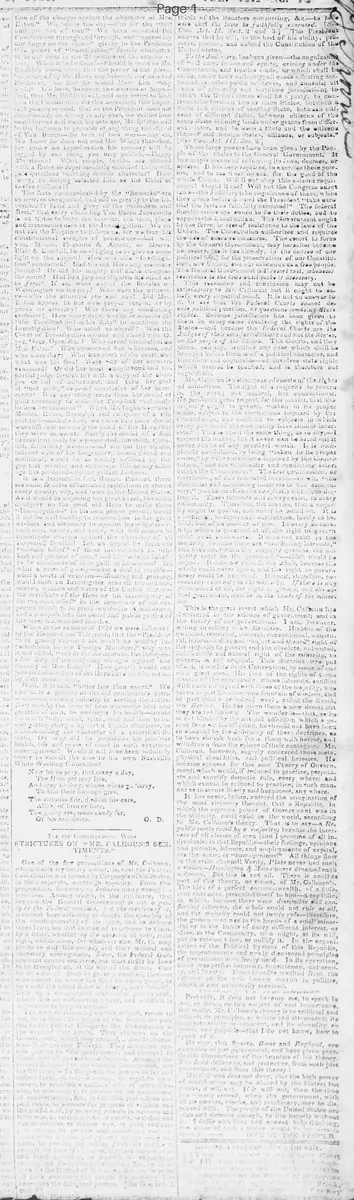
One of the few propositions of Mr. Calhoun, which meets my hearty assent, is, that the Federal Constitution was formed by the people of the states in their separate, sovereign capacity. From this proposition, however, he deduces many wrong inferences. Among which, is the doctrine, that because the General Government is not a party to the Federal compact, that the creature of it, cannot have authority to decide the question of the constitutionality of a law, and to enforce those laws; but that in case of resistance to them, by a State, whether by the acts of veto, state right, nullification, (or whatever else Mr. C. may choose to call this power) and their natural and necessary consequence, force, the Federal Gov. cannot use force, but must suffer its laws to be trampled on at the will of the State. Can the serious mind contemplate that our wise ancestors, whose fair fame is so good, as he now the wanton dame of our beloved constitution are grenens.
which a no self-loving government, and which it is impossible to keep in such condition seems to select the The example of them is worthy that the Federal Compact the Constitution is a work at their hands. They may raise the Government, which they erect, to a high state of Federal, Try something cer. L, rs in this government, and [something] Another that calls "state, to obey policy, to regulate and necessary to maintain a uniform etc naturalize. voll. to go in war, to provide to the paying measures counter etc. so. ocate hill processes in, or sounds, to punish the progress or slavery tr the Culai e. , by granting plenty to authors: fn.. rtors, to establish justice, order fn. . 410 local pirates, to declare war, to raise and support armies, to provide and maintain a navy, to make all aiat ia . -y.. t svv, ( this Sr :el.m i s4 si 2; i:4z ati B2:l i:io.:s. fa : yad try :ra Jt ti l:n.: el " , :.1 Iix3 c^:::4: co) c-ra : i ze
thirds of the Senators concurring, &c.—to take such care that the laws be faithfully executed. [See Con. art. II. Sec. 2 and 3] The President swears that he will, to the best of his ability, preserve, protect, and defend the Constitution of the United States.
To the Judiciary, has been given—the cognizance of all cases, in law and equity, arising under the Constitution, the laws and treaties made, or which shall be made, under their authority all cases affecting ambassadors, other public ministers, and consuls; all cases of admiralty and maritime jurisdiction; to cases to which the United States shall be a party, to controversies between two or more States, between a State and citizens of another State, between citizens of different States, between citizens of the same State claiming lands under grants from different states, and between a State and the citizens thereof and foreign states, citizens, or subjects." See Con. art. III. Sec. 2.
These large powers have been given by the People of the States to the General Government. It has ample means of enforcing its laws, decrees, or orders. It has been required, to exercise these powers, and to use all necessary, for the good of the whole Union. Will it not obey this solemn requirement? Ought it not? Will not the Congress enact laws—the Judiciary take cognizance of them, when they come before it—and the President "take care that the laws be faithfully executed?" The federal functionaries are sworn to do their duties, and to support the Constitution. The Government ought to use force, in case of resistance to the laws of the Union. The Constitution authorizes and requires the use of coercive measures. The resort to force by the General Government, may hereafter become necessary, (as it has already, in the course of our political life,) for the preservation of our Constitution, our Union, and our existence as a free people.
The General Government will resort to it, whenever resistance to the laws shall make it necessary.
This reasoning and conclusion may not be satisfactory to Mr. Calhoun; but it ought to satisfy every impartial mind. It is not an answer to it, to say that the Federal Courts cannot decide political questions, or questions involving State rights. Because jurisdiction has been given to them in many cases involving the rights of the States—and because the Federal Courts are the Judges of their own jurisdiction: and not the States, or the people of the States. The Courts, and they alone, can say, whether any case which shall be brought before them is of a political character, and therefore not cognizable—or involves state rights—which cannot be touched, and is therefore not cognizable.
Mr. Calhoun is a strenuous advocate of the rights of minorities. The right of a majority to govern is, (he says,) but natural, but conventional.
He professes great respect for the maxim, that the minority ought to govern, "taken in its proper sense, subject to the restrictions imposed by the Constitution, and confined to subjects in which every part of the community have similar interests." This is about the same thing, as to say,—I respect the maxim, but it never can be acted on it never can be of any practical worth. It is completely annihilated, by being "taken in its proper sense," by "the restrictions imposed by the Constitution,' and the "similar and conflicting interests in the community.' The last qualification, or restriction, of this venerated maxim—to wit, "the similar and conflicting interests in the community," (besides mention the absurd,) will alone destroy it. These interests will always exist, in every community. Therefore, the maxim, that a majority ought to govern, can never be acted on. It is a beautiful, metaphysical abstraction, lovely to behold, but of no manner of use. In every Government, in which is governed at all the right to govern must exist somewhere. It does not exist in the majority. because there are "conflicting interests," and because, "when the majority governs, the minority must be the governed,—which would be unjust. It does not exist in the whole, because the whole could never agree, and the right to govern never could be exercised. It must, therefore, necessarily exist only in the minority. There is no general head at all, the right to govern, in a constitutional government, must be in the hands of the minority.
This is the great secret which Mr. Calhoun has discovered in the science of government; and in the theory of our government. I am, however, wrong in calling it his discovery. Handful of the qualified, restricted, abstract, conventional, unnatural, impracticable, and unjust and absurd" right of the majority to govern and the absolute, unlimited. indefeasible and natural right of the minority, to govern, is not original. This doctrine was put forth, in our last state Convention, by some of our own gentlemen. It set of the rights of those classes of" the community. whose interests, conflict with those of the majority, was taken in part from the fountain of wisdom, and in part from a periodical work, called the Southern Review. He has given them a new dress; but they are not his own The wonder is—that, as he is not blinded by the natural affection which a parent feels for his offspring, he should not have been so shocked by the deformity of the doctrines, as to have shrunk back from them with horror, and withdrawn from the sphere of their contagion. Mr. Calhoun, however, eagerly embraced those meta. physical absurdities, and political heresies. He became sponsor for this new 'Theory of Government; which would, if reduced to practice, perpetuate and sanctify despotic rule, everywhere; and which cannot be reduced to practice, in such manner as to secure liberty and happiness, anywhere.
It never, before, entered the imagination of the most visionary theorist, that a Republic, in which the supreme power of Government was in the majority, could exist in the world, according to Mr. Calhoun's theory. That is to say—a Republic justly ruled by a majority; because the interests of all classes of men (and I presume of all individuals) in that Republic—their feelings, opinions and pursuits, labors, and employments of capital, are the same, or "homogeneous!" All things flow in the same channel! Verily, Plato never had such a vision—Utopia & Lycurgus never dreamed such a dream. But this is not all. There is another part of this theory, or vision, of Mr. Calhoun's.
The idea of a perfect commonwealth. of a different character, presented itself to him—a republic. in which, because there were dissimilar and conflicting interests, the whole could not rule at all, and the majority could not justly rule—therefore, the government was in the hands of a small minority; or in the hands of every different interest, or class, in the Community, who might, at its will, put its veto on a law, or nullify it. In the organization of the Political System of this Republic, the improvements and newly discovered principles of government were freely used. In its operation, there was perfect harmony, consistency, uniformity. and equality. Three benefits resulted from the application of the well known maxim in politics, which is now universally received.
Mr. I understand Probably. it does not become me, to speak in a, or free, such the act of great importance. But really. Mr. Calhoun's theory is so artificial and refined, the principles, so subtle and attenuated; its impracticability so apparent, and its absurdity so gross and palpable—that I do not know, how to speak of it.
He says, that Sparta, Rome and England, are examples of just government. and have given practical illustrations of the beauties of his theory. The Lord deliver us, and protect us, from such just government. and from this theory!
Mr. Calhoun does not deny, that the high power of nullification may be abused by the States; but thinks, it will not. It will not, then the time has already arrived, when the government, with all its powers, checks. and machinery, may be dispensed with. The people of the United States are wise and virtuous enough, to live happily without I differ with him, and cannot help thinking, of.
THE END.
What sub-type of article is it?
What keywords are associated?
What entities or persons were involved?
Editorial Details
Primary Topic
Critique Of Calhoun's Nullification And Minority Rule Doctrines
Stance / Tone
Strongly Opposed To Calhoun's States' Rights Theories, Supportive Of Federal Authority
Key Figures
Key Arguments