Thank you for visiting SNEWPapers!
Sign up free
Poem
June 10, 1840
Olive Leaf And New York Weekly Messenger
New York, New York County, New York
What is this article about?
A patriotic dialogue poem between two boys on the Fourth of July, 1840, recounting British taxation, the Boston Tea Party, Declaration of Independence, and the fight for freedom, while noting reconciliation with England under Victoria for lasting peace.
Clipping
OCR Quality
85%
Good
Full Text
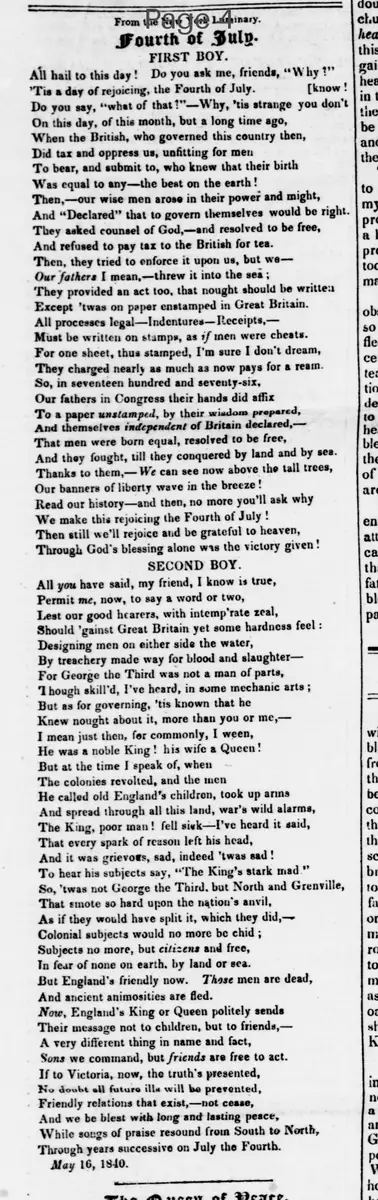
Fourth of July
FIRST BOY.
All hail to this day! Do you ask me, friends, "Why ?"
'Tis a day of rejoicing, the Fourth of July.
Do you say, "what of that?"—Why, 'tis strange you don't know!
On this day, of this month, but a long time ago,
When the British, who governed this country then,
Did tax and oppress us, unfitting for men
To bear, and submit to, who knew that their birth
Was equal to any-the best on the earth!
Then,-our wise men arose in their power and might,
And "Declared" that to govern themselves would be right.
They asked counsel of God,-and resolved to be free,
And refused to pay tax to the British for tea.
Then, they tried to enforce it upon us, but we--
Our fathers I mean,-threw it into the sea;
They provided an act too, that nought should be written:
Except 'twas on paper enstamped in Great Britain.
All processes legal-Indentures-Receipts,-
Must be written on stamps, as if men were cheats.
For one sheet, thus stamped, I'm sure I don't dream,
They charged nearly as much as now pays for a ream.
So, in seventeen hundred and seventy-six,
Our fathers in Congress their hands did affix
To a paper unstamped, by their wisdom prepared,
And themselves independent of Britain declared,-
That men were born equal, resolved to be free,
And they fought, till they conquered by land and by sea.
Thanks to them,-We can see now above the tall trees,
Our banners of liberty wave in the breeze!
Read our history-and then, no more you'll ask why
We make this rejoicing the Fourth of July!
Then still we'll rejoice and be grateful to heaven,
Through God's blessing alone was the victory given!
SECOND BOY.
All you have said, my friend, I know is true,
Permit me, now, to say a word or two,
Lest our good hearers, with intemp'rate zeal,
Should 'gainst Great Britain yet some hardness feel:
Designing men on either side the water,
By treachery made way for blood and slaughter-
For George the Third was not a man of parts,
Though skill'd, I've heard, in some mechanic arts;
But as for governing, 'tis known that he
Knew nought about it, more than you or me,—
I mean just then, for commonly, I ween,
He was a noble King! his wife a Queen!
But at the time I speak of, when
The colonies revolted. and the men
He called old England's children, took up arms
And spread through all this land, war's wild alarms,
The King, poor man! fell sick-I've heard it said,
That every spark of reason left his head,
And it was grievous, sad, indeed 'twas sad!
To hear his subjects say, "The King's stark mad"
So, 'twas not George the Third. but North and Grenville,
That smote so hard upon the nation's anvil,
As if they would have split it, which they did,
Colonial subjects would no more be chid;
Subjects no more, but citizens and free,
In fear of none on earth, by land or sea.
But England's friendly now. Those men are dead,
And ancient animosities are fled.
Now, England's King or Queen politely sends
Their message not to children, but to friends,-
A very different thing in name and fact,
Sons we command, but friends are free to act.
If to Victoria, now, the truth's presented,
No doubt all future ills will be prevented,
Friendly relations that exist,-not cease,
And we be blest with long and lasting peace,
While songs of praise resound from South to North,
Through years successive on July the Fourth.
May 16, 1840.
FIRST BOY.
All hail to this day! Do you ask me, friends, "Why ?"
'Tis a day of rejoicing, the Fourth of July.
Do you say, "what of that?"—Why, 'tis strange you don't know!
On this day, of this month, but a long time ago,
When the British, who governed this country then,
Did tax and oppress us, unfitting for men
To bear, and submit to, who knew that their birth
Was equal to any-the best on the earth!
Then,-our wise men arose in their power and might,
And "Declared" that to govern themselves would be right.
They asked counsel of God,-and resolved to be free,
And refused to pay tax to the British for tea.
Then, they tried to enforce it upon us, but we--
Our fathers I mean,-threw it into the sea;
They provided an act too, that nought should be written:
Except 'twas on paper enstamped in Great Britain.
All processes legal-Indentures-Receipts,-
Must be written on stamps, as if men were cheats.
For one sheet, thus stamped, I'm sure I don't dream,
They charged nearly as much as now pays for a ream.
So, in seventeen hundred and seventy-six,
Our fathers in Congress their hands did affix
To a paper unstamped, by their wisdom prepared,
And themselves independent of Britain declared,-
That men were born equal, resolved to be free,
And they fought, till they conquered by land and by sea.
Thanks to them,-We can see now above the tall trees,
Our banners of liberty wave in the breeze!
Read our history-and then, no more you'll ask why
We make this rejoicing the Fourth of July!
Then still we'll rejoice and be grateful to heaven,
Through God's blessing alone was the victory given!
SECOND BOY.
All you have said, my friend, I know is true,
Permit me, now, to say a word or two,
Lest our good hearers, with intemp'rate zeal,
Should 'gainst Great Britain yet some hardness feel:
Designing men on either side the water,
By treachery made way for blood and slaughter-
For George the Third was not a man of parts,
Though skill'd, I've heard, in some mechanic arts;
But as for governing, 'tis known that he
Knew nought about it, more than you or me,—
I mean just then, for commonly, I ween,
He was a noble King! his wife a Queen!
But at the time I speak of, when
The colonies revolted. and the men
He called old England's children, took up arms
And spread through all this land, war's wild alarms,
The King, poor man! fell sick-I've heard it said,
That every spark of reason left his head,
And it was grievous, sad, indeed 'twas sad!
To hear his subjects say, "The King's stark mad"
So, 'twas not George the Third. but North and Grenville,
That smote so hard upon the nation's anvil,
As if they would have split it, which they did,
Colonial subjects would no more be chid;
Subjects no more, but citizens and free,
In fear of none on earth, by land or sea.
But England's friendly now. Those men are dead,
And ancient animosities are fled.
Now, England's King or Queen politely sends
Their message not to children, but to friends,-
A very different thing in name and fact,
Sons we command, but friends are free to act.
If to Victoria, now, the truth's presented,
No doubt all future ills will be prevented,
Friendly relations that exist,-not cease,
And we be blest with long and lasting peace,
While songs of praise resound from South to North,
Through years successive on July the Fourth.
May 16, 1840.
What sub-type of article is it?
Ballad
Ode
What themes does it cover?
Patriotism
Liberty Independence
Political
What keywords are associated?
Fourth Of July
American Independence
British Taxation
Declaration Of Independence
George Iii
Queen Victoria
Poem Details
Title
Fourth Of July
Subject
Celebration Of American Independence
Form / Style
Dialogue In Rhymed Verse Between Two Boys
Key Lines
All Hail To This Day! Do You Ask Me, Friends, "Why ?"
"Tis A Day Of Rejoicing, The Fourth Of July.
They Asked Counsel Of God, And Resolved To Be Free,
And Refused To Pay Tax To The British For Tea.
Thanks To Them, We Can See Now Above Tho Tall Trees,
Our Banners Of Liberty Wave In The Breeze!
Butengland's Friendly Now.Those Men Are Dead,
And Ancient Animosities Arefled.
While Sougs Of Praise Resound Froin South To North,
Through Years Successive On July The Fourtb.