Thank you for visiting SNEWPapers!
Sign up free
The Rhode Island American, And General Advertiser
Providence, Providence County, Rhode Island
What is this article about?
A satirical article from the Connecticut Mirror critiques the ongoing U.S. congressional session under Jefferson's administration, highlighting wasted time and money on ineffective resolutions and bills related to foreign affairs, trade, military, and torpedoes, with no substantial national benefits.
Merged-components note: These two sequential components are a clear continuation of the same editorial piece on congressional proceedings, with the text flowing directly from one to the other.
Clipping
OCR Quality
Full Text
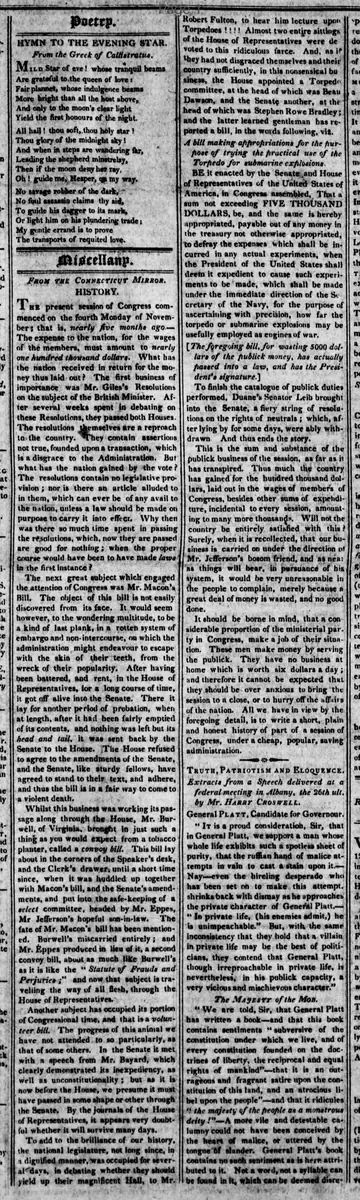
From the Connecticut Mirror.
HISTORY.
THE present session of Congress commenced on the fourth Monday of November; that is, nearly five months ago. The expense to the nation, or the wages of the members, must amount to nearly one hundred thousand dollars. What has the nation received in return for the money thus laid out? The first business of importance, was Mr. Giles's Resolutions on the subject of the British Minister. After several weeks spent in debating on these Resolutions, they passed both Houses. The resolutions themselves are a reproach to the country. They contain assertions not true, founded upon a transaction, which is a disgrace to the Administration. But what has the nation gained by the vote? The resolutions contain no legislative provision; nor is there an article alluded to in them, which can ever be of any avail to the nation, unless a law should be made on purpose to carry it into effect. Why then was there so much time spent in passing the resolutions, which, now they are passed are good for nothing; when the proper course would have been to have made laws in the first instance?
The next great subject which engaged the attention of Congress was Mr. Macon's Bill. The object of this bill is not easily discovered from its face. It would seem however, to the wondering multitude, to be a kind of last plank, in a rotten system of embargo and non-intercourse, on which the administration might endeavour to escape with the skin of their teeth, from the wreck of their popularity. After having been battered, and rent, in the House of Representatives, for a long course of time, it got off alive into the Senate. There it lay for another period of probation, when at length, after it had been fairly emptied of its contents, and nothing was left but its head and tail, it was sent back by the Senate to the House. The House refused to agree to the amendments of the Senate, and the Senate, like sturdy fellows, have agreed to stand to their text, and adhere, and thus the bill is in a fair way to come to a violent death.
Whilst this business was working its passage along through the House, Mr. Burwell, of Virginia, brought in just such a thing as you would expect from a tobacco planter, called a convoy bill. This bill lay about in the corners of the Speaker's desk, and the Clerk's drawer, until a short time since, when it was huddled up together with Macon's bill, and the Senate's amendments, and put into the safe-keeping of a select committee, headed by Mr. Eppes, Mr Jefferson's hopeful son-in-law. The fate of Mr. Macon's bill has been mentioned. Burwell's miscarried entirely; and Mr. Eppes produced in lieu of it, a second convoy bill, about as much like Burwell's as it is like the "Statute of Frauds and Perjuries ;" and now that subject is travelling the way of all flesh, through the House of Representatives.
Another subject has occupied its portion of Congressional time, and that is a volunteer bill. The progress of this animal we have not attended to so particularly, as that of some others. In the Senate it met with a speech from Mr. Bayard, which clearly demonstrated its inexpediency, as well as unconstitutionality; but as it is now before the House, we presume it must have passed in some shape or other through the Senate. By the journals of the House of Representatives, it appears very doubtful whether it will survive many days.
To add to the brilliance of our history, the national legislature, not long since, in a dignified manner, was occupied for several days, in debating whether they should yield up their magnificent Hall, to Mr.
Robert Fulton, to hear him lecture upon Torpedoes !!!! Almost two entire sittings of the House of Representatives were devoted to this ridiculous farce. And, as if they had not disgraced themselves and their country sufficiently, in this nonsensical business, the House appointed a Torpedo committee, at the head of which was Beau Dawson, and the Senate another, at the head of which was Stephen Rowe Bradley; and the latter learned gentleman has reported a bill, in the words following, viz.
A bill making appropriations for the purpose of trying the practical use of the Torpedo for submarine explosions.
BE it enacted by the Senate and House of Representatives of the United States of America, in Congress assembled, That a sum not exceeding FIVE THOUSAND DOLLARS, be, and the same is hereby appropriated, payable out of any money in the treasury not otherwise appropriated, to defray the expenses which shall be incurred in any actual experiments, when the President of the United States shall deem it expedient to cause such experiments to be made, which shall be made under the immediate direction of the Secretary of the Navy, for the purpose of ascertaining with precision, how far the torpedo or submarine explosions may be usefully employed as engines of war.
[The foregoing bill, for wasting 5000 dollars of the publick money, has actually passed into a law, and has the President's signature.]
To finish the catalogue of publick duties performed, Duane's Senator Leib brought into the Senate, a fiery string of resolutions on the rights of neutrals; which, after lying by for some days, were ably withdrawn. And thus ends the story.
This is the sum and substance of the publick business of the session, as far as it has transpired. Thus much the country has gained for the hundred thousand dollars, laid out in the wages of members of Congress, besides other sums of expenditure, incidental to every session, amounting to many more thousands. Will not the country be entirely satisfied with this? Surely, when it is recollected, that our business is carried on under the direction of Mr. Jefferson's bosom friend, and as near as things will bear, in pursuance of his system, it would be very unreasonable in the people to complain, merely because a great deal of money is wasted, and no good done.
It should be borne in mind, that a considerable proportion of the ministerial party in Congress, make a job of their situation. These men make money by serving the publick. They have no business at home which is worth six dollars a day; and therefore it cannot be expected that they should be over anxious to bring the session to a close, or to hurry off the affairs of the nation. All we have in view by the foregoing detail, is to write a short, plain and honest history of part of a session of Congress, under a cheap, popular, saving administration.
What sub-type of article is it?
What keywords are associated?
What entities or persons were involved?
Editorial Details
Primary Topic
Critique Of Congressional Session Inefficiency Under Jefferson Administration
Stance / Tone
Satirical Criticism Of Government Waste And Ineffectiveness
Key Figures
Key Arguments