Thank you for visiting SNEWPapers!
Sign up free
Alexandria Advertiser And Commercial Intelligencer
Alexandria, Virginia
What is this article about?
Memorial by U.S. Minister Livingston to French government argues against France reacquiring Louisiana, citing economic losses from diverting slaves and trade from profitable islands, limited market for French goods in western U.S., and political risks favoring American interests.
Clipping
OCR Quality
Full Text
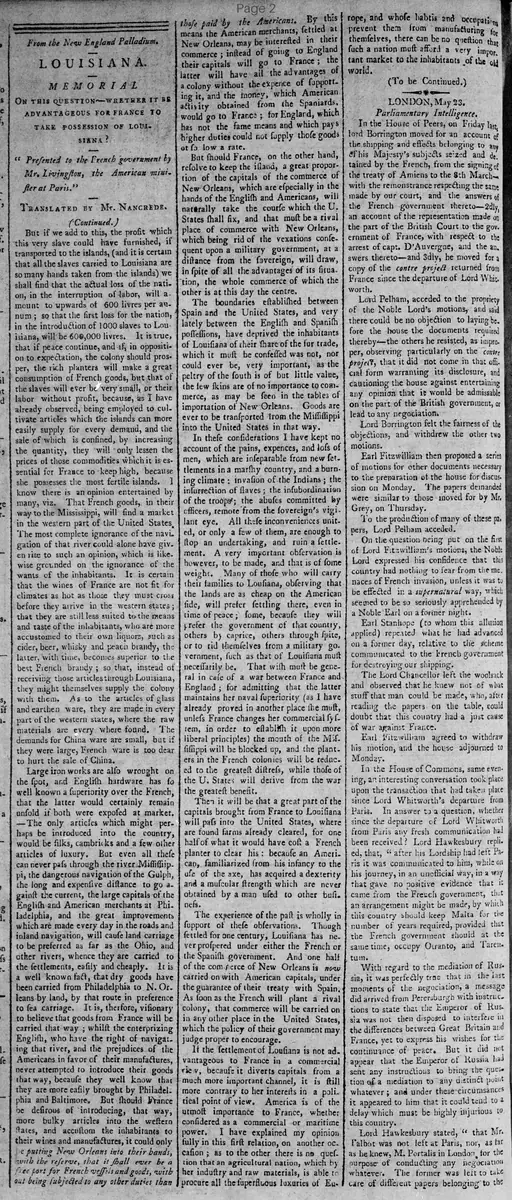
LOUISIANA
MEMORIAL
ON THIS QUESTION—WHETHER IT BE
ADVANTAGEOUS FOR FRANCE TO
TAKE POSSESSION OF LOUISIANA?
Presented to the French government by
Mr. Livingston, the American minister
at Paris.
Translated By Mr. Nancrede.
(Continued.)
But if we add to this, the profit which
this very slave could have furnished, if
transported to the islands, (and it is certain
that all the slaves carried to Louisiana are
so many hands taken from the islands) we
shall find that the actual loss of the nation,
in the interruption of labor, will amount
to upwards of 600 livres per annum; so that the first loss for the nation,
in the introduction of 1000 slaves to Louisiana,
will be 600,000 livres. It is true,
that if peace continue, and if, in opposition
to expectation, the colony should prosper,
the rich planters will make a great
consumption of French goods, but that of
the slaves will ever be very small, or their
labor without profit, because, as I have
already observed, being employed to cultivate
articles which the islands can more
easily supply for every demand, and the
sale of which is confined, by increasing
the quantity, they will only lessen the
prices of those commodities which it is essential
for France to keep high, because
she possesses the most fertile islands. I
know there is an opinion entertained by
many, viz. That French goods, in their
way to the Mississippi, will find a market
in the western part of the United States.
The most complete ignorance of the navigation
of that river could alone have given
rise to such an opinion, which is likewise
grounded on the ignorance of the
wants of the inhabitants. It is certain
that the wines of France are not fit for
climates as hot as those they must cross
before they arrive in the western states;
that they are still less suited to the means
and taste of the inhabitants, who are more
accustomed to their own liquors, such as
cider, beer, whisky and peach brandy, the
latter, with time, becomes superior to the
best French brandy; so that, instead of
receiving those articles through Louisiana,
they might themselves supply the colony
with them. As to the articles of glass
and earthen ware, they are made in every
part of the western states, where the raw
materials are every where found. The
demands for China ware are small, but if
they were large, French ware is too dear
to hurt the sale of China.
Large iron works are also wrought on
the spot, and English hardware has so
well known a superiority over the French.
that the latter would certainly remain
unsold if both were exposed at market.
—The only articles which might perhaps be introduced
into the country,
would be silks, cambricks and a few other
articles of luxury. But even all these
can never pass through the river Mississippi,
the dangerous navigation of the Gulph,
the long and expensive distance to go against
the current, the large capitals of the
English and American merchants at Philadelphia,
and the great improvements
which are made every day in the roads and
inland navigation, will cause land carriage
to be preferred as far as the Ohio, and
other rivers, whence they are carried to
the settlements, easily and cheaply. It is
a well known fact, that dry goods have
been carried from Philadelphia to New Orleans
by land, by that route in preference
to sea carriage. It is, therefore, visionary
to believe that goods from France will be
carried that way; whilst the enterprising
English, who have the right of navigating
that river, and the prejudices of the
Americans in favor of their manufactures,
never attempted to introduce their goods
that way, because they well know that
they are more easily brought by Philadelphia
and Baltimore. But should France
be desirous of introducing, that way,
more bulky articles into the western
states, and accustom the inhabitants to
their wines and manufactures, it could only
be putting New Orleans into their hands,
with the reserve, that it shall ever be a
free port for French vessels and goods, without
being subjected to any other duties than
those paid by the Americans. By this
means the American merchants, settled at
New Orleans, may be interested in their
commerce; instead of going to England
their capitals will go to France; the
latter will have all the advantages of
a colony without the expense of supporting
it, and the money, which American
activity, obtained from the Spaniards,
would go to France; for England, which
has not the same means and which pays
higher duties could not supply those goods
at so low a rate.
But should France, on the other hand,
resolve to keep the island, a great proportion
of the capitals of the commerce of
New Orleans, which are especially in the
hands of the English and Americans, will
naturally take the course which the U.
States shall fix, and that must be a rival
place of commerce with New Orleans,
which being rid of the vexations consequent
upon a military government, at a
distance from the sovereign, will draw,
in spite of all the advantages of its situation,
the whole commerce of which the
other is at this day the centre.
The boundaries established between
Spain and the United States, and very
lately between the English and Spanish
possessions, have deprived the inhabitants
of Louisiana of their share of the fur trade,
which it must be confessed was not, nor
could ever be, very important, as the
peltry of the south is of but little value,
the few skins are of no importance to commerce,
as may be seen in the tables of
importation of New Orleans. Goods are
ever to be transported from the Mississippi
into the United States in that way.
In these considerations I have kept no
account of the pains, expenses, and loss of
men, which are inseparable from new settlements
in a marshy country, and a burning
climate: invasion of the Indians; the
insurrection of slaves; the insubordination
of the troops; the abuses committed by
officers, remote from the sovereign's vigilant
eye. All these inconveniences united,
or only a few of them, are enough to
stop an undertaking, and ruin a settlement.
A very important observation is
however, to be made, and that is of some
weight. Many of those who will carry
their families to Louisiana, observing that
the lands are as cheap on the American
side, will prefer settling there, even in
time of peace; some, because they will
prefer the government of that country,
others by caprice, others through spite,
or to rid themselves from a military government,
such as that of Louisiana must
necessarily be. That wish must be general
in case of a war between France and
England: for admitting that the latter
maintains her naval superiority (as I have
already proved in another place she must,
unless France changes her commercial system,
in order to establish it upon more
liberal principles) the mouth of the Mississippi
will be blocked up, and the planters
in the French colonies will be reduced
to the greatest distress, while those of
the U. States will derive from the war
the greatest benefit.
They it will be that a great part of the
capitals brought from France to Louisiana
will pass into the United States, where
are found farms already cleared, for one
half of what it would have cost a French
planter to clear his: because an American,
familiarized from his infancy to the
use of the axe, has acquired a dexterity
and a muscular strength which are never
obtained by a man used to other business.
The experience of the past is wholly in
support of these observations. Though
settled for one century, Louisiana has never
prospered under either the French or
the Spanish government. And one half
of the commerce of New Orleans is now
carried on with American capitals, under
the guarantee of their treaty with Spain.
As soon as the French will plant a rival
colony, that commerce will be carried on
in any other place in the United States,
which the policy of their government may
judge proper to encourage.
If the settlement of Louisiana is not advantageous
to France in a commercial
view, because it diverts capitals from a
much more important channel, it is still
more contrary to her interests in a political
point of view. America is of the
utmost importance to France, whether
considered as a commercial or maritime
power. I have explained my opinion
fully in this first relation, on another occasion;
as to the other there is no question
that an agricultural nation, which by
her industry and raw materials, is able to
procure all the superfluous luxuries of Europe,
and whose habits and occupations
prevent them from manufacturing for
themselves, there can be no question that
such a nation must afford a very important
market to the inhabitants of the old
world.
(To be Continued.)
What sub-type of article is it?
What keywords are associated?
What entities or persons were involved?
Where did it happen?
Foreign News Details
Primary Location
Louisiana
Key Persons
Outcome
argument against french possession due to economic losses (e.g., 600,000 livres from 1000 slaves diverted) and political disadvantages favoring u.s. and english commerce.
Event Details
Memorial presented by American minister Livingston argues that reacquiring Louisiana would harm French interests by diverting slave labor and trade from profitable islands, limiting markets for French goods in western U.S. due to local production and preferences, risking capital flight to U.S., and exposing vulnerabilities in war, based on historical non-prosperity under French/Spanish rule.