Thank you for visiting SNEWPapers!
Sign up free
Literary
March 18, 1785
Fowle's New Hampshire Gazette And General Advertiser
Portsmouth, Rockingham County, New Hampshire
What is this article about?
Excerpt from Richard Price's essay advocating for a liberal education that fosters critical thinking, candor, and pursuit of truth over dogmatic systems. Critiques traditional education for instilling prejudices, using historical examples from Christianity, Locke, and Newton. Emphasizes mathematics and honest inquiry, especially for Christianity.
Clipping
OCR Quality
95%
Excellent
Full Text
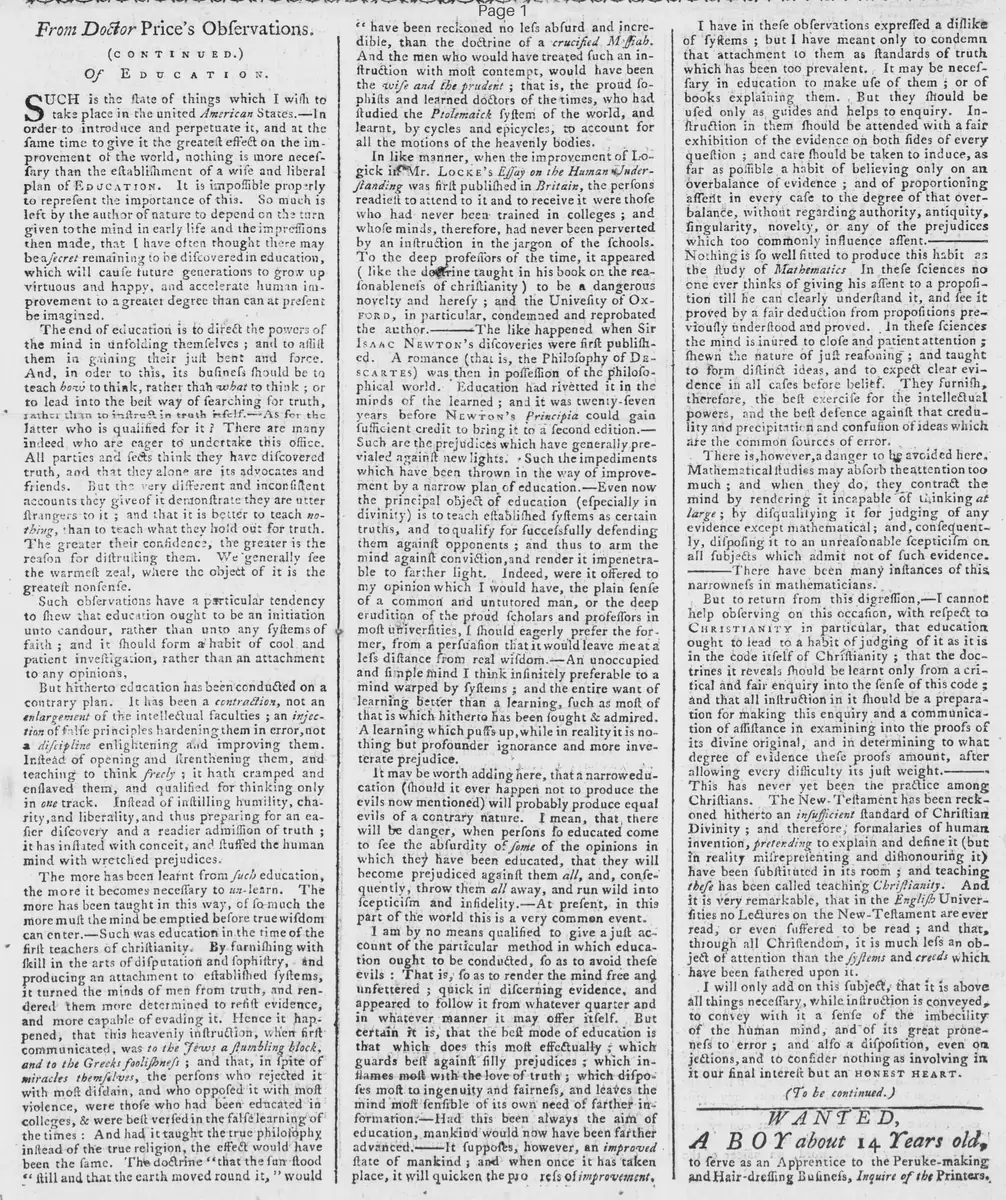
From Doctor Price's Observations:
(CONTINUED.)
Of EDUCATION.
Such a state of things which I wish to take place in the united American States.--In order to introduce and perpetuate it, and at the same time to give it the greatest effect on the improvement of the world, nothing is more necessary than the establishment of a wise and liberal plan of Education. It is impossible properly to represent the importance of this. So much is left by the author of nature to depend on the turn given to the mind in early life and the impressions then made, that I have often thought there may be a secret remaining to be discovered in education, which will cause future generations to grow up virtuous and happy, and accelerate human improvement to a greater degree than can at present be imagined.
The end of education is to direct the powers of the mind in unfolding themselves: and to assist them in gaining their just bent and force. And, in order to this, its business should be to teach how to think, rather than what to think: or to lead into the best way of searching for truth, rather than to instruct in truth itself.--As for the latter who is qualified for it? There are many indeed who are eager to undertake this office. All parties and sects think they have discovered truth, and that they alone are its advocates and friends. But the very different and inconsistent accounts they give of it demonstrate they are utter strangers to it; and that it is better to teach nothing, than to teach what they hold out for truth. The greater their confidence, the greater is the reason for distrusting them. We generally see the warmest zeal, where the object of it is the greatest nonsense.
Such observations have a particular tendency to shew that education ought to be an initiation unto candour, rather than unto any systems of faith: and it should form a habit of cool and patient investigation, rather than an attachment to any opinions.
But hitherto education has been conducted on a contrary plan. It has been a contraction, not an enlargement of the intellectual faculties; an injection of false principles hardening them in error, not a discipline enlightening and improving them. Instead of opening and strengthening them, and teaching to think freely; it hath cramped and enslaved them, and qualified for thinking only in one track. Instead of instilling humility, charity, and liberality, and thus preparing for an easier discovery and a readier admission of truth: it has inflated with conceit, and stuffed the human mind with wretched prejudices.
The more has been learnt from such education, the more it becomes necessary to un-learn. The more has been taught in this way, of so much the more must the mind be emptied before true wisdom can enter.--Such was education in the time of the first teachers of christianity. By furnishing with skill in the arts of disputation and sophistry, and producing an attachment to established systems, it turned the minds of men from truth, and rendered them more determined to resist evidence, and more capable of evading it. Hence it happened, that this heavenly instruction, when first communicated, was to the Jews a stumbling block, and to the Greeks foolishness: and that, in spite of miracles themselves, the persons who rejected it with most disdain, and who opposed it with most violence, were those who had been educated in colleges, & were best versed in the false learning of the times: And had it taught the true philosophy instead of the true religion, the effect would have been the same. The doctrine "that the sun stood still and that the earth moved round it," would have been reckoned no less absurd and incredible, than the doctrine of a crucified Messiah. And the men who would have treated such an instruction with most contempt, would have been the wise and the prudent: that is, the proud sophists and learned doctors of the times, who had studied the Ptolemaick system of the world, and learnt, by cycles and epicycles, to account for all the motions of the heavenly bodies.
In like manner, when the improvement of Logic in Mr. Locke's Essay on the Human Understanding was first published in Britain, the persons readiest to attend to it and to receive it were those who had never been trained in colleges; and whose minds, therefore, had never been perverted by an instruction in the jargon of the schools. To the deep professors of the time, it appeared (like the doctrine taught in his book on the reasonableness of christianity) to be a dangerous novelty and heresy; and the University of Oxford, in particular, condemned and reprobated the author.--The like happened when Sir Isaac Newton's discoveries were first published. A romance (that is, the Philosophy of Descartes) was then in possession of the philosophical world. Education had rivetted it in the minds of the learned: and it was twenty-seven years before Newton's Principia could gain sufficient credit to bring it to a second edition.--Such are the prejudices which have generally prevailed against new lights: Such the impediments which have been thrown in the way of improvement by a narrow plan of education.--Even now the principal object of education (especially in divinity) is to teach established systems as certain truths, and to qualify for successfully defending them against opponents; and thus to arm the mind against conviction, and render it impenetrable to farther light. Indeed, were it offered to my opinion which I would have, the plain sense of a common and untutored man, or the deep erudition of the proud scholars and professors in most universities, I should eagerly prefer the former, from a persuasion that it would leave me at a less distance from real wisdom.--An unoccupied and simple mind I think infinitely preferable to a mind warped by systems: and the entire want of learning better than a learning, such as most of that is which hitherto has been sought & admired. A learning which puffs up, while in reality it is nothing but profounder ignorance and more inveterate prejudice.
It may be worth adding here, that a narrow education (should it ever happen not to produce the evils now mentioned) will probably produce equal evils of a contrary nature. I mean, that, there will be danger, when persons so educated come to see the absurdity of some of the opinions in which they have been educated, that they will become prejudiced against them all, and, consequently, throw them all away, and run wild into scepticism and infidelity.--At present, in this part of the world this is a very common event.
I am by no means qualified to give a just account of the particular method in which education ought to be conducted, so as to avoid these evils: That is, so as to render the mind free and unfettered; quick in discerning evidence, and prepared to follow it from whatever quarter and in whatever manner it may offer itself. But certain it is, that the best mode of education is that which does this most effectually; which guards best against silly prejudices; which inflames most with the love of truth: which disposes most to ingenuity and fairness, and leaves the mind most sensible of its own need of farther information.--Had this been always the aim of education, mankind would now have been farther advanced.--It supposes, however, an improved state of mankind; and when once it has taken place, it will quicken the progress of improvement.
I have in these observations expressed a dislike of systems; but I have meant only to condemn that attachment to them as standards of truth which has been too prevalent. It may be necessary in education to make use of them; or of books explaining them. But they should be used only as guides and helps to enquiry. Instruction in them should be attended with a fair exhibition of the evidence on both sides of every question; and care should be taken to induce, as far as possible a habit of believing only on an overbalance of evidence; and of proportioning assent in every case to the degree of that overbalance, without regarding authority, antiquity, singularity, novelty, or any of the prejudices which too commonly influence assent.
Nothing is so well fitted to produce this habit as the study of Mathematics. In these sciences no one ever thinks of giving his assent to a proposition till he can clearly understand it, and see it proved by a fair deduction from propositions previously understood and proved. In these sciences the mind is inured to close and patient attention; shewn the nature of just reasoning: and taught to form distinct ideas, and to expect clear evidence in all cases before belief. They furnish therefore, the best exercise for the intellectual powers, and the best defence against that credulity and precipitation and confusion of ideas which are the common sources of error.
There is, however, a danger to be avoided here. Mathematical studies may absorb the attention too much: and when they do, they contract the mind by rendering it incapable of thinking at large; by disqualifying it for judging of any evidence except mathematical; and, consequently, disposing it to an unreasonable scepticism on all subjects which admit not of such evidence. There have been many instances of this narrowness in mathematicians.
But to return from this digression,--I cannot help observing on this occasion, with respect to CHRISTIANITY in particular, that education ought to lead to a habit of judging of it as it is in the code itself of Christianity; that the doctrines it reveals should be learnt only from a critical and fair enquiry into the sense of this code; and that all instruction in it should be a preparation for making this enquiry and a communication of assistance in examining into the proofs of its divine original, and in determining to what degree of evidence these proofs amount, after allowing every difficulty its just weight.
This has never yet been the practice among Christians. The New Testament has been reckoned hitherto an insufficient standard of Christian Divinity; and therefore, formularies of human invention, pretending to explain and define it (but in reality misrepresenting and dishonouring it) have been substituted in its room; and teaching these has been called teaching Christianity. And it is very remarkable, that in the English Universities no Lectures on the New-Testament are ever read; or even suffered to be read; and that, through all Christendom, it is much less an object of attention than the systems and creeds which have been fathered upon it.
I will only add on this subject, that it is above all things necessary, while instruction is conveyed, to convey with it a sense of the imbecility of the human mind; and of its great proneness to error; and also a disposition, even on subjections, and to consider nothing as involving in it our final interest but an HONEST HEART.
(To be continued.)
(CONTINUED.)
Of EDUCATION.
Such a state of things which I wish to take place in the united American States.--In order to introduce and perpetuate it, and at the same time to give it the greatest effect on the improvement of the world, nothing is more necessary than the establishment of a wise and liberal plan of Education. It is impossible properly to represent the importance of this. So much is left by the author of nature to depend on the turn given to the mind in early life and the impressions then made, that I have often thought there may be a secret remaining to be discovered in education, which will cause future generations to grow up virtuous and happy, and accelerate human improvement to a greater degree than can at present be imagined.
The end of education is to direct the powers of the mind in unfolding themselves: and to assist them in gaining their just bent and force. And, in order to this, its business should be to teach how to think, rather than what to think: or to lead into the best way of searching for truth, rather than to instruct in truth itself.--As for the latter who is qualified for it? There are many indeed who are eager to undertake this office. All parties and sects think they have discovered truth, and that they alone are its advocates and friends. But the very different and inconsistent accounts they give of it demonstrate they are utter strangers to it; and that it is better to teach nothing, than to teach what they hold out for truth. The greater their confidence, the greater is the reason for distrusting them. We generally see the warmest zeal, where the object of it is the greatest nonsense.
Such observations have a particular tendency to shew that education ought to be an initiation unto candour, rather than unto any systems of faith: and it should form a habit of cool and patient investigation, rather than an attachment to any opinions.
But hitherto education has been conducted on a contrary plan. It has been a contraction, not an enlargement of the intellectual faculties; an injection of false principles hardening them in error, not a discipline enlightening and improving them. Instead of opening and strengthening them, and teaching to think freely; it hath cramped and enslaved them, and qualified for thinking only in one track. Instead of instilling humility, charity, and liberality, and thus preparing for an easier discovery and a readier admission of truth: it has inflated with conceit, and stuffed the human mind with wretched prejudices.
The more has been learnt from such education, the more it becomes necessary to un-learn. The more has been taught in this way, of so much the more must the mind be emptied before true wisdom can enter.--Such was education in the time of the first teachers of christianity. By furnishing with skill in the arts of disputation and sophistry, and producing an attachment to established systems, it turned the minds of men from truth, and rendered them more determined to resist evidence, and more capable of evading it. Hence it happened, that this heavenly instruction, when first communicated, was to the Jews a stumbling block, and to the Greeks foolishness: and that, in spite of miracles themselves, the persons who rejected it with most disdain, and who opposed it with most violence, were those who had been educated in colleges, & were best versed in the false learning of the times: And had it taught the true philosophy instead of the true religion, the effect would have been the same. The doctrine "that the sun stood still and that the earth moved round it," would have been reckoned no less absurd and incredible, than the doctrine of a crucified Messiah. And the men who would have treated such an instruction with most contempt, would have been the wise and the prudent: that is, the proud sophists and learned doctors of the times, who had studied the Ptolemaick system of the world, and learnt, by cycles and epicycles, to account for all the motions of the heavenly bodies.
In like manner, when the improvement of Logic in Mr. Locke's Essay on the Human Understanding was first published in Britain, the persons readiest to attend to it and to receive it were those who had never been trained in colleges; and whose minds, therefore, had never been perverted by an instruction in the jargon of the schools. To the deep professors of the time, it appeared (like the doctrine taught in his book on the reasonableness of christianity) to be a dangerous novelty and heresy; and the University of Oxford, in particular, condemned and reprobated the author.--The like happened when Sir Isaac Newton's discoveries were first published. A romance (that is, the Philosophy of Descartes) was then in possession of the philosophical world. Education had rivetted it in the minds of the learned: and it was twenty-seven years before Newton's Principia could gain sufficient credit to bring it to a second edition.--Such are the prejudices which have generally prevailed against new lights: Such the impediments which have been thrown in the way of improvement by a narrow plan of education.--Even now the principal object of education (especially in divinity) is to teach established systems as certain truths, and to qualify for successfully defending them against opponents; and thus to arm the mind against conviction, and render it impenetrable to farther light. Indeed, were it offered to my opinion which I would have, the plain sense of a common and untutored man, or the deep erudition of the proud scholars and professors in most universities, I should eagerly prefer the former, from a persuasion that it would leave me at a less distance from real wisdom.--An unoccupied and simple mind I think infinitely preferable to a mind warped by systems: and the entire want of learning better than a learning, such as most of that is which hitherto has been sought & admired. A learning which puffs up, while in reality it is nothing but profounder ignorance and more inveterate prejudice.
It may be worth adding here, that a narrow education (should it ever happen not to produce the evils now mentioned) will probably produce equal evils of a contrary nature. I mean, that, there will be danger, when persons so educated come to see the absurdity of some of the opinions in which they have been educated, that they will become prejudiced against them all, and, consequently, throw them all away, and run wild into scepticism and infidelity.--At present, in this part of the world this is a very common event.
I am by no means qualified to give a just account of the particular method in which education ought to be conducted, so as to avoid these evils: That is, so as to render the mind free and unfettered; quick in discerning evidence, and prepared to follow it from whatever quarter and in whatever manner it may offer itself. But certain it is, that the best mode of education is that which does this most effectually; which guards best against silly prejudices; which inflames most with the love of truth: which disposes most to ingenuity and fairness, and leaves the mind most sensible of its own need of farther information.--Had this been always the aim of education, mankind would now have been farther advanced.--It supposes, however, an improved state of mankind; and when once it has taken place, it will quicken the progress of improvement.
I have in these observations expressed a dislike of systems; but I have meant only to condemn that attachment to them as standards of truth which has been too prevalent. It may be necessary in education to make use of them; or of books explaining them. But they should be used only as guides and helps to enquiry. Instruction in them should be attended with a fair exhibition of the evidence on both sides of every question; and care should be taken to induce, as far as possible a habit of believing only on an overbalance of evidence; and of proportioning assent in every case to the degree of that overbalance, without regarding authority, antiquity, singularity, novelty, or any of the prejudices which too commonly influence assent.
Nothing is so well fitted to produce this habit as the study of Mathematics. In these sciences no one ever thinks of giving his assent to a proposition till he can clearly understand it, and see it proved by a fair deduction from propositions previously understood and proved. In these sciences the mind is inured to close and patient attention; shewn the nature of just reasoning: and taught to form distinct ideas, and to expect clear evidence in all cases before belief. They furnish therefore, the best exercise for the intellectual powers, and the best defence against that credulity and precipitation and confusion of ideas which are the common sources of error.
There is, however, a danger to be avoided here. Mathematical studies may absorb the attention too much: and when they do, they contract the mind by rendering it incapable of thinking at large; by disqualifying it for judging of any evidence except mathematical; and, consequently, disposing it to an unreasonable scepticism on all subjects which admit not of such evidence. There have been many instances of this narrowness in mathematicians.
But to return from this digression,--I cannot help observing on this occasion, with respect to CHRISTIANITY in particular, that education ought to lead to a habit of judging of it as it is in the code itself of Christianity; that the doctrines it reveals should be learnt only from a critical and fair enquiry into the sense of this code; and that all instruction in it should be a preparation for making this enquiry and a communication of assistance in examining into the proofs of its divine original, and in determining to what degree of evidence these proofs amount, after allowing every difficulty its just weight.
This has never yet been the practice among Christians. The New Testament has been reckoned hitherto an insufficient standard of Christian Divinity; and therefore, formularies of human invention, pretending to explain and define it (but in reality misrepresenting and dishonouring it) have been substituted in its room; and teaching these has been called teaching Christianity. And it is very remarkable, that in the English Universities no Lectures on the New-Testament are ever read; or even suffered to be read; and that, through all Christendom, it is much less an object of attention than the systems and creeds which have been fathered upon it.
I will only add on this subject, that it is above all things necessary, while instruction is conveyed, to convey with it a sense of the imbecility of the human mind; and of its great proneness to error; and also a disposition, even on subjections, and to consider nothing as involving in it our final interest but an HONEST HEART.
(To be continued.)
What sub-type of article is it?
Essay
What themes does it cover?
Moral Virtue
Political
Religious
What keywords are associated?
Education
Liberal Education
Truth
Prejudice
Christianity
Critical Thinking
Mathematics
Scepticism
What entities or persons were involved?
From Doctor Price's Observations
Literary Details
Title
Of Education.
Author
From Doctor Price's Observations
Key Lines
The End Of Education Is To Direct The Powers Of The Mind In Unfolding Themselves: And To Assist Them In Gaining Their Just Bent And Force.
Its Business Should Be To Teach How To Think, Rather Than What To Think: Or To Lead Into The Best Way Of Searching For Truth, Rather Than To Instruct In Truth Itself.
Education Ought To Be An Initiation Unto Candour, Rather Than Unto Any Systems Of Faith
A Learning Which Puffs Up, While In Reality It Is Nothing But Profounder Ignorance And More Inveterate Prejudice.
Nothing Is So Well Fitted To Produce This Habit As The Study Of Mathematics.