Thank you for visiting SNEWPapers!
Sign up free
Literary
February 24, 1840
Alexandria Gazette
Alexandria, Alexandria County, District Of Columbia
What is this article about?
Review praising Judge Haliburton's 'The Letter-Bag of the Great Western,' a satirical epistolary work on diverse passengers' lives aboard an Atlantic steamer. Includes humorous excerpts from an actress's journal and a steward's letter, critiquing colonial policies and steamer management.
Clipping
OCR Quality
92%
Excellent
Full Text
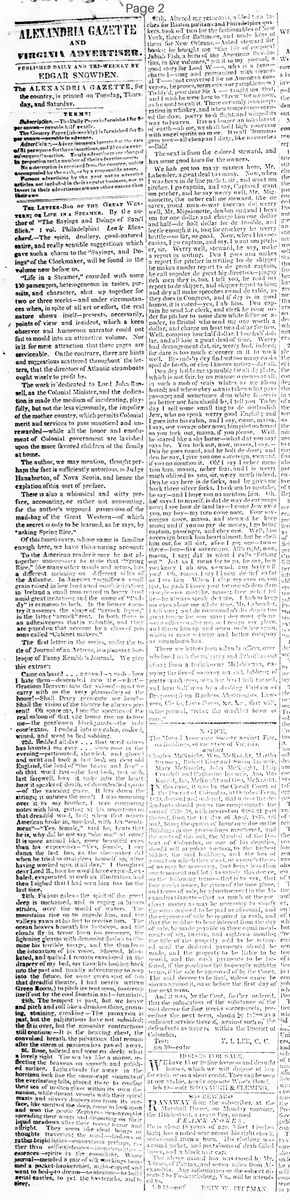
The Letter-Bag of the Great Western; OR LIFE IN A STEAMER. By the author of "The Sayings and Doings of Sam'l Slick." 1 vol. Philadelphia: Lea & Blanchard.—The spirit, drollery, good-natured satire, and really sensible suggestions which gave such a charm to the "Sayings and Doings" of the Clockmaker, will be found in the volume now before us.
"Life in a Steamer," crowded with some 130 passengers, heterogeneous in tastes, pursuits, and character, shut up together for two or three weeks—and under circumstances when, in spite of all art or effort, the real nature shows itself—presents, necessarily, points of view and incident, which a keen observer and humorous narrator could not fail to mould into an attractive volume. Nor is it for mere attraction that these pages are serviceable. On the contrary, there are hints and suggestions scattered throughout the letters, that the directors of Atlantic steamboats ought wisely to profit by.
The work is dedicated to Lord John Russell, as the Colonial Minister, and the dedication is made the medium of inculcating, playfully, but not the less vigorously, the impolicy of the mother country, which permits Colonial merit and services to pass unnoticed and unrewarded—while all the honor and emolument of Colonial government are lavished upon the more favored children of the family at home.
The author, we may mention, (perhaps the fact is sufficiently notorious,) is Judge Haliburton, of Nova Scotia, and hence the explanation of this sort of preface.
There is also a whimsical and witty preface, accounting, or rather not accounting, for the author's supposed possession of the mail-bag of the Great Western—of which the secret is only to be learned, as he says, by "asking Spring Rice."
Of this functionary, whose name is familiar enough here, we have this amusing account:
To the American reader it may be not altogether unnecessary to state that Spring Rice, like many other words and terms, has a different meaning on different sides of the Atlantic. In America it signifies a small grain raised in low land amid much irrigation: in Ireland a small man reared in boggy land amid great irritation; and the name of "Paddy" is common to both. In the former country it assumes the shape of "arrack liquor," in the latter "arrack" rent. In both there is an adhesiveness that is valuable, and they are prized on that account by a class of persons called "Cabinet makers."
The first letter in the series, under the title of Journal of an Actress, is a pleasant burlesque of Fanny Kemble's Journal. We give this extract:
Came on board... a crowd—a mob—how I hate them—descended into the—what?—Gracious Heavens! into the saloon!—must we carry with us the very phraseology of the house!—Shall Drury persecute me here!—Shall the vision of the theatre be always present! Oh spare me, I see the spectres of the real saloon of that vile house rise up before me—the gentlemen blackguards—the lady courtezan. I rushed into my cabin, collated wined, and went to bed sobbing.
22d. Bedded all day... that wood saloon has haunted me ever... since rose in the evening—petticoated, shawled, and gloved, and went and took a last look on dear old England, the land of "the brave and free"—oh that word last—the last look, last sigh, last farewell, how it sinks into the heart how it speaks of death, of disembodied spirits—of the yawning grave. It lets down the strings; it untunes the mind: I was mourning over it to my brother, I was comparing notes with him, getting at his sensations on that dreadful word, last; when that odious American broke in, unasked, with his "sentiment""Yes, female," said he, beats that he is. Why did he not say "she one" at once? It is more animal like, more beautiful even than his expression—"Yes, female, I say damn the last too, as the shoemaker did when he tried to straighten himself up, after having worked upon it all day." I thought of dear Lord B., how he would have expired, exhaled, evaporated at such an illustration, and then I sighed that I had seen him too for the last time.
24th. Furious gales—the spirit of the great deep is unchained, and is raging in furious strides, over the world of waters. The mountains rise up to impede him, and the valleys yawn at his feet to receive him. The ocean heaves beneath his footsteps, and the clouds fly in terror from his presence, the lightning gleams with demoniac flashes to illumine his terrible visage, and the thunder is the intonation of his voice. Sheeted, blanketed, and quilted, I remain enveloped in the drapery of my bed, my thoughts looking back unto the past and timidly adventuring to peep into the future, for some green spot of (oh that dreadful theatre, I had nearly written Green Room,) to pitch its tent upon, to stretch itself out by the cool fountain and—luxuriate.
25th. The tempest is past, but we heave and pitch and roll like a drunken thing, groaning, straining, creaking—The paroxysm is past, but the palpitations have not subsided; the fit is over, but the muscular contractions still continue.—It is the heaving chest, the convulsed breath, the pulsations that remain after the storm of passions has passed away.
Rose, toileted and went on deck: what a lovely sight! The sea lay like a mirror, reflecting the heavens on smooth and polished surface. Light clouds far away in the horizon look like the snow-capt summits of the everlasting hills, placed there to confine their sea of molten glass within its own dominion, while distant vessels with their spiral masts and silvery drapery rise from its surface, like spirits of the deep, come to look upon and woo the gentle Zephyrs—Sea-nymphs spreading their wings and disporting on their liquid meadows after their recent terror and affright. They seem like ideal beings or thoughts traversing the mind—shadows or rather bright lights—emanations perhaps, rather than self-existences—immaterialities—essences—spirits in the moonlight. Wrote journal—mended a pair of silk stockings—hemmed a pocket-handkerchief, night-capped and went to bed—to dream—to realize—to build aerial castles, to get the hysterics, and to alee.
27th. Altered my petticoats, added two inches for Boston puritans and Philadelphia quakers, took off two for the fashionables of New York, three for Baltimore, and made kilts of them for New Orleans.—Asked steward for books: he brought me "the life of corporal Jabish Fish, a hero of the American Revolution, in five volumes." put it in my journal, a good story for Lord W---, who is a hero—chatted—sung and germanized with General T--(not conversed for no American converses, he proses, sermonises or pamphleteers.) Toddy'd, poor dear Sir A -- taught me that, as he used to call it. There certainly is an inspiration in whiskey, and I wish he were here to "L rew y" for me now.
way to beaven. Its no longer an inhabitant of earth—ah me, we shall hold high converse with angel spirits no more. It's all Brummagem now—all cheap and dirty, like its coaches—Bah!
The next is from the colored steward, and has some good hints for the owners.
We hab got too many masters here, Mr. Labender, a great deal too many. Now, when I was beey in de line packet, sir, and want um pitcher. I go captain, and say, Captain I want un pitcher, and he say werry well, Mr. Mignionette, (he neber call me steward, like de sarcy, proud man-o-war buccras do) werry well, Mr. Mignionette, den buy un; and I buys un for one dollar, and charge him one dollar and half—de half dollar for de trouble, and leetle enough it is, too; for crockery he werry brittle—so far, so good. Now, when I has occasion, I go captain, and say, I want um pitcher, sir. Werry well, steward, he say, make a report in writing. Den I goes and makes a report for pitcher in writing for de skipper he makes anoder report to de great captain, he call togeder de great big directors—plaguy rich men dey is, too, I tell you, he read my report to de skipper, and skipper report to him; and dey all make speeches round de table, as they does in Congress, and if dey is in good humor, it is voted—yes, I say him. Den captain he send for clerk, and clerk he issue order for pitcher to some dam white feller or anoder, to Bristol who send me one worth a dollar, and charge un boat two dollar for him. Well, company lose half dollar. I lose half dollar, and all lose a great deal of time. Werry bad derangement dat, sir, werry bad, indeed: for dare is too much cheenery in it to work well. By-and-by dey find out too many cooks spoil de broth, or else I knows noting—dat all. Den dey holds me spousible for all de plite, which is not fair, by no manner o' means at all, in such a mob of scaly whites as we hab on board; and where ebry man is taken what pays passage; and sometimes dem white feliers is no better nor him should be, I tell you. To-day I sell some small ting to de oulandish Jew, who no speak werry good English; and I goes into his cabin, and I say, come, massa, I say, our voyage ober now; him pilot on board so you fork out, massa, if you please. Well, he stared like a shy horse—what dat you say: says he. You fork out, now, massa, I say.—Den he goes round, and he bolt de door; and den he say, I give you one sovereign, steward, if you no mention it. Oh! I say. I neber mention him, massa, neber fear, and I is werry much obliged to you, sir, werry much indeed. Den he say here is de forks, and he gives me back three silver forks. I took um by mistake, he say—and I hope you no mention him. Oh, ho! says I to myself, is dat de way de cat jumps now; I see how de land lay—I come Jew over you, my boy—my turn come now. Four sovereigns more, massa, and steward he keep mum; and if you no pay de money, I go bring captain, passenger, and ebry one. Well, him sovereign break him heart almost, but he shell him out, for all dat, afore I go; one—two—three—four—five sovereigns. All's right, now, massa, I say; dat is what I calls "forking out." Jist as I turns for to go, he say, how you know I hab um, steward, any body tell you? Oh, massa, I say I know de tief so far as I see him When I clap my eyes on you fast, by gosh I know you for one ob dem dam rascals—no mistake, massa: lace peber tel lie—he always speak de trute. I hab to keep my eyes about me all de time. Mr. Labender, I tell you; and de command ob dis ship is too great fatigue for one man; dey must gib me some officers under me, or I resign my place, and throw him up and return to de line again, which is more selecter and better company as steamboats has.
There are letters from a dandy officer, overwhelmed with the vulgarity and filth of his situation; from a tricksome Irishwoman, enjoying the fun of so many sea sick lubbais; of pretty Quakeress, with her baa! baa! turned, and heart hilt won, by a dashing captain of Dragoons; from Butchers, Abolitionists, Lawyers, Clerks, Loco-Focos, &c. &c., that will, in the perusal, "relax the wrinkled brow of care."
"Life in a Steamer," crowded with some 130 passengers, heterogeneous in tastes, pursuits, and character, shut up together for two or three weeks—and under circumstances when, in spite of all art or effort, the real nature shows itself—presents, necessarily, points of view and incident, which a keen observer and humorous narrator could not fail to mould into an attractive volume. Nor is it for mere attraction that these pages are serviceable. On the contrary, there are hints and suggestions scattered throughout the letters, that the directors of Atlantic steamboats ought wisely to profit by.
The work is dedicated to Lord John Russell, as the Colonial Minister, and the dedication is made the medium of inculcating, playfully, but not the less vigorously, the impolicy of the mother country, which permits Colonial merit and services to pass unnoticed and unrewarded—while all the honor and emolument of Colonial government are lavished upon the more favored children of the family at home.
The author, we may mention, (perhaps the fact is sufficiently notorious,) is Judge Haliburton, of Nova Scotia, and hence the explanation of this sort of preface.
There is also a whimsical and witty preface, accounting, or rather not accounting, for the author's supposed possession of the mail-bag of the Great Western—of which the secret is only to be learned, as he says, by "asking Spring Rice."
Of this functionary, whose name is familiar enough here, we have this amusing account:
To the American reader it may be not altogether unnecessary to state that Spring Rice, like many other words and terms, has a different meaning on different sides of the Atlantic. In America it signifies a small grain raised in low land amid much irrigation: in Ireland a small man reared in boggy land amid great irritation; and the name of "Paddy" is common to both. In the former country it assumes the shape of "arrack liquor," in the latter "arrack" rent. In both there is an adhesiveness that is valuable, and they are prized on that account by a class of persons called "Cabinet makers."
The first letter in the series, under the title of Journal of an Actress, is a pleasant burlesque of Fanny Kemble's Journal. We give this extract:
Came on board... a crowd—a mob—how I hate them—descended into the—what?—Gracious Heavens! into the saloon!—must we carry with us the very phraseology of the house!—Shall Drury persecute me here!—Shall the vision of the theatre be always present! Oh spare me, I see the spectres of the real saloon of that vile house rise up before me—the gentlemen blackguards—the lady courtezan. I rushed into my cabin, collated wined, and went to bed sobbing.
22d. Bedded all day... that wood saloon has haunted me ever... since rose in the evening—petticoated, shawled, and gloved, and went and took a last look on dear old England, the land of "the brave and free"—oh that word last—the last look, last sigh, last farewell, how it sinks into the heart how it speaks of death, of disembodied spirits—of the yawning grave. It lets down the strings; it untunes the mind: I was mourning over it to my brother, I was comparing notes with him, getting at his sensations on that dreadful word, last; when that odious American broke in, unasked, with his "sentiment""Yes, female," said he, beats that he is. Why did he not say "she one" at once? It is more animal like, more beautiful even than his expression—"Yes, female, I say damn the last too, as the shoemaker did when he tried to straighten himself up, after having worked upon it all day." I thought of dear Lord B., how he would have expired, exhaled, evaporated at such an illustration, and then I sighed that I had seen him too for the last time.
24th. Furious gales—the spirit of the great deep is unchained, and is raging in furious strides, over the world of waters. The mountains rise up to impede him, and the valleys yawn at his feet to receive him. The ocean heaves beneath his footsteps, and the clouds fly in terror from his presence, the lightning gleams with demoniac flashes to illumine his terrible visage, and the thunder is the intonation of his voice. Sheeted, blanketed, and quilted, I remain enveloped in the drapery of my bed, my thoughts looking back unto the past and timidly adventuring to peep into the future, for some green spot of (oh that dreadful theatre, I had nearly written Green Room,) to pitch its tent upon, to stretch itself out by the cool fountain and—luxuriate.
25th. The tempest is past, but we heave and pitch and roll like a drunken thing, groaning, straining, creaking—The paroxysm is past, but the palpitations have not subsided; the fit is over, but the muscular contractions still continue.—It is the heaving chest, the convulsed breath, the pulsations that remain after the storm of passions has passed away.
Rose, toileted and went on deck: what a lovely sight! The sea lay like a mirror, reflecting the heavens on smooth and polished surface. Light clouds far away in the horizon look like the snow-capt summits of the everlasting hills, placed there to confine their sea of molten glass within its own dominion, while distant vessels with their spiral masts and silvery drapery rise from its surface, like spirits of the deep, come to look upon and woo the gentle Zephyrs—Sea-nymphs spreading their wings and disporting on their liquid meadows after their recent terror and affright. They seem like ideal beings or thoughts traversing the mind—shadows or rather bright lights—emanations perhaps, rather than self-existences—immaterialities—essences—spirits in the moonlight. Wrote journal—mended a pair of silk stockings—hemmed a pocket-handkerchief, night-capped and went to bed—to dream—to realize—to build aerial castles, to get the hysterics, and to alee.
27th. Altered my petticoats, added two inches for Boston puritans and Philadelphia quakers, took off two for the fashionables of New York, three for Baltimore, and made kilts of them for New Orleans.—Asked steward for books: he brought me "the life of corporal Jabish Fish, a hero of the American Revolution, in five volumes." put it in my journal, a good story for Lord W---, who is a hero—chatted—sung and germanized with General T--(not conversed for no American converses, he proses, sermonises or pamphleteers.) Toddy'd, poor dear Sir A -- taught me that, as he used to call it. There certainly is an inspiration in whiskey, and I wish he were here to "L rew y" for me now.
way to beaven. Its no longer an inhabitant of earth—ah me, we shall hold high converse with angel spirits no more. It's all Brummagem now—all cheap and dirty, like its coaches—Bah!
The next is from the colored steward, and has some good hints for the owners.
We hab got too many masters here, Mr. Labender, a great deal too many. Now, when I was beey in de line packet, sir, and want um pitcher. I go captain, and say, Captain I want un pitcher, and he say werry well, Mr. Mignionette, (he neber call me steward, like de sarcy, proud man-o-war buccras do) werry well, Mr. Mignionette, den buy un; and I buys un for one dollar, and charge him one dollar and half—de half dollar for de trouble, and leetle enough it is, too; for crockery he werry brittle—so far, so good. Now, when I has occasion, I go captain, and say, I want um pitcher, sir. Werry well, steward, he say, make a report in writing. Den I goes and makes a report for pitcher in writing for de skipper he makes anoder report to de great captain, he call togeder de great big directors—plaguy rich men dey is, too, I tell you, he read my report to de skipper, and skipper report to him; and dey all make speeches round de table, as they does in Congress, and if dey is in good humor, it is voted—yes, I say him. Den captain he send for clerk, and clerk he issue order for pitcher to some dam white feller or anoder, to Bristol who send me one worth a dollar, and charge un boat two dollar for him. Well, company lose half dollar. I lose half dollar, and all lose a great deal of time. Werry bad derangement dat, sir, werry bad, indeed: for dare is too much cheenery in it to work well. By-and-by dey find out too many cooks spoil de broth, or else I knows noting—dat all. Den dey holds me spousible for all de plite, which is not fair, by no manner o' means at all, in such a mob of scaly whites as we hab on board; and where ebry man is taken what pays passage; and sometimes dem white feliers is no better nor him should be, I tell you. To-day I sell some small ting to de oulandish Jew, who no speak werry good English; and I goes into his cabin, and I say, come, massa, I say, our voyage ober now; him pilot on board so you fork out, massa, if you please. Well, he stared like a shy horse—what dat you say: says he. You fork out, now, massa, I say.—Den he goes round, and he bolt de door; and den he say, I give you one sovereign, steward, if you no mention it. Oh! I say. I neber mention him, massa, neber fear, and I is werry much obliged to you, sir, werry much indeed. Den he say here is de forks, and he gives me back three silver forks. I took um by mistake, he say—and I hope you no mention him. Oh, ho! says I to myself, is dat de way de cat jumps now; I see how de land lay—I come Jew over you, my boy—my turn come now. Four sovereigns more, massa, and steward he keep mum; and if you no pay de money, I go bring captain, passenger, and ebry one. Well, him sovereign break him heart almost, but he shell him out, for all dat, afore I go; one—two—three—four—five sovereigns. All's right, now, massa, I say; dat is what I calls "forking out." Jist as I turns for to go, he say, how you know I hab um, steward, any body tell you? Oh, massa, I say I know de tief so far as I see him When I clap my eyes on you fast, by gosh I know you for one ob dem dam rascals—no mistake, massa: lace peber tel lie—he always speak de trute. I hab to keep my eyes about me all de time. Mr. Labender, I tell you; and de command ob dis ship is too great fatigue for one man; dey must gib me some officers under me, or I resign my place, and throw him up and return to de line again, which is more selecter and better company as steamboats has.
There are letters from a dandy officer, overwhelmed with the vulgarity and filth of his situation; from a tricksome Irishwoman, enjoying the fun of so many sea sick lubbais; of pretty Quakeress, with her baa! baa! turned, and heart hilt won, by a dashing captain of Dragoons; from Butchers, Abolitionists, Lawyers, Clerks, Loco-Focos, &c. &c., that will, in the perusal, "relax the wrinkled brow of care."
What sub-type of article is it?
Essay
What themes does it cover?
Social Manners
Political
What keywords are associated?
Book Review
Haliburton
Steamer Life
Satire
Colonial Policy
What entities or persons were involved?
Anonymous
Literary Details
Author
Anonymous
Subject
Review Of 'The Letter Bag Of The Great Western; Or Life In A Steamer' By Judge Haliburton
Form / Style
Prose Book Review With Excerpts
Key Lines
Came On Board... A Crowd—A Mob—How I Hate Them—Descended Into The—What?—Gracious Heavens! Into The Saloon!—Must We Carry With Us The Very Phraseology Of The House!—Shall Drury Persecute Me Here!—Shall The Vision Of The Theatre Be Always Present! Oh Spare Me, I See The Spectres Of The Real Saloon Of That Vile House Rise Up Before Me—The Gentlemen Blackguards—The Lady Courtezan. I Rushed Into My Cabin, Collated Wined, And Went To Bed Sobbing.
To The American Reader It May Be Not Altogether Unnecessary To State That Spring Rice, Like Many Other Words And Terms, Has A Different Meaning On Different Sides Of The Atlantic. In America It Signifies A Small Grain Raised In Low Land Amid Much Irrigation: In Ireland A Small Man Reared In Boggy Land Amid Great Irritation; And The Name Of "Paddy" Is Common To Both.
We Hab Got Too Many Masters Here, Mr. Labender, A Great Deal Too Many. Now, When I Was Beey In De Line Packet, Sir, And Want Um Pitcher. I Go Captain, And Say, Captain I Want Un Pitcher, And He Say Werry Well, Mr. Mignionette...