Thank you for visiting SNEWPapers!
Sign up free
The Rhode Island Republican
Newport, Newport County, Rhode Island
What is this article about?
Update on the January 11, 1820, Savannah fire that destroyed 150-200 buildings and left many destitute; city has rebuilt extensively despite challenges, showcasing inhabitants' industry, with hopes for brick construction to prevent recurrence.
Merged-components note: Continuation of the article on the Savannah conflagration and rebuilding efforts across pages, with matching topic and sequential reading order.
Clippings
1 of 2
OCR Quality
Full Text
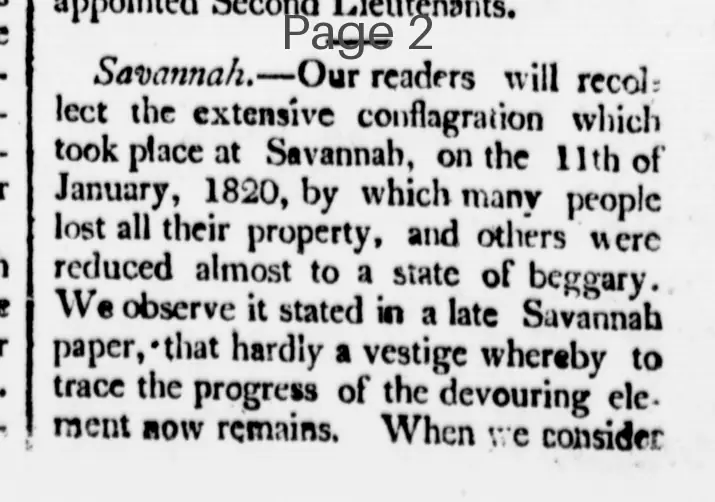
We observe it stated in a late Savannah paper, that hardly a vestige whereby to trace the progress of the devouring element now remains. When we consider
that between 150 and 200 buildings were destroyed, and the unfavorable time last summer to replace these improvements, it must give a favorable impression as to the industry and perseverance of the inhabitants of this unfortunate city. As the buildings in Savannah were principally constructed of wood, it is hoped they have guarded against the like occurrences in substituting brick.
Philad. Union.
What sub-type of article is it?
What keywords are associated?
Where did it happen?
Domestic News Details
Primary Location
Savannah
Event Date
11th Of January, 1820
Outcome
many people lost all their property, and others were reduced almost to a state of beggary; between 150 and 200 buildings were destroyed
Event Details
Extensive conflagration destroyed many buildings; update states hardly a vestige remains, indicating rebuilding with industry and perseverance; buildings were principally wood, hoped to substitute brick