Thank you for visiting SNEWPapers!
Sign up free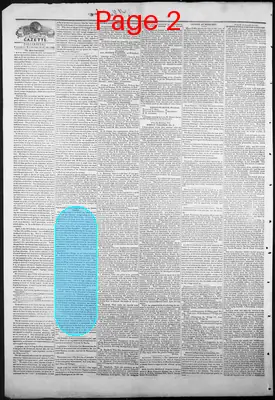
The New Hampshire Gazette
Portsmouth, Rockingham County, New Hampshire
What is this article about?
Political commentary on tensions between Southern and Northern Whigs over alliances with Abolitionists, exemplified by John P. Hale's election in New Hampshire; Southern Whigs decry such coalitions as treacherous and fatal to party unity ahead of 1848 presidential race.
Clipping
OCR Quality
Full Text
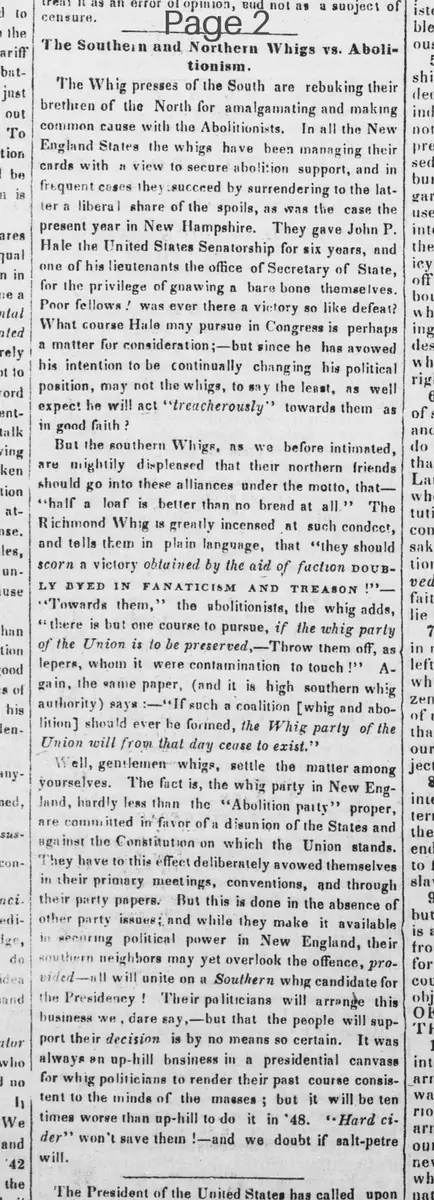
The Whig presses of the South are rebuking their brethren of the North for amalgamating and making common cause with the Abolitionists. In all the New England States the whigs have been managing their cards with a view to secure abolition support, and in frequent cases they succeed by surrendering to the latter a liberal share of the spoils, as was the case the present year in New Hampshire. They gave John P. Hale the United States Senatorship for six years, and one of his lieutenants the office of Secretary of State, for the privilege of gnawing a bare bone themselves. Poor fellows! was ever there a victory so like defeat?
What course Hale may pursue in Congress is perhaps a matter for consideration;—but since he has avowed his intention to be continually changing his political position, may not the whigs, to say the least, as well expect he will act "treacherously" towards them as in good faith?
But the southern Whigs, as we before intimated, are mightily displeased that their northern friends should go into these alliances under the motto, that "half a loaf is better than no bread at all." The Richmond Whig is greatly incensed at such conduct! and tells them in plain language, that "they should scorn a victory obtained by the aid of faction FOULY DYED IN FANATICISM AND TREASON!"
Towards them," the abolitionists, the whig adds, "there is but one course to pursue, if the whig party of the Union is to be preserved,—Throw them off, as lepers, whom it were contamination to touch!" Again, the same paper, (and it is high southern whig authority) says :—"If such a coalition [whig and abolition] should ever be formed, the Whig party of the Union will from that day cease to exist."
Well, gentlemen whigs, settle the matter among yourselves. The fact is, the whig party in New England, hardly less than the "Abolition party" proper, are committed in favor of a disunion of the States and against the Constitution on which the Union stands. They have to this effect deliberately avowed themselves in their primary meetings, conventions, and through their party papers. But this is done in the absence of other party issues; and while they make it available in securing political power in New England, their southern neighbors may yet overlook the offence, provided—all will unite on a Southern whig candidate for the Presidency! Their politicians will arrange this business we, dare say,—but that the people will support their decision is by no means so certain. It was always an up-hill business in a presidential canvass for whig politicians to render their past course consistent to the minds of the masses; but it will be ten times worse than up-hill to do it in '48. “Hard cider” won't save them!—and we doubt if salt-petre will.
What sub-type of article is it?
What themes does it cover?
What keywords are associated?
What entities or persons were involved?
Where did it happen?
Story Details
Key Persons
Location
New England States, New Hampshire, Southern United States
Story Details
Southern Whigs criticize Northern Whigs for allying with Abolitionists to gain political power, such as electing John P. Hale to the Senate in New Hampshire by conceding offices; Southern papers warn that such coalitions threaten the Whig party's unity and survival, predicting disunion sentiments.