Thank you for visiting SNEWPapers!
Sign up free
Richmond Enquirer
Richmond, Richmond County, Virginia
What is this article about?
Report of Mr. Stevenson's speech in Congress on January 23, 1822, opposing the Bankrupt Bill on constitutional grounds, arguing it impairs contract obligations and is inexpedient, citing historical precedents and English failures.
Merged-components note: Continuation of Mr. Stevenson's speech on the Bankrupt Bill across pages 1 and 2.
Clippings
1 of 2
OCR Quality
Full Text
No paper will be discontinued, but at the discretion of the Editors, until all arrearages have been paid up.
Whoever will guarantee the payment of nine papers, shall have a tenth gratis.
TERMS OF ADVERTISING.
One square, or less—First Insertion, 75 cents—each continuance, 50 cents.
No Advertisement inserted, until it has either been paid for, or assumed by some person in this city, or its environs.
[From the National Intelligencer.]
CONGRESSIONAL.
Sketch of Mr. Stevenson's Speech on the Bankrupt Bill.
JANUARY 23, 1822.
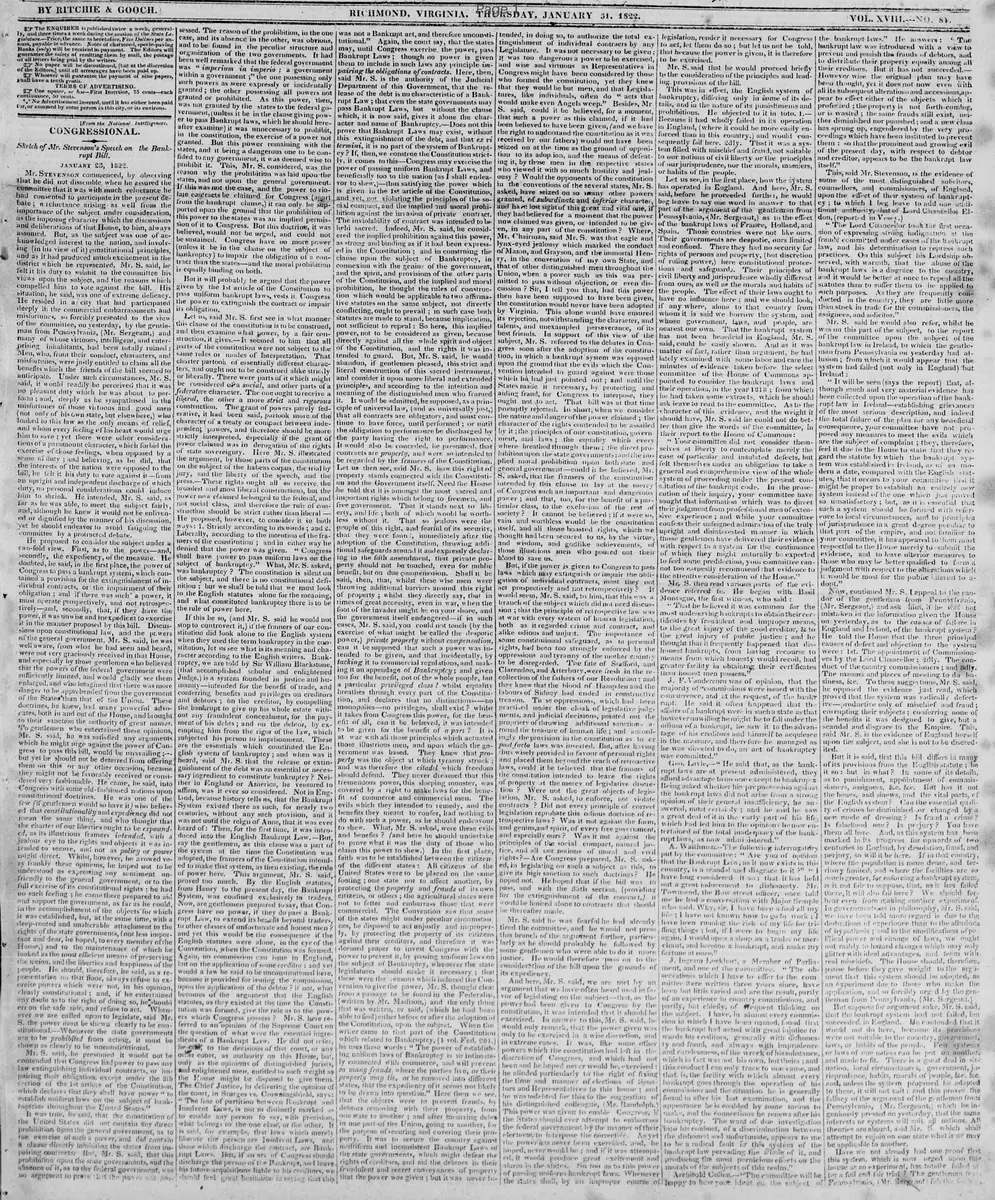
Mr. Stevenson commenced, by observing that he did not dissemble when he assured the committee that it was with much reluctance he had consented to participate in the present debate; a reluctance arising—as well from the importance of the subject under consideration, as the imposing character which the discussions and deliberations of that House, to him, always assumed. But, as the subject was one of acknowledged interest to the nation, and involving (in his view of it) constitutional principles, and as it had produced much excitement in the district which he represented, Mr. S. said, he felt it his duty to submit to the committee his views upon the subject, and the reasons which compelled him to vote against the bill. His situation, he said, was one of extreme delicacy. He resided in a city that had participated deeply in the commercial embarrassments and misfortunes, so forcibly presented to the view of the committee, on yesterday, by the gentleman from Pennsylvania, (Mr. Sergeant,) and many of whose virtuous, intelligent, and enterprising inhabitants, had been totally ruined: Men, who, from their conduct, characters, and misfortunes, were justly entitled to claim all the benefits which the friends of the bill seemed to anticipate. Under such circumstances, Mr. S. said, it would readily be perceived that it was no pleasant duty which he was about to perform; and, deeply as he sympathised in the misfortunes of those virtuous and good men (not only of his own state, but elsewhere,) who looked to this law as the only means of relief, and whom every feeling of his heart would urge him to save; yet there were other considerations of a paramount character, which forbid the exercise of those feelings, when opposed by a sense of duty; and believing, as he did, that the interests of the nation were opposed to the bill, he felt it his duty to vote against it—from an upright and independent discharge of which duty, no personal considerations could induce him to shrink. He intended, Mr. S. said, as far as he was able, to meet the subject fairly, and, although he knew it would not be enlivened or dignified by the manner of his discussion, yet he should endeavor to avoid fatiguing the committee by a protracted debate.
He proposed to consider the subject under a two-fold view. First, as to the power—and, secondly, the expediency, of the measure. He doubted, he said, in the first place, the power of Congress to pass a bankrupt system, which contained a provision for the extinguishment of individual contracts, or the impairment of their obligation; and if there was such a power, it must operate prospectively, and not retrospectively—and, secondly, that, if they have the power, it was unwise and inexpedient to exercise it in the manner proposed by this bill. Discussions upon constitutional law, and the powers of the general government, Mr. S. said, he was well aware, from what he had seen and heard, were not very graciously received in that House, and especially by those gentlemen who believed that the powers of the federal government were sufficiently limited, and would gladly see them enlarged, and who imagined that there was more danger to be apprehended from the government of the States than that of the Union. These doctrines, he knew, had many powerful advocates, both in and out of the House, and brought to their sanction the authority of great names. To gentlemen who entertained these opinions, Mr. S. said, he was satisfied any arguments which he might urge against the power of Congress to pass this bill, would be unavailing—but yet he should not be deterred from offering them on this or any other occasion, because they might not be favorably received or considered very fashionable. He came, he said, into Congress with some old-fashioned notions upon constitutional doctrines. He was one of the few (if gentlemen would so have it) who believed that constitutionality and expediency did not mean the same thing, and who thought that the charter of our liberties ought to be expounded, as its illustrious framers intended, with a jealous eye to the rights and objects it was intended to secure, and not as policy or power might direct. Whilst, however, he avowed very frankly these opinions, he hoped not to be understood as expressing any sentiment unfriendly to the general government, or to the full exercise of its constitutional rights: he had no such feeling; he came there prepared to aid and support the government, as far as he could, in the accomplishment of the objects for which it was established, but, at the same time, with a deep-rooted and unalterable attachment to the rights of the state governments, (not less important and dear, he hoped, to every member of the House,) and to the maintenance of which he looked as the most efficient means of preserving the union, and the liberties and happiness of the people. He should, therefore, said, as a representative on that floor, always refuse to exercise powers which were not, in his opinion, clearly constitutional; and, if he entertained any doubt as to the right of doing so, he should err on the safe side, and refuse to act. Whenever we are called upon to legislate, said Mr. S. the power must be shewn clearly to be constitutional.—Whenever the state governments are to be prohibited from acting, it must be shewn as clearly to be unconstitutional.
Mr. S. said, he presumed it would not be contended that Congress had power to pass any law extinguishing individual contracts, or impairing their obligation, except under the 8th section of the 1st article of the Constitution, which declares that they shall have power "to establish uniform laws on the subject of bankruptcies throughout the United States."
It was true, he said, that the constitution of the United States did not contain any direct prohibition upon the general government, as to the exercise of such a power, and did contain a clause directly inhibiting the states from impairing contracts; But, Mr. S. said, that this prohibition upon the state governments, and the absence of it, as to the federal government, was no argument to prove that the power was possessed. The reason of the prohibition, in the one case, and its absence in the other, was obvious, and to be found in the peculiar structure and organization of the two governments. It had been well remarked that the federal government was "imperium in imperio; a government within a government;" the one possessing only such powers as were expressly or incidentally granted; the other possessing all powers not granted or prohibited. As this power, then, was not granted by the states to the federal government, (unless it be in the clause giving power to pass Bankrupt laws, which he should hereafter examine) it was unnecessary to prohibit, in the constitution, the exercise of a power not granted. But this power remaining with the states, and it being a dangerous one to be confided to any government, it was deemed wise to prohibit it. This, Mr. S. considered, was the reason why the prohibition was laid upon the states, and not upon the general government.
If this was not the case, and the power to violate contracts be claimed for Congress (apart from the bankrupt clause,) it can only be supported upon the ground that the prohibition of this power to the states was an implied permission of it to Congress. But this doctrine, it was believed, would not be urged, and could not be sustained. Congress have no more power (unless it be in the clause on the subject of bankruptcy) to impair the obligation of a contract than the states—and the moral prohibition is equally binding on both.
But it will probably be argued that the power given by the 1st article of the Constitution to pass uniform bankrupt laws, vests in Congress the power to extinguish the contract or impair its obligation.
Let us, said Mr. S. first see in what manner this clause of the constitution is to be construed, and then examine what power, by a fair construction, it gives.—It seemed to him that all parts of the constitution were not subject to the same rules or modes of interpretation. That charter partook of essentially different characters, and ought not to be construed alike strictly or liberally. There were parts of it which might be considered of a social, and other parts of a federative character. The one ought to receive a liberal, the other a more strict and rigorous construction. The grant of powers purely federative, it had been said, partook more of the character of a treaty or compact between independent powers, and therefore should be more strictly interpreted, especially if the grant of power claimed was in derogation of the rights of state sovereignty. Here Mr. S. illustrated the argument, by those parts of the constitution on the subject of the habeas corpus, the trial by jury, and the liberty of the speech, and the press.—These rights ought all to receive, the broadest and most liberal constructions, but the power now claimed belonged to the federal, and not social class, and therefore the rule of construction should be strict rather than liberal—
He proposed, however, to consider it in both ways: 1. Strictly according to its words; and 2. Liberally, according to the intention of the framers of the constitution; and in either way he denied that the power was given. "Congress shall have power to pass uniform laws on the subject of bankruptcy." What, Mr. S. asked, was bankruptcy? The constitution is silent on the subject, and there is no constitutional definition; but we shall be told that we must look to the English statutes alone for the meaning, and what constituted bankruptcy there is to be the rule of power here.
If this be so, (and Mr. S. said he would not stop to controvert it,) if the framers of our constitution did look alone to the English system when they used the term bankruptcy in the constitution, let us see what is its meaning and character according to the English writers. Bankruptcy, we are told by Sir William Blackstone, (that accomplished scholar and enlightened Judge.) is a system founded in justice and humanity—intended for the benefit of trade, and conferring benefits and privileges on creditors and debtors; on the creditor, by compelling the bankrupt to give up his whole estate without any fraudulent concealment, for the payment of his debts; and on the debtor, by exempting him from the rigor of the law, which subjected his person to imprisonment. These are the essentials which constituted the English system of bankruptcy; and when was it heard, said Mr. S. that the release or extinguishment of the debt was an essential or necessary ingredient to constitute bankruptcy? Neither in England or America, he ventured to affirm, was it ever so considered. Not in England, because history tells us, that the Bankrupt System existed there as such, for nearly two centuries, without any such provision, and it was not until the reign of Anne, that it was ever heard of: Then, for the first time, it was introduced into the English Bankrupt Law.—But, say the gentlemen, as this clause was a part of the system at the time the Constitution was adopted, the framers of the Constitution intended to make that system, as then existing, the rule of power here. This argument, Mr. S. said, proved too much. By the English statutes, from Henry to the present day, the Bankrupt System, was confined exclusively to traders. Now, are gentlemen prepared to say, that Congress have no power, if they do pass a Bankrupt Law, to extend its benefit beyond traders, to other classes of unfortunate and honest men? and yet this would be the consequence if the English statutes were alone, in the eye of the Convention, when the Constitution was formed.
Again, no commission can issue in England, but on the application of some creditor: and yet would a law be said to be unconstitutional here, because it provided for issuing the commission, upon the application of the debtor? if not, what becomes of the argument that the English statutes, as they existed at the time the Constitution was formed, give the rule as to the powers which Congress possess? Mr. S. here referred to an opinion of the Supreme Court on the question of what were the essential ingredients of a Bankrupt Law. He did not refer, he said, to the decisions of that court, or any other court, as authority on this House, but only as the opinions of distinguished jurists, and enlightened men, entitled to such weight as the House might be disposed to give them.
The Chief Justice, in delivering the opinion of the court, in Sturges vs. Crowninshield, says: "The line of partition between Bankrupt and Insolvent Laws, is not so distinctly marked as to enable any person to say, with precision, what belongs to the one class, or the other. It is said, for example, that the laws which merely liberate the person are Insolvent Laws, and those which discharge the contract, are Bankrupt Laws. But, if an act of Congress should discharge the person of the Bankrupt, and leave his future acquisitions liable to his creditors, we should feel great hesitation in saying that this was not a bankrupt act, and therefore unconstitutional." Again, the court say, that the states may, until Congress exercise the power, pass Bankrupt Laws; though no power is given them to include in such laws any principle impairing the obligations of contracts. Here, then, said Mr. S. is the authority of the Judicial Department of this Government, that the release of the debt is no characteristic of a Bankrupt Law; that even the state governments may pass Bankrupt Laws, but without the clause which, it is now said, gives it alone the character and name of Bankruptcy.—Does not this prove that Bankrupt Laws may exist, without this extinguishment of the debt, and that ex vi termini, it is no part of the system of Bankruptcy? If, then, we construe the Constitution strictly, it comes to this—Congress may exercise the power of passing uniform Bankrupt Laws, and beneficially too to the nation (as I shall endeavor to shew,)—thus satisfying the power which is given in the 1st article of the Constitution, and yet, not violating the principles of the social compact, and the implied and moral prohibition against the invasion of private contract.
The inviolability of contract was intended to be held sacred. Indeed, Mr. S. said, he considered the implied prohibition against this power, as strong and binding as if it had been expressed in the Constitution; and in construing the clause upon the subject of Bankruptcy, in connexion with the genius of the government, and the spirit, and provisions of the other parts of the Constitution, and the implied and moral prohibition, he thought the rules of construction which would be applicable to two affirmative statutes on the same subject, not directly conflicting, ought to prevail; in such case both statutes are made to stand, because implication, not sufficient to repeal: So here, this implied power, not to be considered as given, because directly against all the whole spirit and object of the Constitution, and the rights it was intended to guard. But, Mr. S. said, he would abandon, if gentlemen pleased, this strict and literal construction of this sacred instrument, and consider it upon more liberal and extended principles, and according to the intention and meaning of the distinguished men who framed it. It would be admitted, he supposed, as a principle of universal law, (and as universally just,) that all contracts are obligatory, and must continue to have force, until performed: or until the obligation to performance be discharged by the party having the right to performance.
It would also be conceded, he presumed, that contracts are properly, and were so intended to be regarded by the framers of the Constitution. Let us then see, said Mr. S. how this right of property stands connected with the Constitution and the Government itself. Need the House be told that it is amongst the most sacred and important rights which belong to freemen, and free government. That it stands next to liberty, and life; both of which would be worthless without it. That so jealous were the people of this right, and fearful of its security, that they were found, immediately after the adoption of the Constitution, throwing additional safeguards around it and expressly declaring in the fifth amendment, that private property should not be touched, even for public benefit, but on due compensation. Shall it be said, then, that, whilst these wise men were throwing additional barriers around this right of property; whilst they directly say, that in times of great necessity, even in war, when the foot of the invader might be on your shore, and the government itself endangered—if in such cases, Mr. S. said, you could not touch (by the exercise of what might be called the despotic power,) private property without compensation, can it be supposed that such a power was intended to be given, and that incidentally, by tacking it to commercial regulations, and making it an appendage of Bankruptcy; and given too for the benefit, not of the whole people, but a particular privileged class! whilst equality breathes through every part of the Constitution, and declares that no distinctions—no monopolies—no privileges, shall exist? whilst it takes from Congress this power, for the benefit of all, can it be believed, it was intended to be given for the benefit of a part? It is at war with all those principles which actuated those illustrious men, and upon which the government was based. They knew that property was the object at which tyranny struck; and was therefore the citadel which freedom should defend. They never dreamed that this tremendous power, this sleeping monster, was covered by a right to make laws for the benefit of commerce and commercial men. The evils which they intended to remedy, and the benefits they meant to confer, had nothing to do with such a power, as he should endeavour to shew. What, Mr. S. asked, were these evils and benefits? (and here he should undertake to prove what it was the duty of those who claim this power to shew.) In the first place, faith was to be established between the citizen of the different states: All citizens of the United States were to be placed on the same footing; one state not to affect another, by protecting the property and frauds of its own citizens, or others; the agricultural states were not to fetter and embarrass those that were commercial. The Convention saw that some of the states might under peculiar circumstances, be disposed to act unjustly and improperly, by protecting the property of its citizens against their creditors. and therefore it was deemed proper to invest Congress with the power to prevent it, by passing uniform Laws on the subject of Bankruptcy, whenever the state legislatures should make it necessary; that these were the reasons which induced the Convention to give the power, Mr. S. thought clear from a passage to be found in the Federalist, (written by Mr. Madison,) and the only thing that was written, or said, (which he had been able to find) either before or after the adoption of the Constitution, upon the subject. When the writer came to that part of the Constitution which related to Bankruptcy, (1 vol. Fed. col.,) he uses these words: "The power of establishing uniform laws of Bankruptcy is so intimately connected with commerce, and will prevent so many frauds, where the parties live, or their property may lie, or be removed into different states, that the expediency of it seems not likely to be drawn into question." Here then we see, that the objects were to prevent frauds, by debtors removing with their property, from one state to another; and after incurring debts in one part of the Union, going to another, for the purpose of securing and covering their property. It was to secure the country against multiform and inconsistent Bankrupt Laws of the state governments, which might defeat the rights of creditors. and aid the debtors in their fraudulent and secret conveyances of property that the trustee
intended, in doing so, to authorize the total extinguishment of individual contracts by any Legislature. It was not necessary to be given; it was too dangerous a power to be exercised, and wise and virtuous as Representatives in Congress might have been considered by those who formed the constitution, yet they knew that they would be but men, and that Legislatures, like individuals, often do "acts that would make even Angels weep." Besides, Mr. S. said, could it be believed, for a moment, that such a power as this claimed, if it had been believed to have been given, (and we have the right to understand the constitution as it was received by our fathers) would not have been seized on at the time as the ground of opposition to its adoption, and the means of defeating it, by those men in the respective states who viewed it with so much hostility and jealousy? Would the opponents of the constitution in the conventions of the several states, Mr. S. asked, have seized on so many other powers granted, of subordinate and inferior character, and have lost sight of this great and vital one, if they had believed for a moment that the power now claimed was given, or intended to be given, in any part of the constitution? Where, Mr. Chairman, said Mr. S. was that eagle and lynx-eyed jealousy which marked the conduct of Mason, and Grayson, and the immortal Henry, in the convention of my own State, and that of other distinguished men throughout the Union, when a power such as this was permitted to pass without objection, or even discussion? Sir, I tell you that, had this power then have been supposed to have been given, the constitution would never have been adopted by Virginia. This alone would have ensured its rejection, notwithstanding the character, and talents, and unexampled perseverance, of its best friends. In support of this view of the subject, Mr. S. referred to the debates in Congress soon after the adoption of the constitution, in which a bankrupt system was opposed upon the ground that the evils which the Convention intended to guard against were those which he had just pointed out; and until the States made it necessary, by protecting and aiding fraud, for Congress to interpose, they ought not to act. That bill was at that time promptly rejected. In short, when we consider the nature and danger of the power claimed; the character of the rights contended to be assailed by it; the principles of our constitution, government, and laws; the equality which everywhere breathed through them; the direct prohibition upon the state governments: and the implied moral prohibition upon both state and general government—could it be believed, Mr. S. asked, that the framers of the constitution intended by this clause to lay at the mercy of Congress such an important and dangerous power; and that, too, for the benefit of a particular class, to the exclusion of the rest of society? It cannot be believed; if it were so, vain and worthless would be the constitution itself, and all those boasted rights, which we thought had been secured to us, by the virtue, and wisdom, and godlike achievements, of those illustrious men who poured out their blood to save us.
But, if the power is given to Congress to pass laws which may extinguish or impair the obligation of individual contracts, must they not act prospectively and not retrospectively? It would seem, Mr. S. said, to him, that this was a branch of the subject which did not need discussion; that the principle of retrospective law was at war with every system of human legislation, both as it regarded crime and contract, and alike odious and unjust. The importance of some constitutional safeguard, as to personal rights, had been too strongly enforced by the oppressions and tyranny of the mother country to be disregarded. The fate of Stafford, and Clarendon, and Atterbury, were fresh in the recollection of the fathers of our Revolution; and they knew that the blood of Hampden and the labours of Sidney had ended in constructive treason. These oppressions, which had been practised under the cloak of legislative judgments, and judicial decisions, pointed out the propriety of throwing additional sanctions around the treasure of human life: and accordingly the provision in the constitution as to ex post facto laws was inserted. But, after having thus wisely provided in favour of personal rights and placed them beyond the reach of retroactive laws, could it be believed that the framers of the constitution intended to leave the rights of property at the mercy of legislative discretion? Were not the great objects of legislation, Mr. S. asked, to enforce, not violate contracts? Did not every principle of correct legislation reprobate this odious doctrine of retrospective laws? Was it not against the form, and genius, and spirit, of every free government, and especially ours? Was it not against the principles of the social compact, natural justice, and all our notions of moral and civil rights?—Are Congress prepared, Mr. S. asked, in legislating on such a subject as this, to give its high sanction to such doctrines? He hoped not. He hoped that if the bill was to pass, and with the 8th section, (providing for the extinguishment of the contract,) it would be limited alone to contracts that should be thereafter made.
Mr. S. said he was fearful he had already tired the committee, and he would not press this branch of the argument further, particularly as he should probably be followed by some gentlemen who were able to do it more justice. He would therefore pass on to the consideration of the bill upon the grounds of its expediency.
And here, Mr. S. said, we are met by an argument that we have often heard used in favor of legislating on the subject—that, as the power had been given to Congress by the constitution, it was intended that it should be exercised. In answer to this, Mr. S. said, he would only remark, that the power given was only to be exercised in a wise discretion, and in extreme cases. It was, like some other powers which the constitution had left in the discretion of Congress, and which had not been and he hoped never would be, exercised: he alluded particularly to the right of fixing the time and manner of elections of Senators and Representatives to this house; and he was indebted for this to the suggestion of his distinguished colleague, (Mr. Randolph.) This power was given to enable Congress, if the States should ever attempt to embarrass the federal government by the manner of their elections, to interpose the corrective. As yet the power has never been exercised, and, he hoped, never would be; and if it was attempted, it would produce great excitement and alarm in the states. So too as to this power of passing uniform bankrupt laws. Whenever the states shall, by an improper course of
legislation, render it necessary for Congress to act, let them do so; but let us not be told, that because the power is given, it is therefore to be exercised.
Mr. S. said that he would proceed briefly to the consideration of the principles and leading-provisions of the bill. This was in effect, the English system of bankruptcy, differing only in some of its details, and in the nature of its punishments and prohibitions. He objected to it in toto. 1.—Because it had wholly failed in its operation in England, (where it could be more easily enforced than in this country.) and would consequently fail here. 2dly. That it was a system filled with mischief and fraud, not suitable to our notions of civil liberty or the principles of our jurisprudence, nor the morals, manners, or habits of the people.
Let us see, in the first place, how the system has operated in England. And here, Mr. S. said, before he proceeded further, he would beg leave to say one word in answer to that part of the argument of the gentleman from Pennsylvania, (Mr. Sergeant,) as to the effect of the bankrupt laws of France, Holland, and Spain. Those countries were not like ours. Their governments are despotic, ours limited and confined. There they had no security for rights of persons and property, (but discretion of ruling power,) here constitutional protections and safeguards. Their principles of civil liberty and jurisprudence wholly different from ours, as well as the morals and habits of the people. The effect of their laws ought to have no influence here: and we should look, if anywhere, alone to that country from whom it is said we borrow the system, and whose government, laws, and people, are nearest our own. That the bankrupt system has not been beneficial in England, Mr. S. said, could be easily shown. And as it was matter of fact, rather than argument, he had lately examined with some labor and care the minutes of evidence taken before the select committee of the House of Commons appointed to consider the bankrupt laws and their operation, in the year 1818; from which he had taken some extracts, which he should ask leave to read to the committee. As to the character of this evidence, and the weight it should have, Mr. S. said he could not do better than give the words of the committee, in their report to the House of Commons:
"Your committee did not consider themselves at liberty to contemplate merely the case of particular and insulated defects, but felt themselves under an obligation to take a general and comprehensive view of the whole system of proceeding under the present constitution of the bankrupt code. In the prosecution of their inquiry, your committee have sought that information which was to direct their judgment from professional men of extensive experience; and while your committee confess their unfeigned admiration of the truly upright and disinterested manner in which those gentlemen have delivered their evidence with respect to a system for the continuance of which they might naturally be expected to feel some predilection, your committee cannot too earnestly recommend that evidence to the attentive consideration of the House."
Mr. S. then read various parts of the evidence referred to. He began with Basil Montague, the first witness, who said:
"That he believed it was common for the most undeserving bankrupts to obtain their certificates by fraudulent and improper means, to the great injury of the good creditor, & to the great injury of public justice; and he thought that it frequently happened that dishonest bankrupts, from having recourse to means from which honesty would recoil, had greater facility in obtaining their certificates than honest men possess."
J. F. Vandercook was of opinion, that the majority of commissions were issued with the concurrence, and at the request, of the bankrupt. He said it often happened that the affairs of a bankrupt were in such a state as that however unwilling he might be to fall under the odium of a bankrupt, he saw it to the advantage of his creditors and himself to acquiesce in the measure, and therefore he managed as he was directed to do, an act of bankruptcy was committed."
Geo. Lavie—"He said that, as the bankrupt laws are at present administered, they afford advantage to no one except to bankrupts. Being asked whether his prepossession against the bankrupt laws did not arise from a strong opinion of their general inefficiency, he answered, most certainly; and he said he saw a great deal of it in the early part of his life, which had led him to the opinion; he now entertained of the total inadequacy of the bankrupt laws, as now administered."
A. Waithman,—The following interrogatory put by the committee: "Are you of opinion that the Bankrupt Law, as it now exists in this country, is a scandal and disgrace to it?" "I have long considered it so: that it has held out a great inducement to dishonesty. Mr. Townsend, the Bow street officer, once told me he had a conversation with Major Semple who said, Why, sir, I have been a fool all my life; I have not known how to go to work; I have been running the risk of my life for trifling things: but, if I were to begin my life again, I would open a shop as a trader or merchant, and become a bankrupt, and make my fortune at once."
J. Ingram Lockhart, a Member of Parliament, and one of the committee. "The observations which I have to offer to the committee were written three years since, have been but little varied and are the result, partly of an experience in country commissions, and partly, but chiefly, of frequent thinking on the subject. I have, in almost every commission in which I have been named, found that the bankrupt had acted with great injustice towards his creditors, generally with dishonesty and fraud, and always with imprudence and carelessness, of the wreck of his substance, which in fact was got his own, but theirs; and this conduct I can only trace to one cause, and that is, the facility with which almost every bankrupt goes through the operation, of his commission and the situation he is generally found in after his last examination, and the appearance he is enabled by some means to make, and the connections he renews after his bankruptcy. The want of due investigation into his conduct, of a discrimination between the dishonest and unfortunate, appears to me to be a radical fault in this system of the bankrupt law pervading the whole of it, and producing the most pernicious effects on the morals of the subjects of this realm."
Archibald Cullen.—"The committee will be happy to hear your ideas on the subject of the bankrupt laws." He answers:
"The bankrupt law was introduced with a view to prevent and punish the frauds of debtors, and to distribute their property equally among all their creditors. But it has not succeeded.—However wise the original plan may have been thought, yet it does not now even with all its subsequent alterations and accessions, appear to effect either of the objects which it professed; the property is not forth-coming, or is wasted; the same frauds still exist, neither diminished nor punished; and a new class has sprung up, engendered by the very proceedings which have been instituted to prevent them: so that the prominent and growing evil of the present day, with respect to debtor and creditor, appears to be the bankrupt law itself."
This, said Mr. Stevenson, is the evidence of some of the most distinguished solicitors, counsellors, and commissioners, of England, upon the effect of their system of bankruptcy; to which I beg leave to add one additional authority, that of Lord Chancellor Eldon, (reported in Vesey’s.)
"The Lord Chancellor took the first occasion of expressing strong indignation at the frauds committed under cases of the bankrupt law, and his determination to repress such practices. On this subject his Lordship observed, with warmth, that the abuse of the bankrupt laws is a disgrace to the country, and it would be better at once to repeal all the statutes than to suffer them to be applied to such purposes. As they are frequently conducted in the country, they are little more than stock in trade for the commissioners, the assignees, and solicitor."
Mr. S. said he would also refer, whilst he was on this part of the subject, to the report of the committee upon the subject of the bankrupt law in Ireland, to which the gentleman from Pennsylvania on yesterday had allusion: from which it would appear that the system had failed (not only in England) but Ireland:
"It will be seen (says the report) that, although much and very material evidence has been collected upon the operation of the bankrupt law in Ireland—establishing grievances of the most serious description, and indeed the total failure of the plan for any beneficial consequence, your committee have not proposed any measures to meet the evils which are the subject of complaint; they, therefore, feel it due to the House to state that they regard the statute by which the bankrupt system was established in Ireland, as of so modern a date, compared with the English statutes, that it occurs to your committee, that it might be proper to establish an entirely new system instead of the one which has proved so unsatisfactory: but, as it is essential that such a system should be formed with reference to local circumstances, and to principles of jurisprudence in a great degree peculiar to that part of the empire, and not familiar to your committee, it has appeared to them most respectful to the House merely to submit the evidence, and to leave ulterior measures to those who may be better qualified to form a judgment with respect to the alterations which it would be most for the public interest to adopt."
Now, continued Mr. S. I appeal to the candor of the gentleman from Pennsylvania, (Mr. Sergeant.) and ask him, if he was not mistaken in the information given the House on yesterday, as to the causes of failure in England and Ireland, of the bankrupt system? He told the House that the three principal causes of defect and objection to the system were: 1st. The appointment of Commissioners by the Lord Chancellor; 2dly. The conduct of the country commissioners; and 3dly. The manner and places of meeting to do business, &c. To these suggestions, Mr. S. said, he opposed the evidence just read, which proved that the system was radically defective—productive only of mischief and fraud; corrupting their subjects; conferring none of the benefits it was designed to give, but a scandal and disgrace to the Empire. This, said Mr. S. is the evidence of England herself upon the subject, and she is not to be discredited.
But it is said, that this bill differs in many of its provisions from the English statute; be it so: but in what? In some of its details. as to punishment, appointment of commissioners, assignees, &c. &c. But has it not the bones, and sinews, and the vital parts, of the English system? Can the essential quality of crimes be diminished or changed by a new mode of dressing? Is fraud a crime? Is forgery one? Is perjury? You have them all here. And, as this system has been marked in its progress for upwards of two centuries in England. by desolation, fraud, and perjury, so will it be here. If in that country, where the population is more dense, and territory limited, and where the facilities are so much greater, for enforcing a bankrupt system, is it not fair to suppose, that. as it has failed there, it will also fail here? We should forbear even from making another experiment. In governments, as in philosophy, Mr. S. said, we have been told more regard is due to the deductions of experience than to the allusions of hypothesis; and in the modifications of political power and change of laws, we ought not rashly to hazard changes which may only glitter with ideal advantages, and teem with real mischiefs. The House should. therefore. pause before they gave weight to the argument that this system should be adopted, as an experiment due to those who make the application, and so forcibly urged by the gentleman from Pennsylvania, (Mr. Sergeant.)
But suppose for argument sake, Mr. S. said, that the bankrupt system had not failed, but succeeded. in England. He contended that it would not do here, because its provisions were not suitable to the country, government, laws, or habits of the people. Few systems or laws of one nation can be put on another. and made to fit. There is a great deal in situation, local circumstances, government, jurisprudence, habits, morals of people, &c. &c. and, unless the system proposed is adapted to these, it will not suit: and this proves the fallacy of the argument of the gentleman from Pennsylvania, (Mr. Sergeant,) which he ingeniously pressed on yesterday, that the same interests or systems will suit all nations. All theories are absurd, said Mr. S. which shall attempt to enjoin on one state what is or may be applicable to another.
Have we not already had one proof that this system, which is now urged upon this house as an experiment, has totally failed at home for a full and fair trial? The gentleman from Pennsylvania, (Mr. Sergeant) felt the—
his objection, and ingenuously endeavored to avoid it, by impressing the house with the opinion that the old bankrupt law of 1800 was the offspring of party, and was ushered into being amidst the storms and excesses of party spirit, and therefore unpopular. &c. Of this fact, Mr. S. said, he could with certainty say nothing, being too young to know any thing personally of the occurrences of those times, but he might venture to say that, from the course of events which succeeded the coming in of the republican party, that the gentleman from Pennsylvania, (Mr. Sergeant,) was mistaken in the fact. We all know, Mr. S. said, there were certain laws which passed under what was termed the federal administration, and believed to be of a party character, which were, consequently, unpopular to the new administration, and continued to be so until repealed; the judiciary and bankrupt laws Mr. S. particularly alluded to—the one was directly repealed, and the other expired.— But if this bankrupt law had been considered in those days of heat and contest, as a party-measure, and intended as such, to be saddled on the nation by a party going out of power, rely on it, among the first acts done by the new administration, would have been the repeal of this law—it would have been expunged from the statute book which it stained, and not suffered to linger out an existence of so many years. Mr. S. said he therefore felt justified in saying that the fact was not as the gentleman from Pennsylvania, (Mr. Sergeant,) had supposed; the law of 1800 was passed, (and he said it too in honor of the Congress that passed it,) from other and better motives—as an experiment called for at that time by the commercial part of the country, and which expired under the weight of its own sins. It ought then to be considered as a fair experiment, which the enemies of this bill had a right to claim, and which should have weight with the house. But, said Mr. S. let us see what are the evils which are likely to arise under this system if it were to be adopted; among many the following may be taken at the most prominent: 1st. It will induce persons to contract debts, without any regard to the means by which they may be discharged, to the injury of the commerce and credit of the country. 2d. By the great increase of litigation and expense to the people, by the number of courts, commissioners, changes of the board, conflicting decisions, &c. 3d. The facility with which fictitious debts will be proved, (by ex parte affidavits) and consequent frauds, forgeries, and perjuries. 4th. The difficulty of dividing the property of the bankrupt early, getting it out of the hands of assignees, and preventing them from speculating on it, &c. 5th. The mismanagement of assignees, and want of sufficient motives to insure activity and attention on their part to the affairs of the bankrupt. 6th. The ease with which undeserving men will get certificates, and the absence of all discrimination between culpability and misfortune. Besides these objections, there are others of a much stronger character. What, said Mr. S. shall be said of the power given to these commissioners, to issue a warrant to any one authorizing the seizure, in any part of the Union, of a man declared a bankrupt, and giving the right of dragging him from one quarter of this continent to the other? Whilst the murderer, who commits homicide in one state, and flies to another, cannot be pursued and re-taken, but must be applied for through the Executive authority of the state where he may be, a power is here given to a commissioner—no, to an acquitted felon, if the commissioner chooses to appoint one, a man without character and property, to seize, and carry, as a prisoner, a free man from one end of the Union to another—and no remedy provided by the bill for any abuse of this power— whilst no officer in one state can go into another, this man named by the commissioner not sworn holding no office, and destitute of character and responsibility, is to be clothed with a power so unlimited and so dangerous to the personal liberty and rights of the citizens! Again, by the 5th and 21st sections of this bill, the right is given the Commissioners to issue their warrant directing any one to break open the houses, chambers, doors, trunks, or chests of the bankrupt, and take possession of his papers, goods, and effects, upon what they may consider to be probable cause, in direct violation, Mr. S. said, of the spirit, if not the letter of the constitutional provision which declares, "that the right of the people, to be secure in their persons, houses, papers, and effects, against unreasonable seizures, shall not be violated." But there was another provision of this bill still more odious and detestable, and at war with all the best feelings of the human heart —it was that section which authorized the punishment by imprisonment of the child, the devoted daughter, who should attempt to aid her ruined and wretched father! What are we to think of a system which denounces, as criminal, acts that bring to their support the highest moral and religious sanctions; a system which requires to be sustained by tearing loose all those endearing and filial ties, which unite, indissolubly, the parent and child, and which dignify and adorn the female character? Mr. S. said that he was confident there could be but one sentiment in the Committee upon this feature in the bill, and that was of the strongest reprobation: He urged the committee to reject, whilst they had it in their power, this bill, freighted, as he believed it was, with the most ruinous and dangerous consequences to the best interests of the nation; and concluded by declaring it as his opinion, that, if it passed, the people of this country would have cause ceaselessly to deplore its defects, and imprecate its continuance.
What sub-type of article is it?
What themes does it cover?
What keywords are associated?
What entities or persons were involved?
Where did it happen?
Story Details
Key Persons
Location
Congress
Event Date
January 23, 1822
Story Details
Mr. Stevenson delivers a speech opposing the Bankrupt Bill, arguing Congress lacks constitutional power to impair contracts, the bill is inexpedient based on English failures, and it violates personal liberties.