Thank you for visiting SNEWPapers!
Sign up free
The New Hampshire Gazette And General Advertiser
Portsmouth, Exeter, Rockingham County, New Hampshire
What is this article about?
In a letter to the New-Hampshire Gazette, 'A Whig' rebuts arguments for confiscating estates of absentees from the American Revolution, contending that wives and children retain natural, common law, and civil rights to the property they possess, criticizing such seizures as unjust and contrary to principles of justice and family protection.
Clipping
OCR Quality
Full Text
Melcher's PRINTERS.
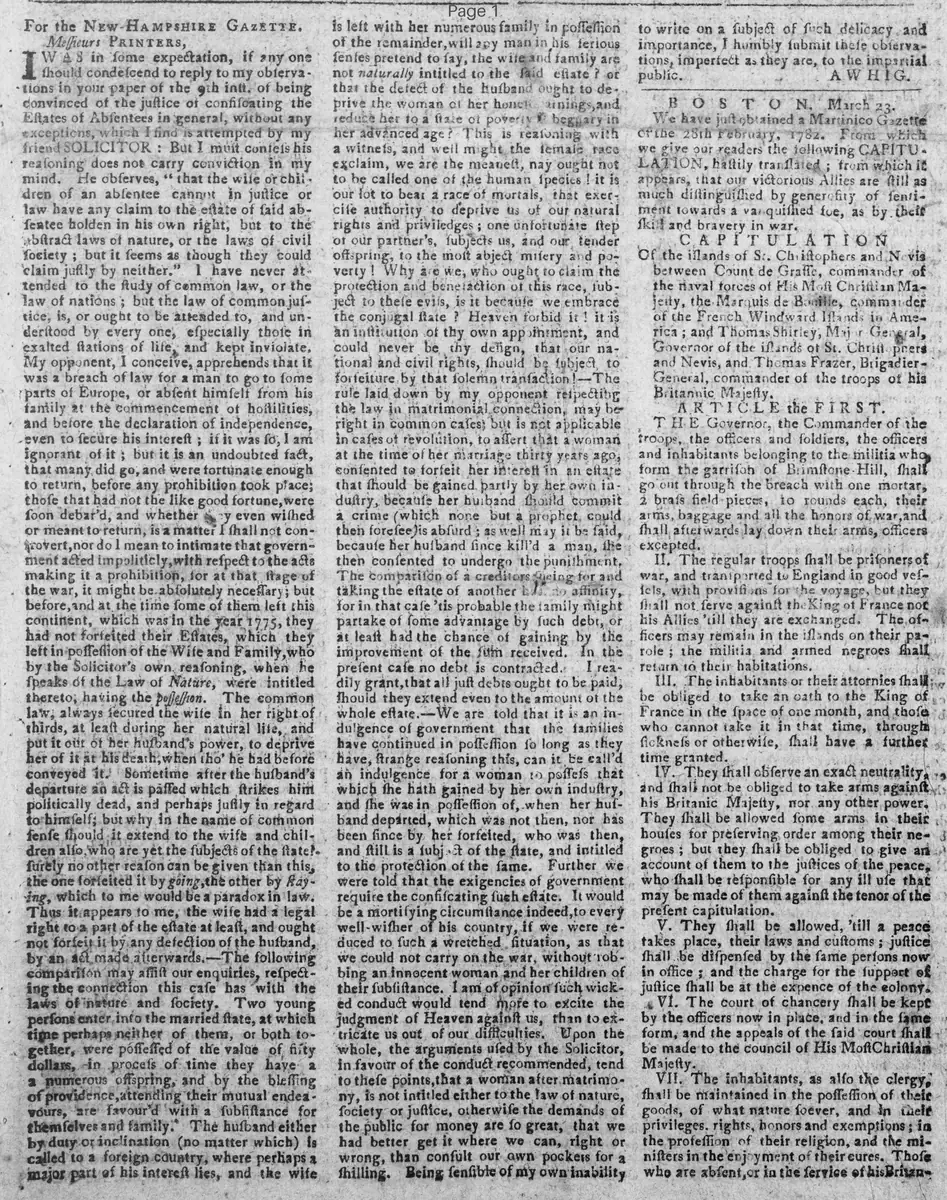
I was in some expectation, if anyone should condescend to reply to my observations in your paper of the 6th inst. of being convinced of the justice of confiscating the estates of absentees in general, without any exceptions, which I find is attempted by my friend SOLICITOR: But I must confess his reasoning does not carry conviction in my mind. He observes, "that the wife or children of an absentee cannot in justice or law have any claim to the estate of said absentee holden in his own right, but to the abstract laws of nature, or the laws of civil society: but it seems as though they could claim justly by neither." I have never attended to the study of common law, or the law of nations: but the law of common justice, is, or ought to be attended to, and understood by everyone, especially those in exalted stations of life, and kept inviolate. My opponent, I conceive, apprehends that it was a breach of law for a man to go to some parts of Europe, or absent himself from his family at the commencement of hostilities, and before the declaration of independence, even to secure his interest: if it was so, I am ignorant of it; but it is an undoubted fact, that many did go, and were fortunate enough to return, before any prohibition took place; those that had not the like good fortune, were soon debarred, and whether they even wished or meant to return, is a matter I shall not controvert, nor do I mean to intimate that government acted impolitically, with respect to the acts making it a prohibition, for at that stage of the war, it might be absolutely necessary: but before, and at the time some of them left this continent, which was in the year 1775, they had not forfeited their estates, which they left in possession of the wife and family, who by the Solicitor's own reasoning, when he speaks of the Law of Nature, were entitled thereto; having the possession. The common law always secured the wife in her right of thirds, at least during her natural life: and put it out of her husband's power, to deprive her of it at his death, when tho' he had before conveyed it. Sometime after the husband's departure an act is passed which strikes him politically dead, and perhaps justly in regard to himself: but why in the name of common sense should it extend to the wife and children also, who are yet the subjects of the state? Surely no other reason can be given than this, the one forfeited it by going, the other by staying, which to me would be a paradox in law. Thus it appears to me, the wife had a legal right to a part of the estate at least, and ought not forfeit it by any defection of the husband, by an act made afterwards. The following comparison may assist our enquiries, respecting the connection this case has with the laws of nature and society. Two young persons enter into the married state, at which time perhaps neither of them, or both together, were possessed of the value of fifty dollars, in process of time they have a numerous offspring, and by the blessing of providence, attending their mutual endeavours, are favoured with a subsistence for themselves and family. The husband either by duty or inclination (no matter which) is called to a foreign country, where perhaps a major part of his interest lies, and the wife is left with her numerous family in possession of the remainder, will any man in his serious senses pretend to say, the wife and family are not naturally entitled to the said estate? or that the defect of the husband ought to deprive the woman of her honest earnings, and reduce her to a state of poverty beggary in her advanced age? This is reasoning with a witness, and well might the female race exclaim, we are the meanest, nay ought not to be called one of the human species! it is our lot to bear a race of mortals, that exercise authority to deprive us of our natural rights and privileges; one unfortunate step of our partner's, subjects us, and our tender offspring, to the most abject misery and poverty! Why are we, who ought to claim the protection and benediction of this race, subject to these evils, is it because we embrace the conjugal state? Heaven forbid it! it is an institution of thy own appointment, and could never be thy design, that our national and civil rights, should be subject to forfeiture, by that solemn transaction! The rule laid down by my opponent respecting the law in matrimonial connection, may be right in common cases; but is not applicable in cases of revolution, to assert that a woman at the time of her marriage thirty years ago; consented to forfeit her interest in an estate that should be gained, partly by her own industry, because her husband should commit a crime (which none but a prophet could then foresee) is absurd: as well may it be said, because her husband since killed a man, she then consented to undergo the punishment. The comparison of a creditor's seizing for and taking the estate of another bears no affinity, for in that case 'tis probable the family might partake of some advantage by such debt, or at least had the chance of gaining by the improvement of the sum received. In the present case no debt is contracted. I readily grant, that all just debts ought to be paid, should they extend even to the amount of the whole estate. We are told that it is an indulgence of government that the families have continued in possession so long as they have, strange reasoning this, can it be called an indulgence for a woman to possess that which she hath gained by her own industry, and she was in possession of, when her husband departed, which was not then, nor has been since by her forfeited, who was then, and still is a subject of the state, and entitled to the protection of the same. Further we were told that the exigencies of government require the confiscating such estate. It would be a mortifying circumstance indeed, to every well-wisher of his country: if we were reduced to such a wretched situation, as that we could not carry on the war, without robbing an innocent woman and her children of their subsistence. I am of opinion such wicked conduct would tend more to excite the judgment of Heaven against us, than to extricate us out of our difficulties. Upon the whole, the arguments used by the Solicitor, in favour of the conduct recommended, tend to these points, that a woman after matrimony, is not entitled either to the law of nature, society or justice, otherwise the demands of the public for money are so great, that we had better get it where we can, right or wrong, than consult our own pockets for shilling. Being sensible of my own inability to write on a subject of such delicacy and importance, I humbly submit these observations, imperfect as they are, to the impartial public.
A WHIG.
What sub-type of article is it?
What themes does it cover?
What keywords are associated?
What entities or persons were involved?
Letter to Editor Details
Author
A Whig.
Recipient
Melcher's Printers
Main Argument
the confiscation of absentees' estates unjustly deprives loyal wives and children of their natural, common law, and civil rights to property possessed before any forfeiture acts, as such seizures punish the innocent for the husband's actions and contradict principles of justice and family protection.
Notable Details