Thank you for visiting SNEWPapers!
Sign up free
Alexandria Gazette
Alexandria, Alexandria County, District Of Columbia
What is this article about?
In a March 14, 1845, letter to the Alexandria Gazette, John S. Pendleton responds to rival congressional candidate Jeremiah Morton's recent publication, defending his political evolution from Jackson supporter to Whig, critiquing Morton's tactics and ambitions in Virginia's 9th district election, and urging a courteous canvass while ready for confrontation.
Clipping
OCR Quality
Full Text
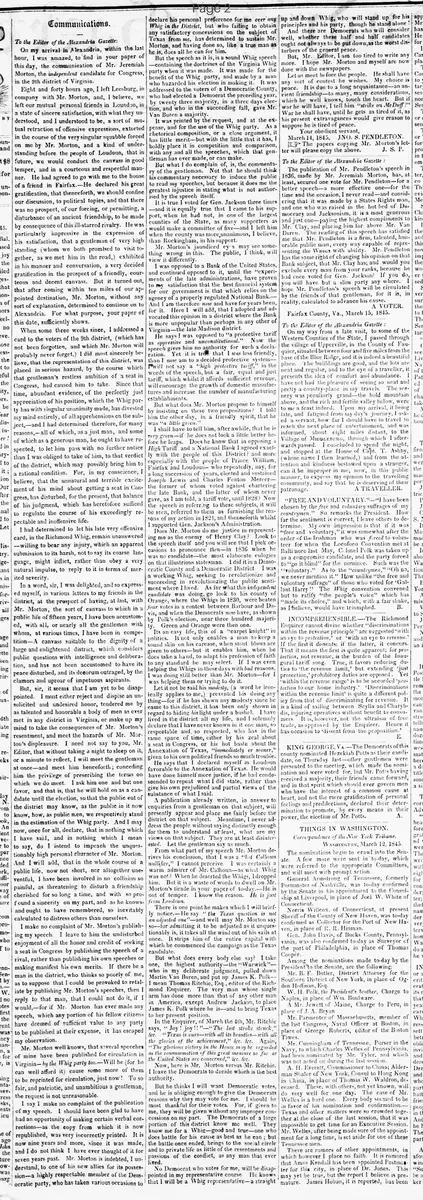
To the Editor of the Alexandria Gazette:
On my arrival in Alexandria, within the last hour, I was amazed, to find in your paper of this day, the communication of Mr. Jeremiah Morton, the independent candidate for Congress, in the 9th district of Virginia. Eight and forty hours ago, I left Leesburg, in company with Mr. Morton, and, I believe, we left our mutual personal friends in Loudoun, in a state of sincere satisfaction, with what they understood, and I understood to be, a sort of mutual retraction of offensive expressions, extorted in the course of the very singular squabble forced on me by Mr. Morton, and a kind of understanding before the people of Loudoun, that in future, we would conduct the canvass in good temper, and in a courteous and respectful manner. He had agreed to go with me to the house of a friend in Fairfax. He declared his great gratification, that thenceforth, we should confine our discussion, to political topics, and that there was no prospect, of our forcing, or permitting, a disturbance of an ancient friendship, to be made by consequence of this ill-starred rivalry. He was particularly impressive in the expression of his satisfaction, that a gentleman of very high standing (whom we both promised to visit together, as we met him in the road,) exhibited in his manner and conversation, a very decided gratification in the prospect of a friendly, courteous and decent canvass. But it turned out, that after coming within ten miles of our appointed destination, Mr. Morton, without any sort of explanation, determined to continue on to Alexandria. For what purpose, your paper of this date, sufficiently shows.
When some three weeks since, I addressed a card to the voters of the 9th district, (which has not been forgotten, and which Mr. Morton will probably never forget,) I did most sincerely believe, that the representation of this district, was placed in serious hazard, by the course which that gentleman's restless ambition of a seat in Congress, had caused him to take. Since that time, abundant evidence, of the perfectly just appreciation of his position, which the Whig party has with singular unanimity made, has divested my mind entirely, of all apprehensions on the subject,--and I had determined therefore, for many reasons,--all of which, as a just man, and some of which as a generous man, he ought to have respected, to let him pass with no further notice than I was obliged to take of him, to that verdict of the district, which may possibly bring him to a rational condition. For, in my conscience, I believe, that the unnatural and terrible excitement of his mind about getting a seat in Congress, has disturbed, for the present, that balance of his judgment, which has heretofore sufficed to regulate the course of his exceedingly respectable and inoffensive life.
I had determined to let his late very offensive card, in the Richmond Whig, remain unanswered--willing to bear any injury, which an apparent submission to its harsh, not to say its coarse language, might inflict, rather than obey a very natural impulse, to reply to it in terms of merited severity.
In a word, sir, I was delighted, and so expressed myself, in various letters to my friends in the district, at the prospect of having, at last, with Mr. Morton, the sort of canvass to which in a public life of fifteen years, I have been accustomed, with all, or nearly all the gentlemen with whom, at various times, I have been in competition--A canvass suitable to the dignity of a large and enlightened district, which considers public questions with intelligence and deliberation, and has not been accustomed to have its peace disturbed, and its decorum outraged, by the clamors and uproar of impetuous aspirants.
But, sir, it seems that I am yet to be disappointed. I must either reject and despise an unsolicited and undesired honor, tendered me by as talented and honorable a body of men as ever met in any district in Virginia, or make up my mind to take the consequences of Mr. Morton's resentment, and meet the hazards of Mr. Morton's displeasure. I need not say to you, Mr. Editor, that without taking a night to sleep on it, or a minute to reflect, I will meet the gentleman at once--and meet him henceforth; conceding him the privilege of prescribing the terms on which we do meet. I ask him one and but one favor, and that is, that he will hold on as a candidate until the election, so that the public out of the district may know, as the public in it now know, how, as public men, we respectively stand in the estimation of the Whig party. And I may now, once for all, declare, that in nothing which I have said, and in nothing which I mean to say, do I intend to impeach the unquestionably high personal character of Mr. Morton. And I will add, that in the whole course of a public life, now not short, nor altogether uneventful, I have been involved in no collision so painful, as threatening to disturb a friendship cherished for so long a time, and with so profound a sincerity on my part, and as he knows and ought to have remembered, so inevitably calculated to distress others than ourselves.
I make no complaint of Mr. Morton's publishing my speech. I leave to him the undisturbed enjoyment of all the honor and credit of seeking a seat in Congress by publishing the speech of a rival, rather than publishing his own speeches or making manifest his own merits. If there be a man in the district, who thinks so poorly of me, as to suppose that I could be provoked to retaliate by publishing Mr. Morton's speeches, then I reply to that man, that I could not do it, if I would,--for if Mr. Morton has ever made any speech, which any portion of his fellow citizens have deemed of sufficient value to any party to be published at their expense, it has escaped my observation.
Mr. Morton well knows, that several speeches of mine have been published for circulation in Virginia-- by the Whig party too.--Will he (for he can well afford it) cause some more of them to be reprinted for circulation, just now! To so fair, and patriotic, and unambitious a gentleman, the request is not unreasonable.
I say I make no complaint of the publication of my speech. I should have been glad to have had an opportunity of making certain verbal corrections--as the copy from which it is now republished, was very incorrectly printed. It is now nine years and more, since it was made, and I do not think I have ever thought of it for seven years past. Mr. Morton is indebted, I understand, to one of his new allies for its possession--a highly respectable member of the Democratic party, who has taken various occasions to declare his personal preference for me over any Whig in the District, but who failing to obtain any satisfactory concessions on the subject of Texas from me, has determined to sustain Mr. Morton, and having done so, like a true man as he is, does all he can for him.
But the speech as it is, is a sound Whig speech ---containing the doctrines of the Virginia Whig party when it was made. It was made for the benefit of the Whig party, and made by a man who hazarded his election in making it. It was addressed to the voters of a Democratic County, who had elected a Democrat the preceding year, by twenty three majority, in a three days election, and who in the succeeding fall, gave Mr. Van Buren a majority.
It was printed by the request, and at the expense, and for the use of the Whig party. As a rhetorical composition, or a close argument, it has little merit--but with the little that it has, I boldly place it in competition and comparison, with any and all the speeches, which that gentleman has ever made, or can make.
But what I do complain of, is, the commentary of the gentleman. Not that he should think his commentary necessary to induce the public to read my speeches, but because it does me the greatest injustice in stating what is not authorized by the speech itself.
It is true I voted for Gen. Jackson three times --and it is equally true that I came to his support, when he had not, in one of the largest counties of the State, as many supporters as would make a committee of five--and I left him when the county was more unanimous, I believe, than Rockingham, in his support.
Mr. Morton's jaundiced eyes may see something wrong in this. The public, I think, will view it differently.
I was opposed to a Bank of the United States, and continued opposed to it, until the "experiments of the late administrations, have proven to my satisfaction that the best financial system for our government is that which relies on the agency of a properly regulated National Bank.-- And I am therefore now and have for years been, for it. Here I will add, that I adopted and advocated this opinion in a district where the Bank is more unpopular than perhaps in any other of Virginia--the late Madison district.
He says I was opposed to "a protective tariff as oppressive and unconstitutional." Now the speech gives him no authority for such a declaration. Yet it is true that I was less friendly than I now am to a decided protective system-- I will not say a "high protective tariff," in the words of the speech, but a fair, equal and just tariff, which whilst it affords sufficient revenue, will encourage the growth of domestic manufactures and increase the number of manufacturing establishments.
But what does Mr. Morton propose to himself by insisting on these two propositions? I told him the other day, in a friendly spirit, that he was "a little green."
I shall have to tell him, after awhile, that he is very green--if he does not look a little better before he leaps. Does he know that in opposing High Tariff and a National Bank I agreed exactly with the people of this District: and more especially with the people of Prince William, Fairfax and Loudoun-- who repeatedly, nay, for a long succession of years, elected and sustained Joseph Lewis and Charles Fenton Mercer-- the former of whom voted against chartering the late Bank, and the latter of whom never gave, as I am told, a tariff vote, until 1828? Now the speech in referring to these subjects, it will be seen, referred to them as furnishing the reasons of my action in 1821, and thenceforth whilst I supported Gen. Jackson's Administration.
Does Mr. Morton do me justice in representing me as the enemy of Henry Clay? Look to the speech itself and you will see that I pick occasions to pronounce then--in 1836 when he was no candidate--the most elaborate eulogies on that illustrious statesman. I did it in a Democratic County and a Democratic District I was a working Whig, seeking to revolutionize and succeeding in revolutionizing the public sentiment where I lived. As for what this independent candidate was doing, go look to his county of Orange, where the Whigs in 1830, were beaten four votes in a contest between Barbour and Davis, and when the Democrats now have, as shown by Polk's election, near three hundred majority. Green and Orange were then one.
Its an easy life, this of a "carpet knight" in politics. It not only enables a man to keep a sound skin on his carcase, when stout blows are given to others--but it enables him, when he does take a hand, to adapt his profession of faith to any standard he may select. If I was even helping the Whigs in those days with bad reasons. I was doing still better than Mr. Morton--for I was helping them or trying to do it.
Let it not be said his modesty, (a word he ironically applies to me,) prevented his doing any thing--for if he has shewn any modesty since he came to this district, it has been only shown in regard to hiding his light under a bushel. I have lived in the district all my life, and I solemnly declare that I have never known in it one man, so respectable and so respected, who has in the same space of time, either by his zeal about a seat in Congress, or his hot haste about the Annexation of Texas, "immediately or sooner," given to his own political friends so much trouble.
He says that I declared myself in Loudoun favorable to the Annexation of Texas. He would have done himself more justice, if he had condescended to repeat what I did state, rather than give his own prejudiced and partial views of the substance of what I said.
A publication already written, in answer to enquiries from a gentleman on that subject, will presently appear and place me fairly before the district on that subject. Meantime, I never address the people without saying distinctly enough for them to understand at least, what are my views on that subject. They are at least disinterested. Let the gentleman say as much.
From what part of my speech Mr. Morton derives his conclusion, that I was a "hot Calhoun nullifier," I cannot perceive. I was certainly a warm admirer of Mr. Calhoun--as what Whig was not? When he deserted the Whigs. I dropped him. But it is a waste of words to dwell on Mr. Morton's tirade in your paper of to-day.--He is out of temper. I know the reason. He is just from Loudoun.
There is one point he makes which I will briefly notice.--He say " the Texas question is not an adjusted one"--and well may Mr. Morton say so--for admitting it to be adjusted as it unquestionably is, it takes all the wind out of his sails at once. It strips him of the entire capital with which he commenced the campaign as the Texas candidate.
But what does every body else say? I take one, the highest authority--the "Warwick"-- who in my deliberate judgment, pulled down Martin Van Buren, and put up James K. Polk-- I mean Thomas Ritchie, Esq, editor of the Richmond Enquirer. The very man whose single arm has done more than that of any other man in America, except Andrew Jackson, to place James K. Polk where he is--and to bring Texas to her present position.
In the Enquirer, of March the 4th, Mr. Ritchie says, " Joy! joy!!" "The last stroke struck." &c. "Texas is ours--with all its beauties--with all the glories of the achievement," &c. &c. Again, "The glorious victory in the House may be regarded as the consummation of this great measure so far as the United States are concerned," &c. &c.
Now, here is Mr. Morton versus Mr. Ritchie I leave the Democrats to decide which is the best authority.
But he thinks I will want Democratic votes, and he is obliging enough to give the Democrats reasons why they may vote for me. I should be most thankful for their votes. For, if given to me, they will be given without any improper concessions on my part. The Democrats of a large portion of this district know me well. They know me for a Whig--good and true--one who does battle for his cause as best as he can ; but the battle once ended, brings to the social circle and to private life as little of the resentments and passions of the conflict, as any man that ever lived.
No Democrat who votes for me, will be disappointed in my representative course. He knows that I will be a Whig representative--a straight up and down Whig, who will stand up for his principles and his party, though he stand alone ! And there are Democrats who will consider well, whether these half and half candidates ought not always to be put down, as the worst disturbers of the general peace.
But, Mr. Editor, I am too tired to write any more. I hope Mr. Morton and myself are now done with the newspapers. Let us meet before the people. He shall have any sort of contest he wishes. My choice is peace. It is due to a long acquaintance--an ancient friendship--to many, many considerations, which he well knows, touch the heart. But if war he will have, I tell him "strike on MacDuff!" War he shall have, until he gets as tired of it, as his present extravagances would give reason to suppose he is tired of peace.
Your obedient servant,
March 14, 1845. JNO. S. PENDLETON
The papers copying Mr. Morton's letter will please copy the above.
J. S. P.
What sub-type of article is it?
What themes does it cover?
What keywords are associated?
What entities or persons were involved?
Letter to Editor Details
Author
Jno. S. Pendleton
Recipient
To The Editor Of The Alexandria Gazette
Main Argument
pendleton defends his political record against morton's criticisms, affirms his commitment to whig principles on issues like the national bank and tariff, disputes morton's portrayal of his views on texas annexation, and challenges morton to continue the campaign respectfully while ready to confront his attacks.
Notable Details