Thank you for visiting SNEWPapers!
Sign up free
Story
August 30, 1961
The Nome Nugget
Nome, Nome County, Alaska
What is this article about?
In Honolulu, California oceanographer Dr. Walter Munk tells the 10th Pacific Science Congress that a reliable tidal wave warning system is nearly impossible due to undetectable causes like earthquakes and the waves' invisibility across open seas until they reach shorelines.
Clipping
OCR Quality
98%
Excellent
Full Text
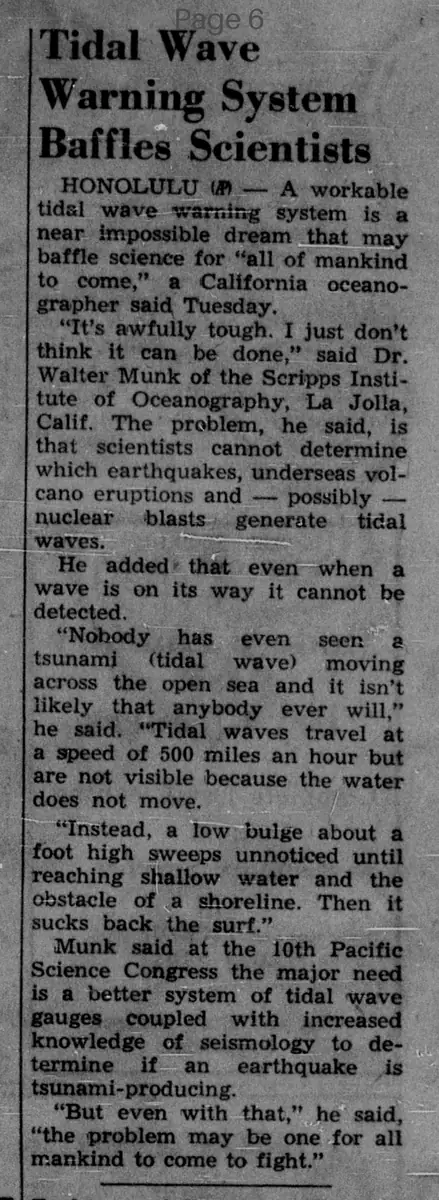
Tidal Wave
Warning System
Baffles Scientists
HONOLULU ()—A workable
tidal wave warning system is a
near impossible dream that may
baffle science for "all of mankind
to come," a California oceanographer said Tuesday.
"It's awfully tough. I just don't
think it can be done," said Dr.
Walter Munk of the Scripps Institute
of Oceanography, La Jolla,
Calif. The problem, he said, is
that scientists cannot determine
which earthquakes, underseas volcano
eruptions and—possibly—
nuclear
blasts generate tidal
waves.
He added that even when a
wave is on its way it cannot be
detected.
"Nobody
has
even
seen
a
tsunami
(tidal
wave)
moving
across
the
open sea and it isn't
likely that anybody ever will,"
he said. "Tidal waves travel at
a speed of 500 miles an hour but
are not visible because the water
does not move.
"Instead, a low bulge about a
foot high sweeps unnoticed until
reaching shallow water and the
obstacle of a shoreline. Then it
sucks back the surf."
Munk said at the 10th Pacific
Science Congress the major need
is a better system of tidal wave
gauges coupled with increased
knowledge of seismology to determine
if an earthquake is
tsunami-producing.
"But even with that," he said,
"the problem may be one for all
mankind to come to fight."
Warning System
Baffles Scientists
HONOLULU ()—A workable
tidal wave warning system is a
near impossible dream that may
baffle science for "all of mankind
to come," a California oceanographer said Tuesday.
"It's awfully tough. I just don't
think it can be done," said Dr.
Walter Munk of the Scripps Institute
of Oceanography, La Jolla,
Calif. The problem, he said, is
that scientists cannot determine
which earthquakes, underseas volcano
eruptions and—possibly—
nuclear
blasts generate tidal
waves.
He added that even when a
wave is on its way it cannot be
detected.
"Nobody
has
even
seen
a
tsunami
(tidal
wave)
moving
across
the
open sea and it isn't
likely that anybody ever will,"
he said. "Tidal waves travel at
a speed of 500 miles an hour but
are not visible because the water
does not move.
"Instead, a low bulge about a
foot high sweeps unnoticed until
reaching shallow water and the
obstacle of a shoreline. Then it
sucks back the surf."
Munk said at the 10th Pacific
Science Congress the major need
is a better system of tidal wave
gauges coupled with increased
knowledge of seismology to determine
if an earthquake is
tsunami-producing.
"But even with that," he said,
"the problem may be one for all
mankind to come to fight."
What sub-type of article is it?
Curiosity
Extraordinary Event
What themes does it cover?
Catastrophe
Misfortune
What keywords are associated?
Tidal Wave
Warning System
Tsunami
Oceanographer
Earthquake
Seismology
What entities or persons were involved?
Dr. Walter Munk
Where did it happen?
Honolulu
Story Details
Key Persons
Dr. Walter Munk
Location
Honolulu
Event Date
Tuesday
Story Details
Dr. Walter Munk explains why a tidal wave warning system is nearly impossible, citing difficulties in identifying earthquake and volcanic causes and detecting the invisible waves traveling at 500 mph with only a low bulge until hitting shorelines.