Thank you for visiting SNEWPapers!
Sign up free
Poem
July 10, 1792
The Patowmac Guardian, And Berkeley Advertiser
Martinsburg, Shepherdstown, Berkeley County, Jefferson County, West Virginia
What is this article about?
A philosophical soliloquy contemplating death as a peaceful rest and transition to eternity, questioning the fear of it in light of divine order and the soul's ascent to heaven.
Clipping
OCR Quality
98%
Excellent
Full Text
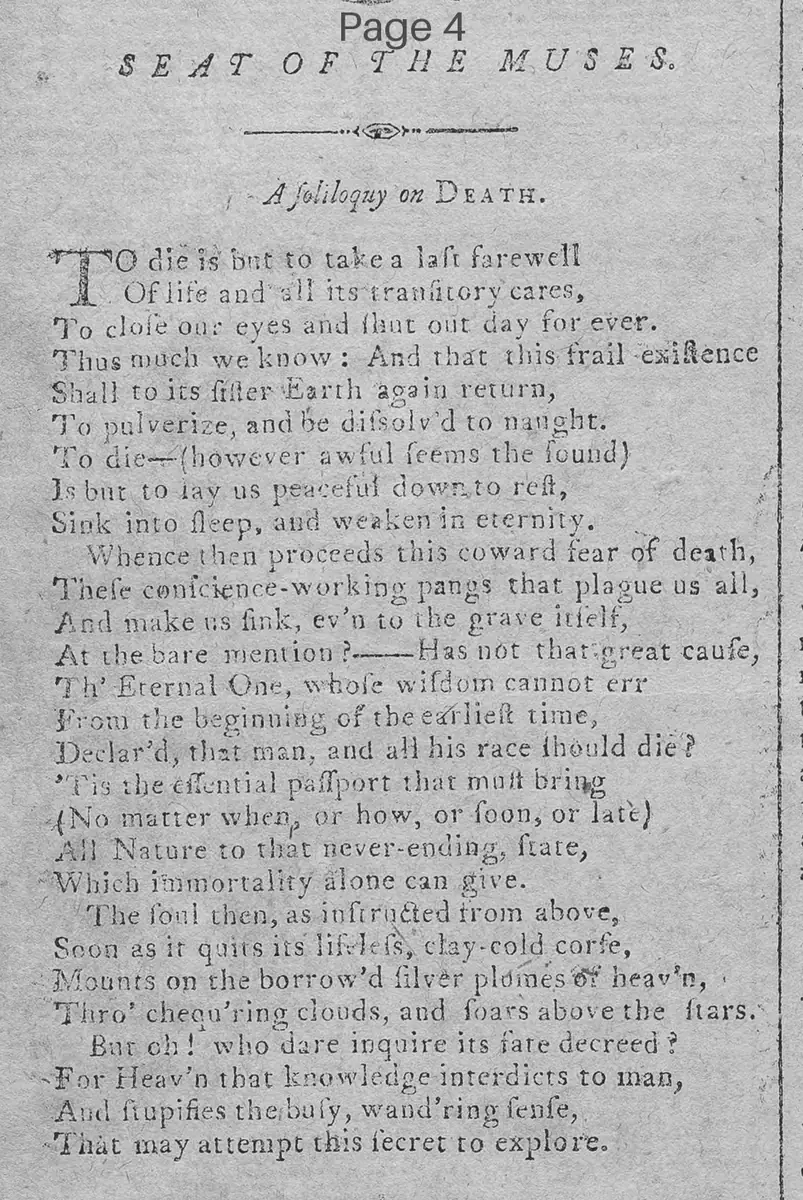
SEAT OF THE MUSES.
A Soliloquy on DEATH.
To die is but to take a last farewell
Of life and all its transitory cares,
To close our eyes and shut out day for ever.
Thus much we know: And that this frail existence
Shall to its sister Earth again return,
To pulverize, and be dissolved to naught.
To die—(however awful seems the sound)
Is but to lay us peaceful down to rest,
Sink into sleep, and waken in eternity.
Whence then proceeds this coward fear of death.
These conscience-working pangs that plague us all,
And make us shrink, ev'n to the grave itself,
At the bare mention?—Has not that great cause,
Th' Eternal One, whose wisdom cannot err
From the beginning of the earliest time,
Declar'd, that man and all his race should die?
'Tis the essential passport that must bring
(No matter when, or how, or soon, or late)
All Nature to that never-ending state,
Which immortality alone can give.
The soul then, as instructed from above.
Soon as it quits its lifeless, clay-cold corse.
Mounts on the borrow'd silver plumes of heav'n,
Thro' chequering clouds, and soars above the stars.
But oh! who dare inquire its fate decreed?
For Heav'n that knowledge interdicts to man,
And stupifies the busy, wand'ring sense,
That may attempt this secret to explore.
A Soliloquy on DEATH.
To die is but to take a last farewell
Of life and all its transitory cares,
To close our eyes and shut out day for ever.
Thus much we know: And that this frail existence
Shall to its sister Earth again return,
To pulverize, and be dissolved to naught.
To die—(however awful seems the sound)
Is but to lay us peaceful down to rest,
Sink into sleep, and waken in eternity.
Whence then proceeds this coward fear of death.
These conscience-working pangs that plague us all,
And make us shrink, ev'n to the grave itself,
At the bare mention?—Has not that great cause,
Th' Eternal One, whose wisdom cannot err
From the beginning of the earliest time,
Declar'd, that man and all his race should die?
'Tis the essential passport that must bring
(No matter when, or how, or soon, or late)
All Nature to that never-ending state,
Which immortality alone can give.
The soul then, as instructed from above.
Soon as it quits its lifeless, clay-cold corse.
Mounts on the borrow'd silver plumes of heav'n,
Thro' chequering clouds, and soars above the stars.
But oh! who dare inquire its fate decreed?
For Heav'n that knowledge interdicts to man,
And stupifies the busy, wand'ring sense,
That may attempt this secret to explore.
What sub-type of article is it?
Elegy
What themes does it cover?
Death Mourning
Religious Faith
What keywords are associated?
Death
Soliloquy
Fear Of Death
Eternity
Immortality
Soul
Divine Wisdom
Poem Details
Title
A Soliloquy On Death.
Subject
On Death
Form / Style
Rhymed Couplets
Key Lines
To Die Is But To Take A Last Farewell
Of Life And All Its Transitory Cares,
To Close Our Eyes And Shut Out Day For Ever.
Whence Then Proceeds This Coward Fear Of Death.
These Conscience Working Pangs That Plague Us All,
And Make Us Shrink, Ev'n To The Grave Itself,
At The Bare Mention?
The Soul Then, As Instructed From Above.
Soon As It Quits Its Lifeless, Clay Cold Corse.
Mounts On The Borrow'd Silver Plumes Of Heav'n,
Thro' Chequering Clouds, And Soars Above The Stars.