Thank you for visiting SNEWPapers!
Sign up free
Story
November 22, 1832
Herald Of The Times
Newport, Newport County, Rhode Island
What is this article about?
Napoleon Bonaparte shares with Josephine and her companions an anecdote about a young man in Marseilles who misjudges a frugal banker based on his modest office but is astonished by the luxurious home and dinner, learning the value of accumulated small economies in building power.
Clipping
OCR Quality
95%
Excellent
Full Text
A PLEASANT STORY,
TOLD BY NAPOLEON BONAPARTE.
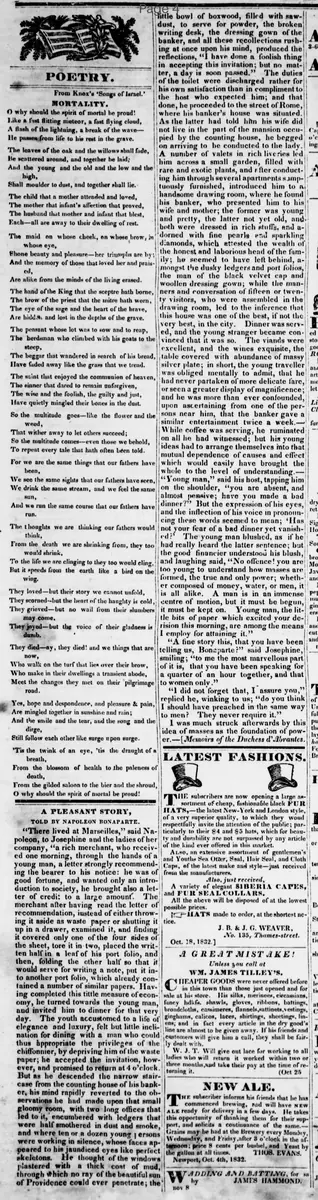
"There lived at Marseilles," said Napoleon, to Josephine and the ladies of her company, "a rich merchant, who received one morning, through the hands of a young man, a letter strongly recommending the bearer to his notice: he was of good fortune, and wanted only an introduction to society, he brought also a letter of credit to a large amount. The merchant after having read the letter of recommendation, instead of either throwing it aside as waste paper or shutting it up in a drawer, examined it, and finding it covered only one of the four sides of the sheet, tore it in two, placed the written half in a leaf of his portfolio, and then, folding the other half so that it would serve for writing a note, put it into another portfolio, which already contained a number of similar papers. Having completed this little measure of economy, he turned towards the young man, and invited him to dinner on that very day. The youth accustomed to a life of elegance and luxury, felt but little inclination for dining with a man who could thus appropriate the privileges of the chiffonnier, by depriving him of the waste paper; he accepted the invitation, however, and promised to return at 4 o'clock. But as he descended the narrow staircase from the counting house of his banker, his mind rapidly reverted to the observations he had made upon that small gloomy room, with two long offices that led to it, encumbered with ledgers that were half smothered in dust and smoke, and where ten or a dozen young persons were working in silence, whose faces appeared to his jaundiced eyes like perfect skeletons. He thought of the windows plastered with a thick coat of mud, through which no ray of the beautiful sun of Providence could ever penetrate; the little bowl of boxwood, filled with sawdust, to serve for powder, the broken writing desk, the dressing gown of the banker, and all these recollections rushing at once upon his mind, produced the reflections, "I have done a foolish thing in accepting this invitation; but no matter, a day is soon passed." The duties of the toilet were discharged rather for his own satisfaction than in compliment to the host who expected him; and that done, he proceeded to the street of Rome, where his banker's house was situated. As the latter had told him his wife did not live in the part of the mansion occupied by the counting house, he begged on arriving to be conducted to the lady. A number of valets in rich liveries led him across a small garden, filled with rare and exotic plants, and after conducting him through several apartments sumptuously furnished, introduced him to a handsome drawing room, where he found his banker, who presented him to his wife and mother; the former was young and pretty, the latter not yet old, and both were dressed in rich stuffs, and adorned with fine pearls and sparkling diamonds, which attested the wealth of the honest and laborious head of the family; he seemed to have left behind, amongst the dusky ledgers and portfolios, the man of the black velvet cap and woollen dressing gown; while the manners and conversation of fifteen or twenty visitors, who were assembled in the drawing room, led to the inference that this house was one of the best, if not the very best, in the city. Dinner was served, and the young stranger became convinced that it was so. The viands were excellent, and the wines exquisite, the table covered with abundance of massy silver plate; in short, the young traveller was obliged mentally to admit, that he had never partaken of more delicate fare, or seen a greater display of magnificence: and he was more than ever confounded, upon ascertaining from one of the persons near him, that the banker gave a similar entertainment twice a week. While coffee was serving, he ruminated on all he had witnessed; but his young ideas had to arrange themselves into that mutual dependence of causes and effect which would easily have brought the whole to the level of understanding. "Young man," said his host, tapping him on the shoulder, "you are absent, and almost pensive; have you made a bad dinner?" But the expression of his eyes, and the inflection of his voice in pronouncing these words seemed to mean; 'Has not your fear of a bad dinner yet vanished?' The young man blushed, as if he had really heard the latter sentence; but the good financier understood his blush, and laughing said, "No offence! you are too young to understand how masses are formed, the true and only power; whether composed of money, water, or men, it is all alike. A man is in an immense centre of motion, but it must be begun, it must be kept on. Young man, the little bits of paper which excited your derision this morning, are among the means I employ for attaining it." "A fine story this, that you have been telling us, Bonaparte?" said Josephine, smiling; "to me the most marvellous part of it is, that you have been speaking for a quarter of an hour together, and that to women only." "I did not forget that, I assure you," replied he, winking to us; "do you think I should have preached in the same way to men? They never require it." I was much struck afterwards by this idea of masses as the foundation of power.—[Memoirs of the Duchess d'Abrantes.
TOLD BY NAPOLEON BONAPARTE.
"There lived at Marseilles," said Napoleon, to Josephine and the ladies of her company, "a rich merchant, who received one morning, through the hands of a young man, a letter strongly recommending the bearer to his notice: he was of good fortune, and wanted only an introduction to society, he brought also a letter of credit to a large amount. The merchant after having read the letter of recommendation, instead of either throwing it aside as waste paper or shutting it up in a drawer, examined it, and finding it covered only one of the four sides of the sheet, tore it in two, placed the written half in a leaf of his portfolio, and then, folding the other half so that it would serve for writing a note, put it into another portfolio, which already contained a number of similar papers. Having completed this little measure of economy, he turned towards the young man, and invited him to dinner on that very day. The youth accustomed to a life of elegance and luxury, felt but little inclination for dining with a man who could thus appropriate the privileges of the chiffonnier, by depriving him of the waste paper; he accepted the invitation, however, and promised to return at 4 o'clock. But as he descended the narrow staircase from the counting house of his banker, his mind rapidly reverted to the observations he had made upon that small gloomy room, with two long offices that led to it, encumbered with ledgers that were half smothered in dust and smoke, and where ten or a dozen young persons were working in silence, whose faces appeared to his jaundiced eyes like perfect skeletons. He thought of the windows plastered with a thick coat of mud, through which no ray of the beautiful sun of Providence could ever penetrate; the little bowl of boxwood, filled with sawdust, to serve for powder, the broken writing desk, the dressing gown of the banker, and all these recollections rushing at once upon his mind, produced the reflections, "I have done a foolish thing in accepting this invitation; but no matter, a day is soon passed." The duties of the toilet were discharged rather for his own satisfaction than in compliment to the host who expected him; and that done, he proceeded to the street of Rome, where his banker's house was situated. As the latter had told him his wife did not live in the part of the mansion occupied by the counting house, he begged on arriving to be conducted to the lady. A number of valets in rich liveries led him across a small garden, filled with rare and exotic plants, and after conducting him through several apartments sumptuously furnished, introduced him to a handsome drawing room, where he found his banker, who presented him to his wife and mother; the former was young and pretty, the latter not yet old, and both were dressed in rich stuffs, and adorned with fine pearls and sparkling diamonds, which attested the wealth of the honest and laborious head of the family; he seemed to have left behind, amongst the dusky ledgers and portfolios, the man of the black velvet cap and woollen dressing gown; while the manners and conversation of fifteen or twenty visitors, who were assembled in the drawing room, led to the inference that this house was one of the best, if not the very best, in the city. Dinner was served, and the young stranger became convinced that it was so. The viands were excellent, and the wines exquisite, the table covered with abundance of massy silver plate; in short, the young traveller was obliged mentally to admit, that he had never partaken of more delicate fare, or seen a greater display of magnificence: and he was more than ever confounded, upon ascertaining from one of the persons near him, that the banker gave a similar entertainment twice a week. While coffee was serving, he ruminated on all he had witnessed; but his young ideas had to arrange themselves into that mutual dependence of causes and effect which would easily have brought the whole to the level of understanding. "Young man," said his host, tapping him on the shoulder, "you are absent, and almost pensive; have you made a bad dinner?" But the expression of his eyes, and the inflection of his voice in pronouncing these words seemed to mean; 'Has not your fear of a bad dinner yet vanished?' The young man blushed, as if he had really heard the latter sentence; but the good financier understood his blush, and laughing said, "No offence! you are too young to understand how masses are formed, the true and only power; whether composed of money, water, or men, it is all alike. A man is in an immense centre of motion, but it must be begun, it must be kept on. Young man, the little bits of paper which excited your derision this morning, are among the means I employ for attaining it." "A fine story this, that you have been telling us, Bonaparte?" said Josephine, smiling; "to me the most marvellous part of it is, that you have been speaking for a quarter of an hour together, and that to women only." "I did not forget that, I assure you," replied he, winking to us; "do you think I should have preached in the same way to men? They never require it." I was much struck afterwards by this idea of masses as the foundation of power.—[Memoirs of the Duchess d'Abrantes.
What sub-type of article is it?
Biography
Curiosity
What themes does it cover?
Moral Virtue
Social Manners
What keywords are associated?
Napoleon Anecdote
Frugal Banker
Misjudging Appearances
Economy Lesson
Wealth Accumulation
What entities or persons were involved?
Napoleon Bonaparte
Josephine
Young Man
Rich Merchant
Banker
Banker's Wife
Banker's Mother
Where did it happen?
Marseilles
Story Details
Key Persons
Napoleon Bonaparte
Josephine
Young Man
Rich Merchant
Banker
Banker's Wife
Banker's Mother
Location
Marseilles
Story Details
A young man introduced to a frugal banker in Marseilles misjudges him by his modest office but is surprised by the opulent home and dinner, learning that small economies build great wealth and power.