Thank you for visiting SNEWPapers!
Sign up free
Atlanta Daily World
Atlanta, Fulton County, Georgia
What is this article about?
Julius A. Thomas of the National Urban League reports increasing numbers of Negroes employed as street car and bus operators and conductors in multiple US cities, with first hires in Grand Rapids, Michigan, and Denver, Colorado.
Clipping
OCR Quality
Full Text
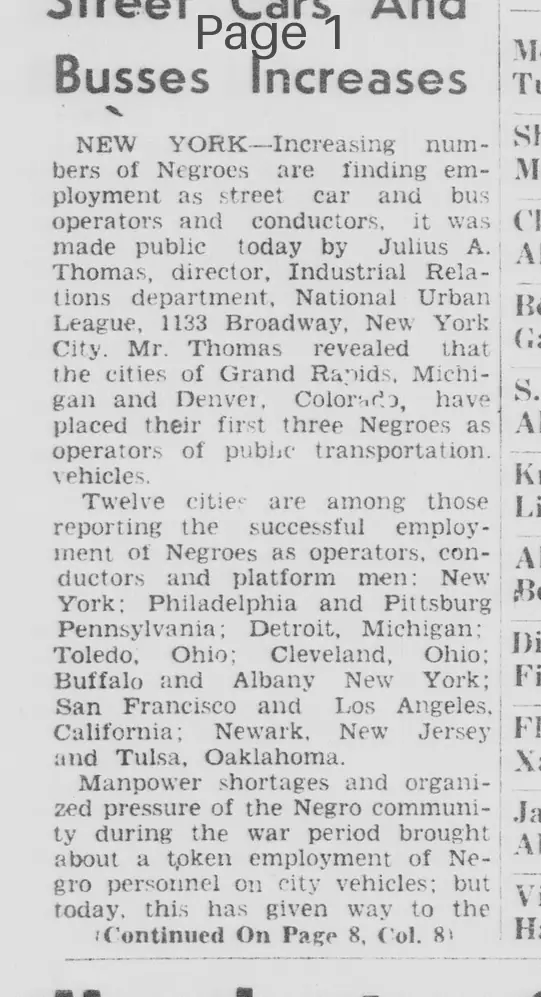
NEW YORK-Increasing numbers of Negroes
are finding employment
as street car and bus
operators and conductors, it was
made public today by Julius A.
Thomas, director, Industrial Relations
department, National Urban
League, 1133 Broadway, New York
City. Mr. Thomas revealed that
the cities of Grand Rapids, Michigan
and Denver, Colorado, have
placed their first three Negroes as
operators of public transportation
vehicles.
Twelve cities are among those
reporting the successful employment
of Negroes as operators,
conductors and platform men: New
York; Philadelphia and Pittsburgh,
Pennsylvania; Detroit, Michigan;
Toledo, Ohio; Cleveland,
Ohio;
Buffalo and Albany, New
York;
San Francisco and Los Angeles,
California; Newark, New Jersey
and Tulsa, Oklahoma.
Manpower shortages and organized
pressure of the Negro community
during the war period brought
about a token employment of Negro
personnel on city vehicles; but
today, this has given way to the
Continued on page 5, col. 8.
What sub-type of article is it?
What keywords are associated?
What entities or persons were involved?
Where did it happen?
Domestic News Details
Primary Location
New York
Key Persons
Outcome
increasing employment of negroes as operators, conductors, and platform men in twelve cities, including first hires in grand rapids and denver.
Event Details
Increasing numbers of Negroes are finding employment as street car and bus operators and conductors, announced by Julius A. Thomas of the National Urban League. Cities reporting successful employment include New York, Philadelphia, Pittsburgh, Detroit, Toledo, Cleveland, Buffalo, Albany, San Francisco, Los Angeles, Newark, and Tulsa. Manpower shortages and Negro community pressure during the war led to token employment, now expanding.