Thank you for visiting SNEWPapers!
Sign up free
Story
December 7, 1837
The Daily Herald
New Haven, New Haven County, Connecticut
What is this article about?
Extract from Governor Everett's address to the Massachusetts Charitable Association, discussing the history of spinning from distaff to modern machinery, its labor-saving impact on clothing production, population growth, and hailing inventors as civilization's benefactors.
Clipping
OCR Quality
95%
Excellent
Full Text
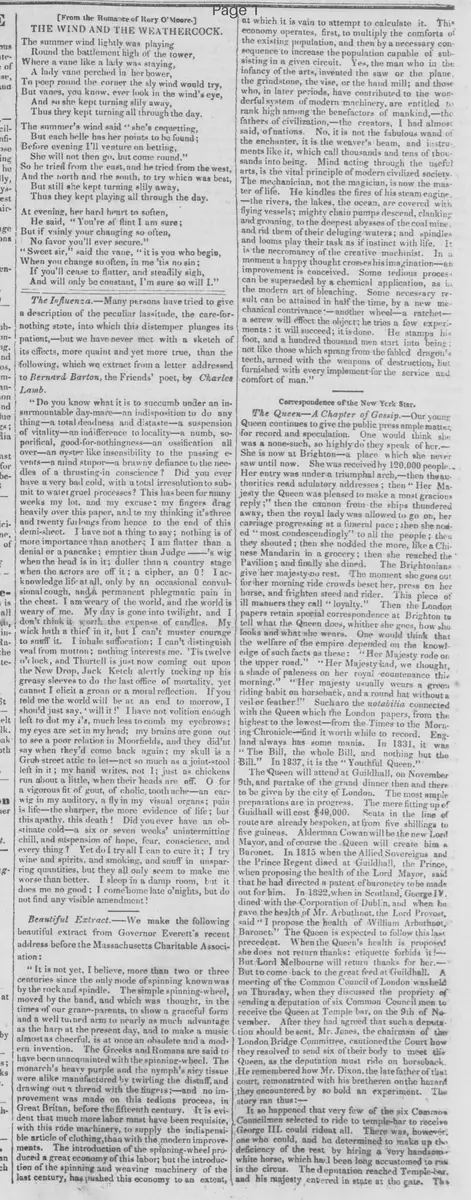
Beautiful Extract.—We make the following beautiful extract from Governor Everett's recent address before the Massachusetts Charitable Association:
"It is not yet, I believe, more than two or three centuries since the only mode of spinning known was by the rock and spindle. The simple spinning-wheel, moved by the hand, and which was thought, in the times of our grand-parents, to show a graceful form and a well tuned arm to nearly as much advantage as the harp at the present day, and to make a music almost as cheerful, is at once an obsolete and a modern invention. The Greeks and Romans are said to have been unacquainted with the spinning-wheel. The monarch's heavy purple and the nymph's airy tissue were alike manufactured by twirling the distaff, and drawing out a thread with the fingers;—and no improvement was made on this tedious process, in Great Britain, before the fifteenth century. It is evident that much more labor must have been requisite, with this rude machinery, to supply the indispensable article of clothing, than with the modern improvements. The introduction of the spinning-wheel produced a great economy of this labor; but the introduction of the spinning and weaving machinery of the last century, has pushed this economy to an extent, at which it is vain to attempt to calculate it. This economy operates, first, to multiply the comforts of the existing population, and then by a necessary consequence to increase the population capable of subsisting in a given circuit." Yes, the man who in the infancy of the arts, invented the saw or the plane, the grindstone, the vise, or the hand mill; and those who, in later periods, have contributed to the wonderful system of modern machinery, are entitled to rank high among the benefactors of mankind,—the fathers of civilization,—the creators. I had almost said, of nations. No, it is not the fabulous wand of the enchanter, it is the weaver's beam, and instruments like it, which call thousands and tens of thousands into being. Mind acting through the useful arts, is the vital principle of modern civilized society. The mechanician, not the magician, is now the master of life. He kindles the fires of his steam engine.—the rivers, the lakes, the ocean, are covered with flying vessels; mighty chain pumps descend, clanking and groaning, to the deepest abysses of the coal mine, and rid them of their deluging waters; and spindles and looms play their task as if instinct with life. It is the necromancy of the creative machinist. In a moment a happy thought crosses his imagination—an improvement is conceived. Some tedious process can be superseded by a chemical application, as in the modern art of bleaching. Some necessary result can be attained in half the time, by a new mechanical contrivance:—another wheel—a ratchet—a screw will effect the object; he tries a few experiments: it will succeed; it is done. He stamps his foot, and a hundred thousand men start into being; not like those which sprang from the fabled dragon's teeth, armed with the weapons of destruction, but furnished with every implement for the service and comfort of man."
"It is not yet, I believe, more than two or three centuries since the only mode of spinning known was by the rock and spindle. The simple spinning-wheel, moved by the hand, and which was thought, in the times of our grand-parents, to show a graceful form and a well tuned arm to nearly as much advantage as the harp at the present day, and to make a music almost as cheerful, is at once an obsolete and a modern invention. The Greeks and Romans are said to have been unacquainted with the spinning-wheel. The monarch's heavy purple and the nymph's airy tissue were alike manufactured by twirling the distaff, and drawing out a thread with the fingers;—and no improvement was made on this tedious process, in Great Britain, before the fifteenth century. It is evident that much more labor must have been requisite, with this rude machinery, to supply the indispensable article of clothing, than with the modern improvements. The introduction of the spinning-wheel produced a great economy of this labor; but the introduction of the spinning and weaving machinery of the last century, has pushed this economy to an extent, at which it is vain to attempt to calculate it. This economy operates, first, to multiply the comforts of the existing population, and then by a necessary consequence to increase the population capable of subsisting in a given circuit." Yes, the man who in the infancy of the arts, invented the saw or the plane, the grindstone, the vise, or the hand mill; and those who, in later periods, have contributed to the wonderful system of modern machinery, are entitled to rank high among the benefactors of mankind,—the fathers of civilization,—the creators. I had almost said, of nations. No, it is not the fabulous wand of the enchanter, it is the weaver's beam, and instruments like it, which call thousands and tens of thousands into being. Mind acting through the useful arts, is the vital principle of modern civilized society. The mechanician, not the magician, is now the master of life. He kindles the fires of his steam engine.—the rivers, the lakes, the ocean, are covered with flying vessels; mighty chain pumps descend, clanking and groaning, to the deepest abysses of the coal mine, and rid them of their deluging waters; and spindles and looms play their task as if instinct with life. It is the necromancy of the creative machinist. In a moment a happy thought crosses his imagination—an improvement is conceived. Some tedious process can be superseded by a chemical application, as in the modern art of bleaching. Some necessary result can be attained in half the time, by a new mechanical contrivance:—another wheel—a ratchet—a screw will effect the object; he tries a few experiments: it will succeed; it is done. He stamps his foot, and a hundred thousand men start into being; not like those which sprang from the fabled dragon's teeth, armed with the weapons of destruction, but furnished with every implement for the service and comfort of man."
What sub-type of article is it?
Historical Event
Curiosity
What themes does it cover?
Triumph
Moral Virtue
What keywords are associated?
Spinning Wheel
Machinery Invention
Industrial Progress
Labor Economy
Population Growth
What entities or persons were involved?
Governor Everett
Where did it happen?
Massachusetts
Story Details
Key Persons
Governor Everett
Location
Massachusetts
Event Date
Recent
Story Details
Governor Everett's address praises the invention of the spinning-wheel and modern machinery for economizing labor, multiplying comforts, increasing population, and ranking inventors as benefactors of mankind and creators of civilization, emphasizing mind acting through useful arts as the vital principle of modern society.