Thank you for visiting SNEWPapers!
Sign up free
Literary
August 10, 1787
The New York Packet
New York, New York County, New York
What is this article about?
Reflections on military leadership, contrasting officers' sacrifices with soldiers', advocating balanced discipline, study of ancient tactics, and inspiring liberty in troops for victory, illustrated by an anecdote from Chevert's siege of Prague.
Clipping
OCR Quality
98%
Excellent
Full Text
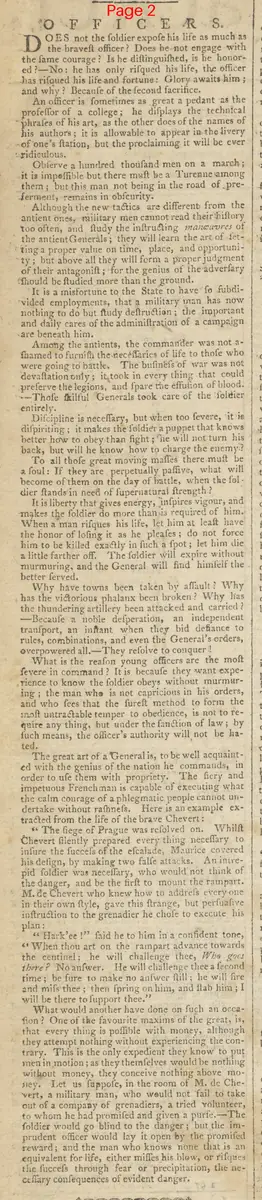
OFFICERS.
Does not the soldier expose his life as much as the bravest officer? Does he not engage with the same courage? Is he distinguished, is he honored? No: he has only risked his life, the officer has risked his life and fortune: Glory awaits him; and why? Because of the second sacrifice.
An officer is sometimes as great a pedant as the professor of a college; he displays the technical phrases of his art, as the other does of the names of his authors; it is allowable to appear in the livery of one's station, but the proclaiming it will be ever ridiculous.
Observe a hundred thousand men on a march; it is impossible but there must be a Turenne among them; but this man not being in the road of preferment, remains in obscurity.
Although the new tactics are different from the ancient ones, military men cannot read their history too often, and study the instructing manoeuvres of the ancient Generals; they will learn the art of setting a proper value on time, place, and opportunity; but above all they will form a proper judgment of their antagonist; for the genius of the adversary should be studied more than the ground.
It is a misfortune to the State to have so subdivided employments, that a military man has now nothing to do but study destruction; the important and daily cares of the administration of a campaign are beneath him.
Among the ancients, the commander was not ashamed to furnish the necessaries of life to those who were going to battle. The business of war was not devastation only; it took in every thing that could preserve the legions, and spare the effusion of blood.
Those skillful Generals took care of the soldier entirely.
Discipline is necessary, but when too severe, it is dispiriting: it makes the soldier a puppet that knows better how to obey than fight; he will not turn his back, but will he know how to charge the enemy?
To all those great moving masses there must be a soul: If they are perpetually passive, what will become of them on the day of battle, when the soldier stands in need of supernatural strength?
It is liberty that gives energy, inspires vigour, and makes the soldier do more than is required of him.
When a man risks his life, let him at least have the honor of losing it as he pleases; do not force him to be killed exactly in such a spot; let him die a little farther off. The soldier will expire without murmuring, and the General will find himself the better served.
Why have towns been taken by assault? Why has the victorious phalanx been broken? Why has the thundering artillery been attacked and carried?
Because a noble desperation, an independent transport, an instant when they bid defiance to rules, combinations, and even the General's orders, overpowered all. They resolve to conquer!
What is the reason young officers are the most severe in command? It is because they want experience to know the soldier obeys without murmuring; the man who is not capricious in his orders, and who sees that the surest method to form the most untractable temper to obedience, is not to require any thing, but under the sanction of law; by such means, the officer's authority will not be hated.
The great art of a General is, to be well acquainted with the genius of the nation he commands, in order to use them with propriety. The fiery and impetuous Frenchman is capable of executing what the calm courage of a phlegmatic people cannot undertake without rashness. Here is an example extracted from the life of the brave Chevert:
"The siege of Prague was resolved on. Whilst Chevert silently prepared every thing necessary to insure the success of the escalade, Maurice covered his design, by making two false attacks. An intrepid soldier was necessary, who would not think of the danger, and be the first to mount the rampart. M. de Chevert who knew how to address every one in their own style, gave this strange, but persuasive instruction to the grenadier he chose to execute his plan:
"Hark'ee!" said he to him in a confident tone, "When thou art on the rampart advance towards the sentinel; he will challenge thee, Who goes there? No answer. He will challenge thee a second time; be sure to make no answer still; he will fire and miss thee; then spring on him, and stab him; I will be there to support thee."
What would another have done on such an occasion? One of the favourite maxims of the great, is, that every thing is possible with money, although they attempt nothing without experiencing the contrary. This is the only expedient they know to put men in motion; as they themselves would be nothing without money, they conceive nothing above money. Let us suppose, in the room of M. de Chevert, a military man, who would not fail to take out of a company of grenadiers, a tried volunteer, to whom he had promised and given a purse. The soldier would go blind to the danger; but the imprudent officer would lay it open by the promised reward; and the man who knows none that is an equivalent for life, either misses his blow, or risks the success through fear or precipitation, the necessary consequences of evident danger.
Does not the soldier expose his life as much as the bravest officer? Does he not engage with the same courage? Is he distinguished, is he honored? No: he has only risked his life, the officer has risked his life and fortune: Glory awaits him; and why? Because of the second sacrifice.
An officer is sometimes as great a pedant as the professor of a college; he displays the technical phrases of his art, as the other does of the names of his authors; it is allowable to appear in the livery of one's station, but the proclaiming it will be ever ridiculous.
Observe a hundred thousand men on a march; it is impossible but there must be a Turenne among them; but this man not being in the road of preferment, remains in obscurity.
Although the new tactics are different from the ancient ones, military men cannot read their history too often, and study the instructing manoeuvres of the ancient Generals; they will learn the art of setting a proper value on time, place, and opportunity; but above all they will form a proper judgment of their antagonist; for the genius of the adversary should be studied more than the ground.
It is a misfortune to the State to have so subdivided employments, that a military man has now nothing to do but study destruction; the important and daily cares of the administration of a campaign are beneath him.
Among the ancients, the commander was not ashamed to furnish the necessaries of life to those who were going to battle. The business of war was not devastation only; it took in every thing that could preserve the legions, and spare the effusion of blood.
Those skillful Generals took care of the soldier entirely.
Discipline is necessary, but when too severe, it is dispiriting: it makes the soldier a puppet that knows better how to obey than fight; he will not turn his back, but will he know how to charge the enemy?
To all those great moving masses there must be a soul: If they are perpetually passive, what will become of them on the day of battle, when the soldier stands in need of supernatural strength?
It is liberty that gives energy, inspires vigour, and makes the soldier do more than is required of him.
When a man risks his life, let him at least have the honor of losing it as he pleases; do not force him to be killed exactly in such a spot; let him die a little farther off. The soldier will expire without murmuring, and the General will find himself the better served.
Why have towns been taken by assault? Why has the victorious phalanx been broken? Why has the thundering artillery been attacked and carried?
Because a noble desperation, an independent transport, an instant when they bid defiance to rules, combinations, and even the General's orders, overpowered all. They resolve to conquer!
What is the reason young officers are the most severe in command? It is because they want experience to know the soldier obeys without murmuring; the man who is not capricious in his orders, and who sees that the surest method to form the most untractable temper to obedience, is not to require any thing, but under the sanction of law; by such means, the officer's authority will not be hated.
The great art of a General is, to be well acquainted with the genius of the nation he commands, in order to use them with propriety. The fiery and impetuous Frenchman is capable of executing what the calm courage of a phlegmatic people cannot undertake without rashness. Here is an example extracted from the life of the brave Chevert:
"The siege of Prague was resolved on. Whilst Chevert silently prepared every thing necessary to insure the success of the escalade, Maurice covered his design, by making two false attacks. An intrepid soldier was necessary, who would not think of the danger, and be the first to mount the rampart. M. de Chevert who knew how to address every one in their own style, gave this strange, but persuasive instruction to the grenadier he chose to execute his plan:
"Hark'ee!" said he to him in a confident tone, "When thou art on the rampart advance towards the sentinel; he will challenge thee, Who goes there? No answer. He will challenge thee a second time; be sure to make no answer still; he will fire and miss thee; then spring on him, and stab him; I will be there to support thee."
What would another have done on such an occasion? One of the favourite maxims of the great, is, that every thing is possible with money, although they attempt nothing without experiencing the contrary. This is the only expedient they know to put men in motion; as they themselves would be nothing without money, they conceive nothing above money. Let us suppose, in the room of M. de Chevert, a military man, who would not fail to take out of a company of grenadiers, a tried volunteer, to whom he had promised and given a purse. The soldier would go blind to the danger; but the imprudent officer would lay it open by the promised reward; and the man who knows none that is an equivalent for life, either misses his blow, or risks the success through fear or precipitation, the necessary consequences of evident danger.
What sub-type of article is it?
Essay
What themes does it cover?
War Peace
Liberty Freedom
Moral Virtue
What keywords are associated?
Military Leadership
Soldier Discipline
Ancient Tactics
Liberty In Troops
Chevert Anecdote
Siege Of Prague
Literary Details
Title
Officers.
Key Lines
It Is Liberty That Gives Energy, Inspires Vigour, And Makes The Soldier Do More Than Is Required Of Him.
Because A Noble Desperation, An Independent Transport, An Instant When They Bid Defiance To Rules, Combinations, And Even The General's Orders, Overpowered All. They Resolve To Conquer!
"Hark'ee!" Said He To Him In A Confident Tone, "When Thou Art On The Rampart Advance Towards The Sentinel; He Will Challenge Thee, Who Goes There? No Answer. He Will Challenge Thee A Second Time; Be Sure To Make No Answer Still; He Will Fire And Miss Thee; Then Spring On Him, And Stab Him; I Will Be There To Support Thee."