Thank you for visiting SNEWPapers!
Sign up free
The Saint Paul Globe
Saint Paul, Ramsey County, Minnesota
What is this article about?
Minnesota House of Representatives passes omnibus taxation bills for express companies (5% gross earnings), sleeping cars (3% gross earnings), telephone companies (5% gross earnings), and fast freight equipment (ad valorem on property valuation), after debates on methods and rates.
Clipping
OCR Quality
Full Text
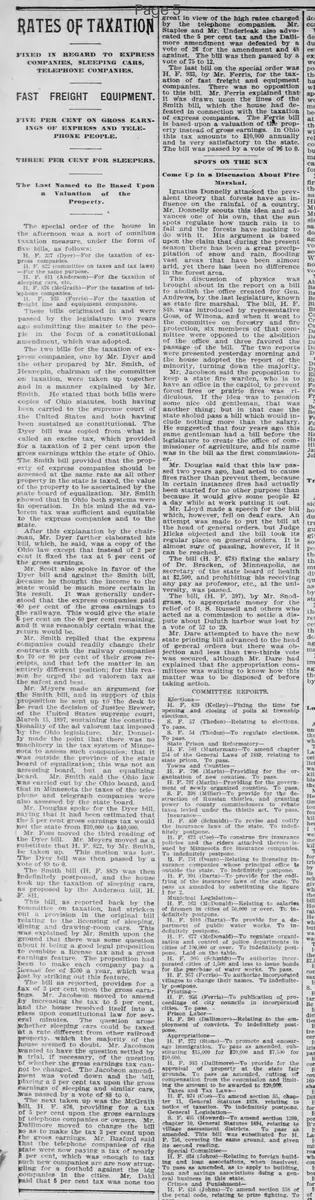
FAST FREIGHT EQUIPMENT.
FIVE PER CENT ON GROSS EARNINGS OF EXPRESS AND TELEPHONE PEOPLE.
THREE PER CENT FOR SLEEPERS.
The Last Named to Be Based Upon a Valuation of the Property.
The special order of the house in the afternoon was a sort of omnibus taxation measure, under the form of five bills, as follows:
H. F. 357 (Dyer)—For the taxation of express companies.
H. F. 822 (committee on taxes and tax laws)—For the same purpose.
H. F. 811 (Anderson)—For the taxation of sleeping cars, etc.
H. F. 876 (McGrath)—For the taxation of telephone companies.
H. F. 933 (Ferris)—For the taxation of freight line and equipment companies.
These bills originated in and were passed by the legislature two years ago submitting the matter to the people in the form of a constitutional amendment, which was adopted.
The two bills for the taxation of express companies, one by Mr. Dyer and the other prepared by Mr. Smith, of Hennepin, chairman of the committee on taxation, were taken up together and in a manner explained by Mr. Smith. He stated that both bills were copies of Ohio statutes, both having been carried to the supreme court of the United States and both having been sustained as constitutional. The Dyer bill was copied from what is called an excise tax, which provided for a taxation of 2 per cent upon the gross earnings within the state of Ohio. The Smith bill provided that the property of express companies should be assessed at the same rate as all other property in the state is taxed, the value of the property to be ascertained by the state board of equalization. Mr. Smith showed that in Ohio both systems were in operation. In his mind the ad valorem tax was sufficient and equitable to the express companies and to the state.
After this explanation by the chairman, Mr. Dyer further elaborated his bill, which, he said, was a copy of the Ohio law except that instead of 2 per cent it fixed the tax at 5 per cent of the gross earnings.
Mr. Scott also spoke in favor of the Dyer bill and against the Smith bill, because he thought the income to the state would be much more certain in its result. It was generally understood that the express companies paid 40 per cent of the gross earnings to the railways. This would give the state 5 per cent on the 60 per cent remaining, and it was reasonably certain what the return would be.
Mr. Smith replied that the express companies could readily change their contracts with the railway companies to 70 or 80 per cent of their gross receipts, and that left the matter in an entirely different position; for this reason he urged the ad valorem tax as the safest and best.
Mr. Meyers made an argument for the Smith bill, and in support of this proposition he sent up to the desk to be read the decision of Justice Brewer, of the United States supreme court, March 15, 1897, sustaining the constitutionality of the ad valorem tax imposed by the Ohio legislature. Mr. Donnelly made the point that there was no machinery in the tax system of Minnesota to assess such companies; that it was outside the province of the state board of equalization; this was not an assessing board, but an equalizing board. Mr. Smith said the Ohio law was carried out by the Ohio board, and that in Minnesota the taxes of the telephone and telegraph companies were also assessed by the state board.
Mr. Douglas spoke for the Dyer bill saying that it had been estimated that the 5 per cent gross earnings tax would net the state from $30,000 to $40,000.
Mr. Foss moved the third reading of the Dyer bill. Mr. Meyers moved as a substitute that H. F. 822, by Mr. Smith, be taken up. This motion was lost. The Dyer bill was then passed by a vote of 89 to 0.
The Smith bill (H. F. 822) was then indefinitely postponed, and the house took up the taxation of sleeping cars as proposed by the Anderson bill, H. F. 811.
This bill, as reported back by the committee on taxation, had stricken out a provision in the original bill relating to the licensing of sleeping, dining and drawing-room cars. This was explained by Mr. Smith upon the ground that there was some question about it being a good legal proposition to combine a license tax and a gross earnings feature. The proposition had been to make each company pay a license fee of $500 a year, which was lost by striking out this feature.
The bill as reported, provides for a tax of 3 per cent upon the gross earnings. Mr. Jacobson moved to amend by increasing the tax to 5 per cent, and the house resolved itself into a class upon constitutional law for several minutes. The question arose whether sleeping cars could be taxed at a rate different from other railroad property, which the majority of the house seemed to doubt. Mr. Jacobson wanted to have the question settled by a trial, if necessary, of the question of whether the gross earnings tax cannot be changed. The Jacobson amendment was voted down and the bill, placing a 3 per cent tax upon the gross earnings of sleeping and similar cars, was passed by a vote of 88 to 0.
The next taken up was the McGrath bill, H. F. 876, providing for a tax of 5 per cent upon the gross earnings of telephone companies or owners. Mr. Dallimore moved to change the bill so as to make the tax 3 per cent upon the gross earnings. Mr. Basford said that the telephone companies of the state were now paying a tax of nearly 5 per cent, which was enough to tax such new companies as are now struggling for a foothold against the big companies in the cities. Mr. Dahl said that 5 per cent tax was none too great in view of the high rates charged by the telephone companies. Mr. Staples and Mr. Underleak also advocated the 5 per cent tax and the Dallimore amendment was defeated by a vote of 26 for the amendment and 45 against. The bill was then passed by a vote of 75 to 12.
The last bill on the special order was H. F. 933, by Mr. Ferris, for the taxation of fast freight and equipment companies. There was no opposition to this bill. Mr. Ferris explained that it was drawn upon the lines of the Smith bill, which the house had defeated in connection with the taxation of express companies. The Ferris bill is based upon a valuation of the property instead of gross earnings. In Ohio this tax amounts to $10,000 annually and is very satisfactory to the state. The bill was passed by a vote of 96 to 0.
What sub-type of article is it?
What keywords are associated?
What entities or persons were involved?
Where did it happen?
Domestic News Details
Primary Location
Minnesota
Key Persons
Outcome
h.f. 357 (dyer) passed 89-0 (5% gross earnings on express companies); h.f. 811 (anderson) passed 88-0 (3% gross earnings on sleeping cars); h.f. 876 (mcgrath) passed 75-12 (5% gross earnings on telephone companies); h.f. 933 (ferris) passed 96-0 (ad valorem tax on freight equipment); h.f. 822 (smith) indefinitely postponed.
Event Details
The Minnesota House debated and passed four bills implementing a constitutional amendment for taxing express companies, sleeping cars, telephone companies, and fast freight equipment companies, based on models from Ohio statutes, with discussions on gross earnings vs. ad valorem taxation methods.