Thank you for visiting SNEWPapers!
Sign up free
Story
March 8, 1856
Anti Slavery Bugle
New Lisbon, Salem, Columbiana County, Ohio
What is this article about?
Chaotic scene at the Know Nothing Convention nominating Millard Fillmore, where Massachusetts delegates Ely, Sumner, and Richmond change votes, denounce Henry Wilson as a traitor, assert anti-slavery principles, and face tumult when Richmond demands to speak.
Clipping
OCR Quality
98%
Excellent
Full Text
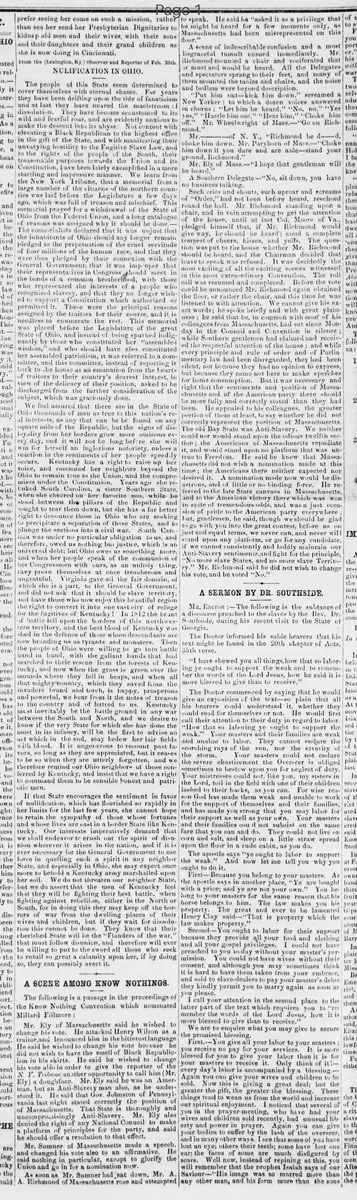
A SCENE AMONG KNOW NOTHINGS.
The following is a passage in the proceedings of the Know Nothing Convention which nominated Millard Fillmore:
Mr. Ely of Massachusetts said he wished to change his vote. He attacked Henry Wilson as a traitor, and renounced him in the bitterest language. He said he wished to change his vote because he did not wish to have the smell of Black Republicanism in his skirts. He said he wished to change his vote also in order to give the reporter of the N. Y. Tribune another opportunity to call him (Mr. Ely) a doughface. Mr. Ely said he was an American, but an Anti-Slavery man also, as he understood it. He said that Gov. Johnston of Pennsylvania last night stated correctly the position of Massachusetts. That State is thoroughly and uncompromisingly Anti-Slavery. Mr. Ely also denied the right of any National Council to make a platform of principles for the party, and said he should offer a resolution to that effect.
Mr. Sumner of Massachusetts made a speech, and changed his vote also to an affirmative. He said nothing in particular, except to glorify the Union and go in for a nomination now.
As soon as Mr. Sumner had sat down, Mr. A. A. Richmond of Massachusetts rose and attempted to speak. He said he "asked it as a privilege that he might be heard for a few moments only, as Massachusetts had been misrepresented on this floor."
A scene of indescribable confusion and a most disgraceful tumult ensued immediately. Mr. Richmond mounted a chair and vociferated that he must and would be heard. All the Delegates and spectators sprang to their feet, and many of them mounted the tables and chairs, and the noise and bedlam were beyond description.
"Put him out—kick him down," screamed a New Yorker: to which a dozen voices answered in chorus: "Let him be heard." "No, no." "Yes, yes," "Hustle him out," "Hear him," "Choke him off." Mr. Wheelwright of Mass.—"Go on, Richmond."
Mr. — of N. Y., "Richmond be d—d, choke him down." Mr. Parvhorn of Mass.—"Choke him down if you dare and are able—stand your ground, Richmond."
Mr. Ely of Mass.—"I hope that gentleman will be heard.?"
A Southern Delegate—"No, sit down, you have no business talking."
Such cries and shouts, such uproar and screams of "Order," had not been before heard, reechoed round the hall. Mr. Richmond standing upon a chair, and in vain attempting to get the attention of the house, until at last Col. Moore of Va., pledged himself that, if Mr. Richmond would give way, he should be heard: and a complete tempest of cheers, hisses, and yells. The question was put to the house whether Mr. Richmond should be heard, and the Chairman decided that leave to speak was refused. It was decidedly the most exciting of all the exciting scenes witnessed in this most extraordinary Convention. The roll call was resumed and completed. Before the vote could be announced Mr. Richmond again obtained the floor, or rather the chair, and this time he was listened to with attention. We cannot give his exact words; he spoke briefly and with great plainness; he said that he, in common with most of his colleagues from Massachusetts, had sat since Monday in the Council and Convention in silence: while Southern gentlemen had claimed and received the respectful attention of the house: and while every principle and rule of order and of Parliamentary law had been disregarded, they had been silent, not because they had no opinion to express, but because they came not here to make speeches for home consumption. But it was necessary and right that the sentiments and position of Massachusetts and of the American party there should be more fully and correctly stated than they had been. He appealed to his colleagues, the greater portion of them at least, to say whether he did not correctly represent the position of Massachusetts. The old Bay State was Anti-Slavery. We neither could nor would stand upon the odious twelfth section: the Americans of Massachusetts repudiate it, and would stand upon no platform that was untrue to Freedom. He said he knew that Massachusetts did not wish a nomination made at this time; the Americans there neither expected nor desired it. A nomination made now would be disastrous, and of little or no binding force. He referred to the late State canvass in Massachusetts, and to the American victory there which was won in spite of tremendous odds, and was a just occasion of pride to the American party everywhere: but, gentlemen, he said, though we should be glad to go with you into the great contest, before us on just and equal terms, we never can, and never will stand upon any platform, or go for any candidate, if we cannot consistently and boldly maintain our Anti-Slavery sentiments, and fight for the principle. No more slave States, and no more slave Territory. Mr. Richmond said he did not wish to change his vote, and he voted "No."
The following is a passage in the proceedings of the Know Nothing Convention which nominated Millard Fillmore:
Mr. Ely of Massachusetts said he wished to change his vote. He attacked Henry Wilson as a traitor, and renounced him in the bitterest language. He said he wished to change his vote because he did not wish to have the smell of Black Republicanism in his skirts. He said he wished to change his vote also in order to give the reporter of the N. Y. Tribune another opportunity to call him (Mr. Ely) a doughface. Mr. Ely said he was an American, but an Anti-Slavery man also, as he understood it. He said that Gov. Johnston of Pennsylvania last night stated correctly the position of Massachusetts. That State is thoroughly and uncompromisingly Anti-Slavery. Mr. Ely also denied the right of any National Council to make a platform of principles for the party, and said he should offer a resolution to that effect.
Mr. Sumner of Massachusetts made a speech, and changed his vote also to an affirmative. He said nothing in particular, except to glorify the Union and go in for a nomination now.
As soon as Mr. Sumner had sat down, Mr. A. A. Richmond of Massachusetts rose and attempted to speak. He said he "asked it as a privilege that he might be heard for a few moments only, as Massachusetts had been misrepresented on this floor."
A scene of indescribable confusion and a most disgraceful tumult ensued immediately. Mr. Richmond mounted a chair and vociferated that he must and would be heard. All the Delegates and spectators sprang to their feet, and many of them mounted the tables and chairs, and the noise and bedlam were beyond description.
"Put him out—kick him down," screamed a New Yorker: to which a dozen voices answered in chorus: "Let him be heard." "No, no." "Yes, yes," "Hustle him out," "Hear him," "Choke him off." Mr. Wheelwright of Mass.—"Go on, Richmond."
Mr. — of N. Y., "Richmond be d—d, choke him down." Mr. Parvhorn of Mass.—"Choke him down if you dare and are able—stand your ground, Richmond."
Mr. Ely of Mass.—"I hope that gentleman will be heard.?"
A Southern Delegate—"No, sit down, you have no business talking."
Such cries and shouts, such uproar and screams of "Order," had not been before heard, reechoed round the hall. Mr. Richmond standing upon a chair, and in vain attempting to get the attention of the house, until at last Col. Moore of Va., pledged himself that, if Mr. Richmond would give way, he should be heard: and a complete tempest of cheers, hisses, and yells. The question was put to the house whether Mr. Richmond should be heard, and the Chairman decided that leave to speak was refused. It was decidedly the most exciting of all the exciting scenes witnessed in this most extraordinary Convention. The roll call was resumed and completed. Before the vote could be announced Mr. Richmond again obtained the floor, or rather the chair, and this time he was listened to with attention. We cannot give his exact words; he spoke briefly and with great plainness; he said that he, in common with most of his colleagues from Massachusetts, had sat since Monday in the Council and Convention in silence: while Southern gentlemen had claimed and received the respectful attention of the house: and while every principle and rule of order and of Parliamentary law had been disregarded, they had been silent, not because they had no opinion to express, but because they came not here to make speeches for home consumption. But it was necessary and right that the sentiments and position of Massachusetts and of the American party there should be more fully and correctly stated than they had been. He appealed to his colleagues, the greater portion of them at least, to say whether he did not correctly represent the position of Massachusetts. The old Bay State was Anti-Slavery. We neither could nor would stand upon the odious twelfth section: the Americans of Massachusetts repudiate it, and would stand upon no platform that was untrue to Freedom. He said he knew that Massachusetts did not wish a nomination made at this time; the Americans there neither expected nor desired it. A nomination made now would be disastrous, and of little or no binding force. He referred to the late State canvass in Massachusetts, and to the American victory there which was won in spite of tremendous odds, and was a just occasion of pride to the American party everywhere: but, gentlemen, he said, though we should be glad to go with you into the great contest, before us on just and equal terms, we never can, and never will stand upon any platform, or go for any candidate, if we cannot consistently and boldly maintain our Anti-Slavery sentiments, and fight for the principle. No more slave States, and no more slave Territory. Mr. Richmond said he did not wish to change his vote, and he voted "No."
What sub-type of article is it?
Historical Event
What themes does it cover?
Betrayal
Justice
Social Manners
What keywords are associated?
Know Nothing Convention
Millard Fillmore Nomination
Massachusetts Delegates
Anti Slavery Platform
Political Tumult
Henry Wilson Traitor
What entities or persons were involved?
Mr. Ely
Henry Wilson
Mr. Sumner
Mr. A. A. Richmond
Millard Fillmore
Gov. Johnston
Col. Moore
Where did it happen?
Know Nothing Convention
Story Details
Key Persons
Mr. Ely
Henry Wilson
Mr. Sumner
Mr. A. A. Richmond
Millard Fillmore
Gov. Johnston
Col. Moore
Location
Know Nothing Convention
Story Details
During the Know Nothing Convention nominating Millard Fillmore, Massachusetts delegates Ely and Sumner change votes while denouncing Black Republicanism and affirming anti-slavery stance; Richmond faces tumult but speaks to assert Massachusetts' rejection of pro-slavery platform elements and opposition to premature nomination.