Thank you for visiting SNEWPapers!
Sign up free
Story
March 2, 1885
New York Tribune
New York, New York County, New York
What is this article about?
The schooner Augusta Muir, en route from Lockport, N.S. to Barbados, was dismasted in a northeast hurricane on February 15. Her crew of six labored at the pumps for days amid heavy seas and leaks until rescued by the bark Artisan on February 19.
Clipping
OCR Quality
98%
Excellent
Full Text
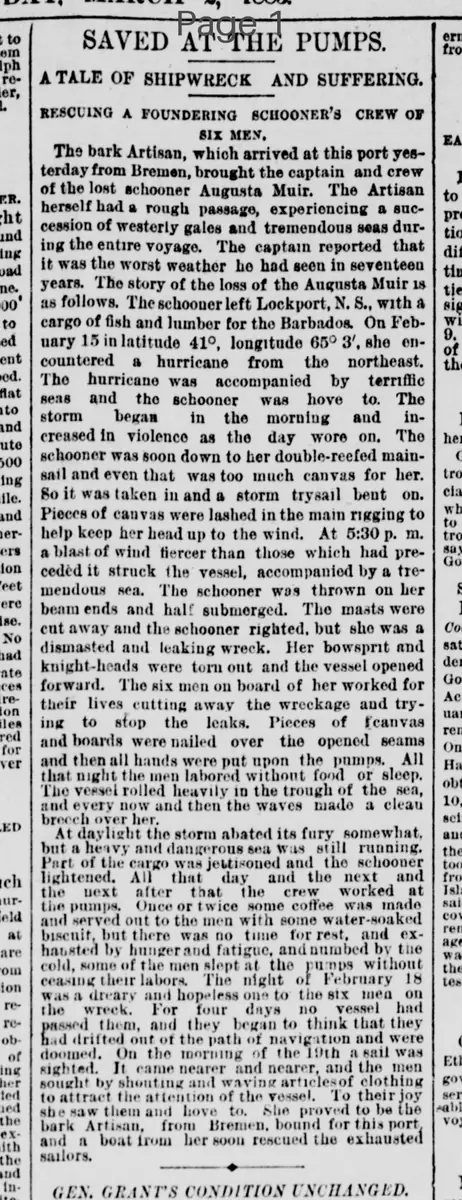
SAVED AT THE PUMPS.
A TALE OF SHIPWRECK AND SUFFERING.
RESCUING A FOUNDERING SCHOONER'S CREW OF SIX MEN.
The bark Artisan, which arrived at this port yesterday from Bremen, brought the captain and crew of the lost schooner Augusta Muir. The Artisan herself had a rough passage, experiencing a succession of westerly gales and tremendous seas during the entire voyage. The captain reported that it was the worst weather he had seen in seventeen years. The story of the loss of the Augusta Muir is as follows. The schooner left Lockport, N. S., with a cargo of fish and lumber for the Barbados. On February 15 in latitude 41, longitude 65° 3', she encountered a hurricane from the northeast. The hurricane was accompanied by terrific seas and the schooner was hove to. The storm began in the morning and increased in violence as the day wore on. The schooner was soon down to her double-reefed mainsail and even that was too much canvas for her. So it was taken in and a storm trysail bent on. Pieces of canvas were lashed in the main rigging to help keep her head up to the wind. At 5:30 p. m. a blast of wind fiercer than those which had preceded it struck the vessel, accompanied by a tremendous sea. The schooner was thrown on her beam ends and half submerged. The masts were cut away and the schooner righted, but she was a dismasted and leaking wreck. Her bowsprit and knight-heads were torn out and the vessel opened forward. The six men on board of her worked for their lives cutting away the wreckage and trying to stop the leaks. Pieces of canvas and boards were nailed over the opened seams and then all hands were put upon the pumps. All that night the men labored without food or sleep. The vessel rolled heavily in the trough of the sea, and every now and then the waves made a clean breach over her.
At daylight the storm abated its fury somewhat, but a heavy and dangerous sea was still running. Part of the cargo was jettisoned and the schooner lightened. All that day and the next and the next after that the crew worked at the pumps. Once or twice some coffee was made and served out to the men with some water-soaked biscuit, but there was no time for rest, and exhausted by hunger and fatigue, and numbed by the cold, some of the men slept at the pumps without ceasing their labors. The night of February 18 was a dreary and hopeless one to the six men on the wreck. For four days no vessel had passed them, and they began to think that they had drifted out of the path of navigation and were doomed. On the morning of the 19th a sail was sighted. It came nearer and nearer, and the men sought by shouting and waving articles of clothing to attract the attention of the vessel. To their joy she saw them and hove to. She proved to be the bark Artisan, from Bremen, bound for this port and a boat from her soon rescued the exhausted sailors.
A TALE OF SHIPWRECK AND SUFFERING.
RESCUING A FOUNDERING SCHOONER'S CREW OF SIX MEN.
The bark Artisan, which arrived at this port yesterday from Bremen, brought the captain and crew of the lost schooner Augusta Muir. The Artisan herself had a rough passage, experiencing a succession of westerly gales and tremendous seas during the entire voyage. The captain reported that it was the worst weather he had seen in seventeen years. The story of the loss of the Augusta Muir is as follows. The schooner left Lockport, N. S., with a cargo of fish and lumber for the Barbados. On February 15 in latitude 41, longitude 65° 3', she encountered a hurricane from the northeast. The hurricane was accompanied by terrific seas and the schooner was hove to. The storm began in the morning and increased in violence as the day wore on. The schooner was soon down to her double-reefed mainsail and even that was too much canvas for her. So it was taken in and a storm trysail bent on. Pieces of canvas were lashed in the main rigging to help keep her head up to the wind. At 5:30 p. m. a blast of wind fiercer than those which had preceded it struck the vessel, accompanied by a tremendous sea. The schooner was thrown on her beam ends and half submerged. The masts were cut away and the schooner righted, but she was a dismasted and leaking wreck. Her bowsprit and knight-heads were torn out and the vessel opened forward. The six men on board of her worked for their lives cutting away the wreckage and trying to stop the leaks. Pieces of canvas and boards were nailed over the opened seams and then all hands were put upon the pumps. All that night the men labored without food or sleep. The vessel rolled heavily in the trough of the sea, and every now and then the waves made a clean breach over her.
At daylight the storm abated its fury somewhat, but a heavy and dangerous sea was still running. Part of the cargo was jettisoned and the schooner lightened. All that day and the next and the next after that the crew worked at the pumps. Once or twice some coffee was made and served out to the men with some water-soaked biscuit, but there was no time for rest, and exhausted by hunger and fatigue, and numbed by the cold, some of the men slept at the pumps without ceasing their labors. The night of February 18 was a dreary and hopeless one to the six men on the wreck. For four days no vessel had passed them, and they began to think that they had drifted out of the path of navigation and were doomed. On the morning of the 19th a sail was sighted. It came nearer and nearer, and the men sought by shouting and waving articles of clothing to attract the attention of the vessel. To their joy she saw them and hove to. She proved to be the bark Artisan, from Bremen, bound for this port and a boat from her soon rescued the exhausted sailors.
What sub-type of article is it?
Disaster
Survival
What themes does it cover?
Misfortune
Survival
Bravery Heroism
What keywords are associated?
Shipwreck
Hurricane
Rescue
Pumps
Schooner Augusta Muir
Bark Artisan
What entities or persons were involved?
Crew Of The Schooner Augusta Muir
Captain Of The Bark Artisan
Where did it happen?
Latitude 41, Longitude 65° 3' At Sea
Story Details
Key Persons
Crew Of The Schooner Augusta Muir
Captain Of The Bark Artisan
Location
Latitude 41, Longitude 65° 3' At Sea
Event Date
February 15 To February 19
Story Details
Schooner Augusta Muir dismasted and leaking after hurricane on February 15; crew of six pumps continuously for days without rest; rescued by bark Artisan on February 19 after signaling distress.