Thank you for visiting SNEWPapers!
Sign up free
Gazette Of The United States
Philadelphia, Philadelphia County, Pennsylvania
What is this article about?
Description of the Spanish part of Hispaniola ceded to France, highlighting its potential based on pre-revolution productivity of the French part of St. Domingo in 1789, including vast plantations, exports, population, and devastation by insurrection, with hopes for recovery.
Clipping
OCR Quality
Full Text
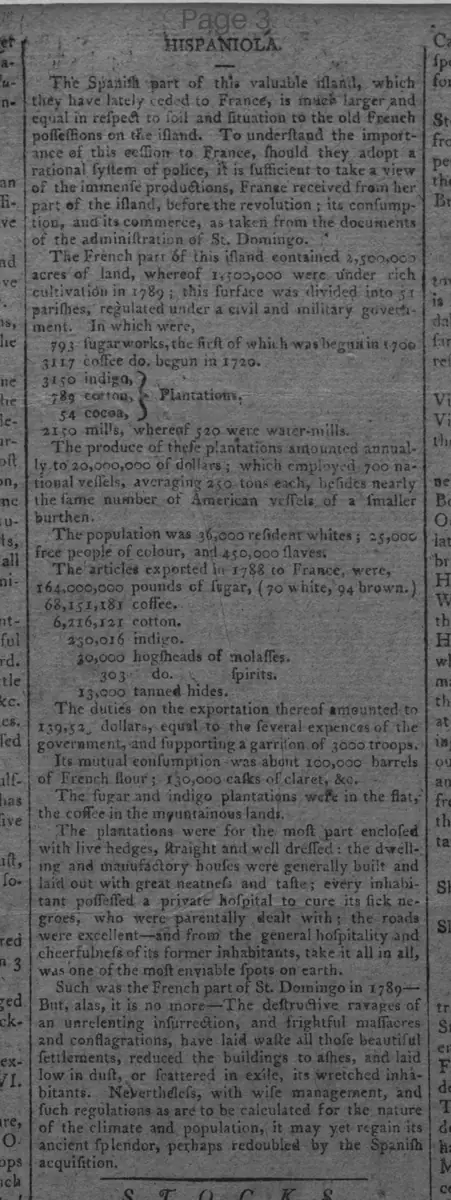
The Spanish part of this valuable island, which they have lately ceded to France, is much larger and equal in respect to soil and situation to the old French possessions on the island. To understand the importance of this cession to France, should they adopt a rational system of police, it is sufficient to take a view of the immense productions, France received from her part of the island, before the revolution; its consumption, and its commerce, as taken from the documents of the administration of St. Domingo.
The French part of this island contained 2,500,000 acres of land, whereof 1,500,000 were under rich cultivation in 1789; this surface was divided into 51 parishes, regulated under a civil and military government. In which were,
793 sugar-works, the first of which was begun in 1700
3117 coffee do. begun in 1720.
3150 indigo,
789 cotton,
Plantations.
19 dyes
54 cocoa,
2150 mills, whereof 520 were water-mills.
The produce of these plantations amounted annually to 20,000,000 of dollars; which employed 700 national vessels, averaging 250 tons each, besides nearly the same number of American vessels of a smaller burthen.
The population was 36,000 resident whites; 25,000 free people of colour, and 450,000 slaves.
The articles exported in 1788 to France, were,
164,000,000 pounds of sugar, (70 white, 94 brown.)
68,151,181 coffee.
6,216,121 cotton.
230,016 indigo.
30,000 hogsheads of molasses.
303 do. spirits.
13,000 tanned hides.
The duties on the exportation thereof amounted to 1,395,252 dollars, equal to the several expenses of the government, and supporting a garrison of 3000 troops.
Its mutual consumption was about 100,000 barrels of French flour; 130,000 casks of claret, &c.
The sugar and indigo plantations were in the flat, the coffee in the mountainous lands.
The plantations were for the most part enclosed with live hedges, straight and well dressed: the dwelling and manufactory houses were generally built and laid out with great neatness and taste; every inhabitant possessed a private hospital to cure its sick negroes, who were parentally dealt with; the roads were excellent—and from the general hospitality and cheerfulness of its former inhabitants, take it all in all, was one of the most enviable spots on earth.
Such was the French part of St. Domingo in 1789— But, alas, it is no more—The destructive ravages of an unrelenting insurrection, and frightful massacres and conflagrations, have laid waste all those beautiful settlements, reduced the buildings to ashes, and laid low in dust, or scattered in exile, its wretched inhabitants. Nevertheless, with wise management, and such regulations as are to be calculated for the nature of the climate and population, it may yet regain its ancient splendor, perhaps redoubled by the Spanish acquisition.
What sub-type of article is it?
What keywords are associated?
Where did it happen?
Foreign News Details
Primary Location
Hispaniola
Event Date
1789
Outcome
devastation by insurrection, massacres, and conflagrations; potential recovery with wise management following cession of spanish part to france.
Event Details
The Spanish part of Hispaniola, lately ceded to France, is larger and comparable to the former French possessions. Pre-revolution French St. Domingo featured extensive plantations producing sugar, coffee, indigo, cotton, and more, exporting vast quantities to France, supporting a large population and economy, but was destroyed by insurrection; hopes for revival with the acquisition.