Thank you for visiting SNEWPapers!
Sign up free
Story
September 5, 1849
The Daily Crescent
New Orleans, Orleans County, Louisiana
What is this article about?
Mr. Kirkwood of Pottsville, Pa., discovers a law of planetary rotation that determines the length of days on each planet, akin to Kepler's law for years. Astronomers verify the calculations, confirming its value and supporting Laplace's Nebular hypothesis.
Clipping
OCR Quality
95%
Excellent
Full Text
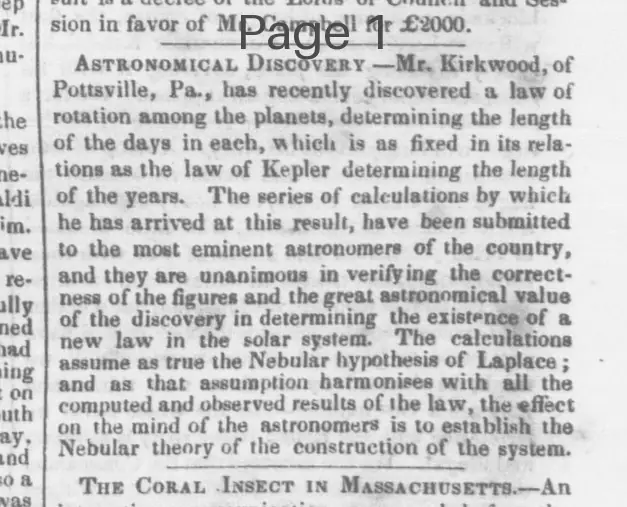
Astronomical Discovery—Mr. Kirkwood, of Pottsville, Pa., has recently discovered a law of rotation among the planets, determining the length of the days in each, which is as fixed in its relations as the law of Kepler determining the length of the years. The series of calculations by which he has arrived at this result, have been submitted to the most eminent astronomers of the country, and they are unanimous in verifying the correctness of the figures and the great astronomical value of the discovery in determining the existence of a new law in the solar system. The calculations assume as true the Nebular hypothesis of Laplace; and as that assumption harmonises with all the computed and observed results of the law, the effect on the mind of the astronomers is to establish the Nebular theory of the construction of the system.
What sub-type of article is it?
Curiosity
Extraordinary Event
What themes does it cover?
Triumph
Exploration
What keywords are associated?
Astronomical Discovery
Planetary Rotation
Nebular Hypothesis
Kepler Law
Laplace Theory
What entities or persons were involved?
Mr. Kirkwood
Where did it happen?
Pottsville, Pa.
Story Details
Key Persons
Mr. Kirkwood
Location
Pottsville, Pa.
Story Details
Mr. Kirkwood discovers a law of planetary rotation determining day lengths, verified by eminent astronomers as a new solar system law, assuming and supporting Laplace's Nebular hypothesis.