Thank you for visiting SNEWPapers!
Sign up free
Editorial
July 5, 1865
Brownlow's Knoxville Whig, And Rebel Ventilator
Knoxville, Knox County, Tennessee
What is this article about?
Editorial contrasts biblical Prodigal Son with returning Confederate rebels, arguing rebels lack genuine repentance and should receive leniency only if they prove peaceful intentions post-Civil War.
Clipping
OCR Quality
98%
Excellent
Full Text
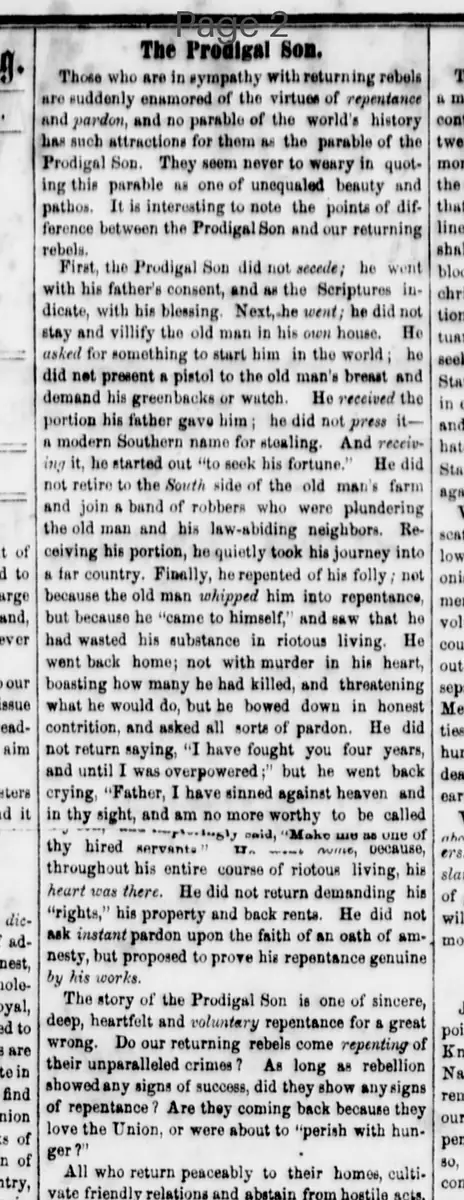
, The Prodigal Son,
Those who are in sympathy with returning rebel are suddenly enamored of the virtues of repentance and pardon, and no parable of the world's history has such attractions for them as the parable of the Prodigal Son. They seem never to weary in quoting this parable as one of unequaled beauty and pathos. It is interesting to note the points of difference between the Prodigal Son and our returning rebels.
First, the Prodigal Son did not secede; he went with his father's consent, and as the Scriptures indicate, with his blessing. Next,—he went; he did not stay and villify the old man in his own house. He asked for something to start him in the world; he did not present a pistol to the old man's breast and demand his greenbacks or watch. He received the portion his father gave him; he did not press it—a modern Southern name for stealing. And receiving it, he started out "to seek his fortune." He did not retire to the South side of the old man's farm and join a band of robbers who were plundering the old man and his law-abiding neighbors. Receiving his portion, he quietly took his journey into a far country. Finally, he repented of his folly; not because the old man whipped him into repentance but because he "came to himself," and saw that he had wasted his substance in riotous living. He went back home; not with murder in his heart boasting how many he had killed, and threatening what he would do, but he bowed down in honest contrition, and asked all sorts of pardon. He did not return saying, "I have fought you four years. and until I was overpowered;" but he went back crying, "Father, I have sinned against heaven and in thy sight, and am no more worthy to be called thy son; make me as one of thy hired servants."
He returned home because throughout his entire course of riotous living, his heart was there. He did not return demanding his "rights," his property and back rents. He did not ask instant pardon upon the faith of an oath of amnesty, but proposed to prove his repentance genuine by his works.
The story of the Prodigal Son is one of sincere deep, heartfelt and voluntary repentance for a great wrong. Do our returning rebels come repenting of their unparalleled crimes? As long as rebellion showed any signs of success, did they show any signs of repentance? Are they coming back because they love the Union, or were about to "perish with hunger?"
All who return peaceably to their homes, cultivate friendly relations and abstain from hostile acts, discountenancing every attempt at disorder, should be met with the same spirit and treated with leniency. When they manifest a hostile spirit, make them bite the dust.
Those who are in sympathy with returning rebel are suddenly enamored of the virtues of repentance and pardon, and no parable of the world's history has such attractions for them as the parable of the Prodigal Son. They seem never to weary in quoting this parable as one of unequaled beauty and pathos. It is interesting to note the points of difference between the Prodigal Son and our returning rebels.
First, the Prodigal Son did not secede; he went with his father's consent, and as the Scriptures indicate, with his blessing. Next,—he went; he did not stay and villify the old man in his own house. He asked for something to start him in the world; he did not present a pistol to the old man's breast and demand his greenbacks or watch. He received the portion his father gave him; he did not press it—a modern Southern name for stealing. And receiving it, he started out "to seek his fortune." He did not retire to the South side of the old man's farm and join a band of robbers who were plundering the old man and his law-abiding neighbors. Receiving his portion, he quietly took his journey into a far country. Finally, he repented of his folly; not because the old man whipped him into repentance but because he "came to himself," and saw that he had wasted his substance in riotous living. He went back home; not with murder in his heart boasting how many he had killed, and threatening what he would do, but he bowed down in honest contrition, and asked all sorts of pardon. He did not return saying, "I have fought you four years. and until I was overpowered;" but he went back crying, "Father, I have sinned against heaven and in thy sight, and am no more worthy to be called thy son; make me as one of thy hired servants."
He returned home because throughout his entire course of riotous living, his heart was there. He did not return demanding his "rights," his property and back rents. He did not ask instant pardon upon the faith of an oath of amnesty, but proposed to prove his repentance genuine by his works.
The story of the Prodigal Son is one of sincere deep, heartfelt and voluntary repentance for a great wrong. Do our returning rebels come repenting of their unparalleled crimes? As long as rebellion showed any signs of success, did they show any signs of repentance? Are they coming back because they love the Union, or were about to "perish with hunger?"
All who return peaceably to their homes, cultivate friendly relations and abstain from hostile acts, discountenancing every attempt at disorder, should be met with the same spirit and treated with leniency. When they manifest a hostile spirit, make them bite the dust.
What sub-type of article is it?
Partisan Politics
Moral Or Religious
War Or Peace
What keywords are associated?
Prodigal Son
Returning Rebels
Repentance
Civil War Pardon
Rebel Amnesty
Union Loyalty
What entities or persons were involved?
Prodigal Son
Returning Rebels
Editorial Details
Primary Topic
Critique Of Pardoning Returning Rebels Via Prodigal Son Parable
Stance / Tone
Critical Of Insincere Rebel Repentance, Advocates Conditional Leniency
Key Figures
Prodigal Son
Returning Rebels
Key Arguments
Prodigal Son Left With Consent, Unlike Secession
Prodigal Did Not Vilify Or Rob Father, Unlike Rebels
Prodigal Repented Voluntarily After Self Realization, Not Defeat
Rebels Show No Genuine Repentance, Only Return Due To Failure
Leniency For Peaceful Returnees Who Abstain From Hostility