Thank you for visiting SNEWPapers!
Sign up free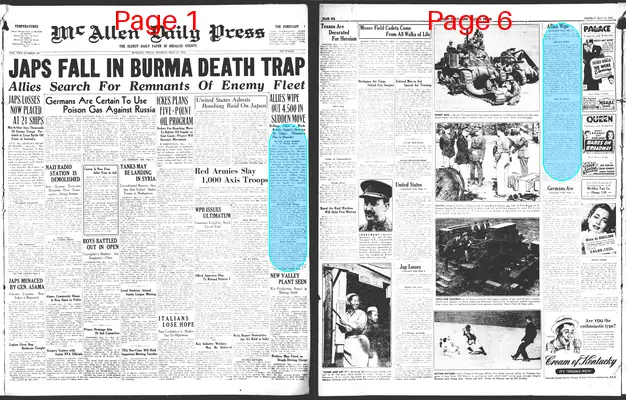
Mcallen Daily Press
Mcallen, Hidalgo County, Texas
What is this article about?
Chinese forces, aided by U.S. Flying Tigers and led by Gen. Stilwell and Chiang Kai-shek, repelled Japanese invasion in southern China, trapping and killing over 5,000 enemy troops fleeing from Chefang into Yunnan Province and along the Burma Road north of Mandalay.
Merged-components note: Merged body on page 1 and continuation on page 6 for coherent foreign news story on Allied counter-blow in Burma
Clippings
1 of 2
OCR Quality
Full Text
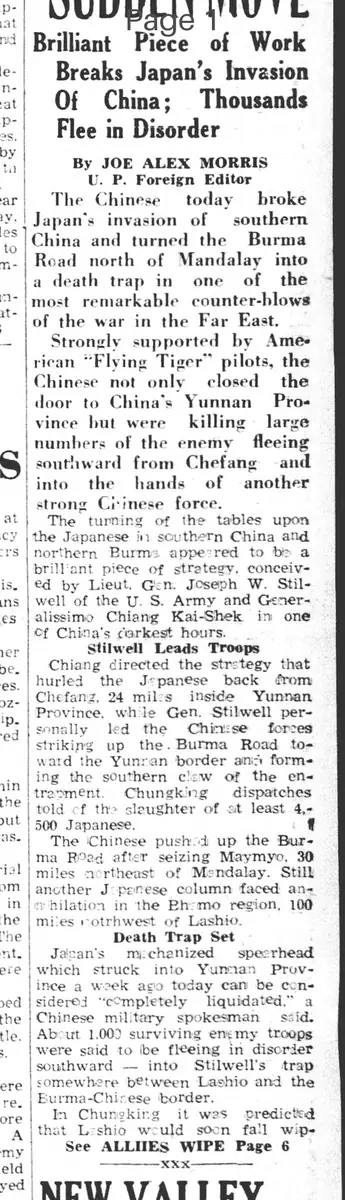
By JOE ALEX MORRIS U. P. Foreign Editor
The Chinese today broke Japan's invasion of southern China and turned the Burma Road north of Mandalay into a death trap in one of the most remarkable counter-blows of the war in the Far East.
Strongly supported by American "Flying Tiger" pilots, the Chinese not only closed the door to China's Yunnan Province but were killing large numbers of the enemy fleeing southward from Chefang and into the hands of another strong Chinese force.
The turning of the tables upon the Japanese in southern China and northern Burma appeared to be a brilliant piece of strategy, conceived by Lieut. Gen. Joseph W. Stilwell of the U. S. Army and Generalissimo Chiang Kai-Shek in one of China's darkest hours.
Stilwell Leads Troops
Chiang directed the strategy that hurled the Japanese back from Chefang, 24 miles inside Yunnan Province, while Gen. Stilwell personally led the Chinese forces striking up the Burma Road toward the Yunnan border and forming the southern claw of the entrapment. Chungking dispatches told of the slaughter of at least 4,500 Japanese.
The Chinese pushed up the Burma Road after seizing Maymyo, 30 miles northeast of Mandalay. Still another Japanese column faced annihilation in the Prome region, 100 miles northwest of Lashio.
Death Trap Set
Japan's mechanized spearhead which struck into Yunnan Province a week ago today can be considered "completely liquidated," a Chinese military spokesman said.
About 1,000 surviving enemy troops were said to be fleeing in disorder southward—into Stilwell's trap somewhere between Lashio and the Burma-Chinese border.
In Chungking it was predicted that Lashio would soon fall.
Lashio, northern terminus of the railroad from Rangoon.
5,000 Are Killed
A spokesman predicted the annihilation of at least 5,000 Japanese, indicating that more than 1,000 were fleeing in disorder into another Chinese trap somewhere along the Burma Road between Lashio and the frontier. Chinese artillery and American pilots trapped and wiped out more than 3,000 enemy troops Saturday, and at least 500 more were known to have been killed since then. In a previous engagement, the Chinese reported 1,000 enemy casualties.
"The remnants of the enemy force are fleeing by truck in a southwesterly direction with Chinese troops hotly in pursuit," a communique said. "They are facing sure annihilation as the way of retreat has been cut and another force of Chinese troops that recaptured Maymyo is driving northward and waylaying the defeated invaders."
Fate Is Sealed
The second Japanese column facing annihilation is in the Bhamo area northwest of Lashio. Its communication lines had been severed and the Chinese said its fate was "sealed."
Maymyo, 30 miles northeast of Mandalay, definitely was back in Chinese hands. Officially the situation at Lashio was obscure, but Chinese quarters predicted the enemy also would be ousted from that railhead city on the Burma Road 116 miles below the Chinese border.
The Chinese force that retook Maymyo moved north with lightning speed from the Taunggyi sector, 75 miles below Mandalay, where it had remained since the Japanese launched their major push toward Lashio. Stilwell was reported personally in command.
Chinese military quarters were both puzzled and jubilant over the foolhardy Japanese drive 25 miles inside the Chinese border where superior Allied troops were waiting.
Allied military leaders emphasized that the Chinese still lack adequate air support for widespread and major counter-offensives.
British troops under Gen. Harold R.L.G. Alexander, meanwhile, were continuing their orderly withdrawal along the Chindwin River Valley toward the Indian frontier.
What sub-type of article is it?
What keywords are associated?
What entities or persons were involved?
Where did it happen?
Foreign News Details
Primary Location
Yunnan Province, China And Northern Burma
Key Persons
Outcome
at least 5,000 japanese killed; japanese spearhead liquidated; thousands fleeing into traps facing annihilation; maymyo recaptured; lashio predicted to fall soon.
Event Details
Chinese forces, supported by American Flying Tiger pilots, repelled Japanese invasion from Chefang in Yunnan Province, trapping fleeing enemy troops between forces led by Chiang Kai-shek and Stilwell along the Burma Road north of Mandalay. Additional Japanese column in Bhamo area faces annihilation with communications severed. British withdrawal continues in Chindwin Valley.