Thank you for visiting SNEWPapers!
Sign up free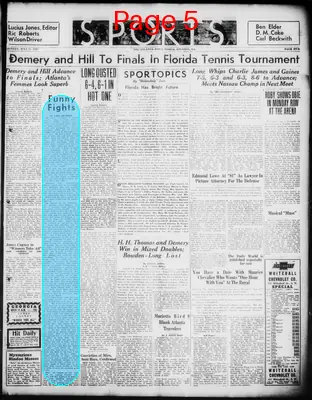
Atlanta Daily World
Atlanta, Fulton County, Georgia
What is this article about?
Memoir of a racially diverse quintet running a crooked carnival fight concession, detailing each member's background and quirks, with the brown-skinned narrator noting public curiosity aiding ticket sales; group arrives by train to join the carnival.
Clipping

OCR Quality
Full Text
BY CARL BECKWITH
We were certainly a strange quintet, come to think about it. And as widely separated racially as we were on color. Barry was, as his name implies, Irish. And he could and probably did, change monikers often, but he couldn't change that map of Ireland he called a face. He was a battle scarred vet of both ring and barroom and every bout had left its mark on him. And every bout had also taught him something. That bird knew more crooked, foul ways to win a fight than any dozen experts at that sort of thing one would meet nowadays. None of them needed the help of the referee to succeed, either. In Barry's day (we can't recall his first name) winning was all that mattered most of the time and the only thing barred was biting and the only time anything was, well, unethical, was when you got caught.
We'll pass the big Norwegian, Roseen. He cost us so much money we let him get kinda mixed up on the hour the train left town one night and also forgot to mention what the next stopping place was. More about him later.
Halloway was Pennsylvania Dutch, which tells us immediately that Halloway was only moniker he had picked up for ring use. He was just an ambitious kid—that is ring ambitious, but no brains. His one great fault was a loose mouth—which was the direct reason why he severed connection—by request—with us.
My partner in the enterprise the mystery man—English, was just a smooth, clever product of the school which teaches a lot of things—most of them bad. His business, outside his connection with the show, was his own and he had ways and means of keeping it so. Slow to anger, he stayed peeved for days at a time. Didn't drink that I knew of, and had no time for frails, but otherwise just an average sort of fellow. I hadn't met him until just previous to our buying the concession together, so of course I didn't know much about him. But I did learn this: he wasn't interested in the show at all. He accepted his part of the earnings without question and spent as little time around the tent as possible. But he was on the lot all right. You'd see him standing with first one group and then another and once in a while he'd have some of the town folks with him talking very earnestly about something. To this day we don't know what his racket was. He wouldn't sell ducats, he wouldn't referee, he wouldn't take tickets and he was never around when it came time to pack or unpack. That was Jack English. We got along fine together while it lasted. Just before the war we heard he had passed out suddenly out in Sterling, Col. Well, not so suddenly either. He wasn't quite dead when he hit the floor. Just an argument over how he could possibly hold four bullets (aces) in a game which wasn't being played with a pinochle deck, when there was one in the discards. Or something similar to that. It was cards, anyway, so we heard.
Last comes yours truly, the only brownskin on the lot. We must have looked like a fly in a pan of milk. We were full of the tales Cash had told us and we were going to stack up bucks like cordwood on this trip. We bought one of those heavy leather money belts to wear under our shirt—and we kept it at least a month. Then, suspecting we would never need it in its intended capacity, we cut the pouches off it and used it for a regular belt. But despite the fact the show was so predominately Caucasian or thereabouts, never an out of the way word was said in our hearing by anyone attached to the outfit. Most of the towns we played had few if any of my race of folks in them, after we left Iowa, so I think that part of our success was due to folks curiosity. They'd stand and stare at me outside the tent—and then buy tickets so they could follow me inside, which was okay by me. That's the truth too. Most of the time I held the watch on the bout when I wasn't actually in there mixing. and every time I looked out in the crowd, everybody seemed to have their mouths open looking at me which made it fairly easy to get away with almost murder at times in order to save the ten-buck prize money.
Well, we hopped off the train with our luggage Sunday night about 9:30 and inquired of some of the folks standing around the depot, where the carnival train was spotted. Getting this information, we hiked off down the track
What sub-type of article is it?
What themes does it cover?
What keywords are associated?
What entities or persons were involved?
Where did it happen?
Story Details
Key Persons
Location
Carnival Lots, Towns After Iowa
Event Date
Before The War
Story Details
A diverse group runs a carnival concession for fixed funny fights: battle-scarred Irish Barry knows crooked tactics; Norwegian Roseen costs money; ambitious Pennsylvania Dutch Halloway has a loose mouth; mysterious English partner Jack involved in shady dealings, dies in card argument; brown-skinned narrator benefits from crowd curiosity.