Thank you for visiting SNEWPapers!
Sign up free
Jeffersonian Republican
Stroudsburg, East Stroudsburg, Milford, Monroe County, Pike County, Pennsylvania
What is this article about?
In 1849, Franklin G. Bragg and Isaac A. Biggs attempted to extort $50,000 from William B. Astor via threatening letters signed 'E.K. Basswood,' claiming unpaid debts from a counterfeit coin scheme involving Astor's father. Police set a trap, arresting the pair in New York City after they collected a fake package.
Clipping
OCR Quality
Full Text
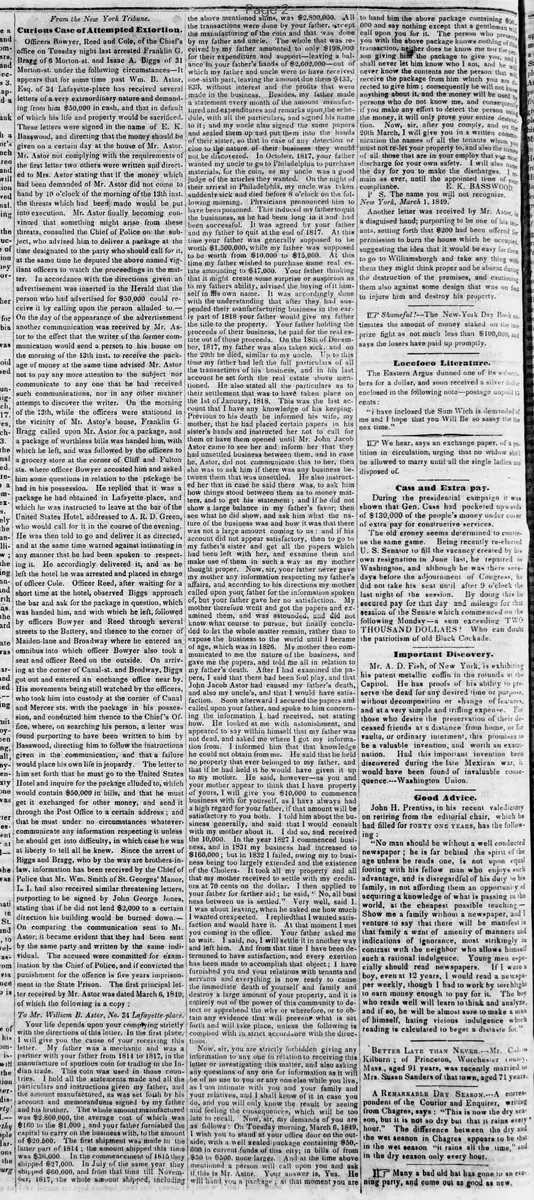
Curious Case of Attempted Extortion.
Officers Bowyer, Reed and Cole, of the Chief’s office on Tuesday night last arrested Franklin G. Bragg of 6 Morton-st. and Isaac A. Biggs of 31 Morton-st. under the following circumstances—It appears that for some time past Wm. B. Astor, Esq. of 34 Lafayette-place has received several letters of a very extraordinary nature and demanding from him $50,000 in cash, and that in default of which his life and property would be sacrificed. These letters were signed in the name of E. K. Basswood, and directing that the money should be given on a certain day at the house of Mr. Astor. Mr. Astor not complying with the requirements of the first letter two others were written and directed to Mrs. Astor stating that if the money which had been demanded of Mr. Astor did not come to hand by 10 o'clock of the morning of the 13th inst. the threats which had been made would be put into execution. Mr. Astor finally becoming convinced that something might arise from these threats, consulted the Chief of Police on the subject, who advised him to deliver a package at the time designated to the party who should call for it, at the same time he deputed the above named vigilant officers to watch the proceedings in the matter. In accordance with the directions given an advertisement was inserted in the Herald that the person who had advertised for $50,000 could receive it by calling upon the person alluded to.—On the day of the appearance of the advertisement another communication was received by Mr. Astor to the effect that the writer of the former communication would send a person to his house on the morning of the 13th inst. to receive the package of money at the same time advised Mr. Astor not to pay any more attention to the subject nor communicate to any one that he had received such communications, nor in any other manner attempt to discover the writer. On the morning of the 13th, while the officers were stationed in the vicinity of Mr. Astor's house, Franklin G. Bragg called upon Mr. Astor for a package, and a package of worthless bills was handed him, with which he left, and was followed by the officers to a grocery store at the corner of Cliff and Fulton sts. where officer Bowyer accosted him and asked him some questions in relation to the package he had in his possession. He replied that it was a package he had obtained in Lafayette-place, and which he was instructed to leave at the bar of the United States Hotel, addressed to A. R. D. Green, who would call for it in the course of the evening. He was then told to go and deliver it as directed, and at the same time warned against intimating in any manner that he had been spoken to respecting it. He accordingly delivered it, and as he left the hotel he was arrested and placed in charge of officer Cole. Officer Reed, after waiting for a short time at the hotel, observed Biggs approach the bar and ask for the package in question, which was handed him, and with which he left, followed by officers Bowyer and Reed through several streets to the Battery, and thence to the corner of Maiden-lane and Broadway where he entered an omnibus into which officer Bowyer also took a seat and officer Reed on the outside. On arriving at the corner of Canal-st. and Broadway, Biggs got out and entered an exchange office near by. His movements being still watched by the officers, who took him into custody at the corner of Canal and Mercer sts. with the package in his possession, and conducted him thence to the Chief's Office, where, on searching his person, a letter was found purporting to have been written to him by Basswood, directing him to follow the instructions given in the communication, and that a failure would place his own life in jeopardy. The letter to him set forth that he must go to the United States Hotel and inquire for the package alluded to, which would contain $50,000 in bills, and that he must get it exchanged for other money, and send it through the Post Office to a certain address; and that he must under no circumstances whatever, communicate any information respecting it unless he should get into difficulty, in which case he was at liberty to tell all he knew. Since the arrest of Biggs and Bragg, who by the way are brothers-in-law, information has been received by the Chief of Police that Mr. Wm. Smith of St. Georges' Manor, L. I. had also received similar threatening letters, purporting to be signed by John George Jones, stating that if he did not lend $2,000 to a certain direction his building would be burned down.—On comparing the communication sent to Mr. Astor; it became evident that they had been sent by the same party and written by the same individual. The accused were committed for examination by the Chief of Police, and if convicted the punishment for the offence is five years imprisonment in the State Prison. The first principal letter received by Mr. Astor was dated March 6, 1849, of which the following is a copy:
To Mr. William B. Astor, No. 34 Lafayette-place.
Your life depends upon your complying strictly with the directions of this letter. In the first place, I will give you the cause of your receiving this letter. My father was a mechanic and was a partner with your father from 1814 to 1817, in the manufacture of spurious coin or trading in the Indian trade. This coin was used in those countries. I hold all the statements made and all the particulars and instructions given my father, and the amount manufactured, as was set out by his account and memorandums signed by my father and his brother. The whole amount manufactured was $2,800,000, the average cost of which was $160 to the $1,000; and your father furnished the capital to carry on the business with, to the amount of $20,500. The first shipment was made in the latter part of 1814; the amount shipped this time was $36,000. In the commencement of 1815 they shipped $27,000. In July of the same year they shipped $60,000, and from that time till November, 1817, the whole amount shipped, including the above mentioned sums, was $2,500,000. All the transactions were done by your father, except the manufacturing of the coin and that was done by my father and uncle. The whole that was received by my father amounted to only $198,000 for their expenditure and support—leaving a balance in your father's hands of $2,602,000—out of which my father and uncle were to have received one-sixth part, leaving the amount due then $433,833, without interest and the profits that were made in the business. Besides, my father made a statement every month of the amount manufactured and expenditures and remarks upon the schedule, with all the particulars, and signed his name to it: and my uncle also signed the same papers and sealed them up and put them into the hands of their sister, so that in case of any detection or clue to the nature of their business they would not be discovered. In October, 1817, your father wanted my uncle to go to Philadelphia to purchase materials, for the coin, as my uncle was a good judge of the articles they wanted. On the night of their arrival in Philadelphia, my uncle was taken suddenly sick and died before 8 o'clock on the following morning. Physicians pronounced him to have been poisoned. This induced my father to quit the business, as he had been long in it and had been successful. It was agreed by your father and my father to quit at the end of 1817. At this time your father was generally supposed to be worth $1,500,000, while my father was supposed to be worth from $10,000 to $15,000. At this time my father wished to purchase some real estate amounting to $47,000. Your father thinking that it might create some surprise or suspicion as to my father's ability, advised the buying of it himself in his own name. It was accordingly done with the understanding that after they had suspended their manufacturing business in the early part of 1818 your father would give my father the title to the property. Your father holding the proceeds of their business, he paid for the real estate out of those proceeds. On the 18th of December, 1817, my father was also taken sick, and on the 20th he died, similar to my uncle. Up to this time my father had left the full particulars of all the transactions of his business, and in his last account he set forth the real estate above mentioned. He also stated all the particulars as to their settlement that was to have taken place on the 1st of January, 1818. This was the last account that I have any knowledge of his keeping. Previous to his death he informed his wife, my mother, that he had placed certain papers in his sister's hands and instructed her not to call for them or have them opened until Mr. John Jacob Astor came to see her and inform her that they had unsettled business between them, and in case he, Astor, did not communicate this to her, then she was to ask him if there was any business between them that was unsettled. He also instructed her that in case he said there was, to ask him how things stood between them as to money matters, and to get his statement: and if he did not show a large balance in my father's favor; then see what he did show, and ask him what the nature of the business was and how it was that there was not a large amount coming to us: and if his account did not appear satisfactory, then to go to my father's sister and get all the papers which had been left with her, and examine them and make use of them in such a way as my mother thought proper. Now, sir, your father never gave my mother any information respecting my father's affairs, and according to his directions my mother called upon your father for the information spoken of, but your father gave her no satisfaction. My mother therefore went and got the papers and examined them, and was astounded, and did not know what course to pursue, but finally concluded to let the whole matter remain, rather than to expose the business to the world until I became of age, which was in 1826. My mother then communicated to me the nature of the business, and gave me the papers, and told me all in relation to my father's death. After I had examined the papers, I said that there had been foul play, and that John Jacob Astor had caused my father's death, and also my uncle's, and that I would have satisfaction. Soon afterward I secured the papers and called upon your father, and spoke to him concerning the information I had received, not stating how. He looked at me with astonishment, and appeared to say within himself that my father was not dead, and asked me where I got my information from. I informed him that that knowledge he could not obtain from me. He said that he held no property that ever belonged to my father, and that if he had held it he would have given it up to my mother. He said, however—as you and your mother appear to think that I have property of yours, I will give you $10,000 to commence business with for yourself, as I have always had a high regard for your father, if that amount will be satisfactory to you both. I told him about the business generally, and said that I would consult with my mother about it. I did so, and received the $10,000. In the year 1827 I commenced business, and in 1831 my business had increased to $160,000; but in 1832 I failed, owing my business being too largely extended and the existence of the Cholera—It took all my property and all that my mother received to settle with my creditors at 70 cents on the dollar. I then applied to your father for further aid; he said, "No, all business between us is settled." Very well, said I. I was about leaving, when he asked me how much I wanted or expected. I replied that I wanted satisfaction and would have it. At that moment I met you coming in the office. Your father asked me to wait. I said, no, I will settle it in another way and left him. And from that time I have been determined to have satisfaction, and every exertion has been made to accomplish that object; I have furnished you and your relations with tenants and servants and everything is now ready to cause the immediate death of yourself and family and destroy a large amount of your property, and it is entirely out of the power of this community to detect or apprehend the why or wherefore, or to obtain any evidence that will prevent what is set forth and will take place, unless the following is complied with in strict accordance with the directions.
Now, sir, you are strictly forbidden giving any information to any one in relation to receiving this letter or investigating this matter, and also asking any questions of any one for information as it will be of no use to you or any one else while you live, as I am intimate with you and your family and your relatives, and I shall know of it in case you do, and you will only know the result by seeing and feeling the consequences, which will be too late to recall. Now, sir, my demands of you are as follows: On Tuesday morning, March 6, 1849, I wish you to stand at your office door on the outside, with a well sealed package containing $50,000 in current funds of this city; in bills from $50 to $500, none larger. And at the time above mentioned a person will call upon you and ask if this is Mr. Astor. Your answer is, Yes. He will hand you a package; at that moment you are to hand him the above package containing $50,000 and say nothing except that a gentleman will call upon you for it. The person who presents you with the above package knows nothing of this transaction, neither does he know me nor the person giving him the package to give you, and I shall never let him know who I am, and he will never know the contents nor the person that will receive the package from him which you are directed to give him; consequently he will not know anything about it, and the money will be used by persons who do not know me, and consequently if you make any effort to detect the person using the money, it will only prove your entire destruction. Now, sir, after you comply, and on the 20th March, I will give you in a written communication the names of all the tenants whom you must not re-let your property to, and also the names of all those that are in your employ that you must discharge for your own safety. I will also name the day for you to make the discharges. I remain as ever, until the appointed time of your compliance.
E. K. BASSWOOD.
P.S. The name you will not recognize.
New York, March 1, 1849.
Another letter was received by Mr. Astor, in a disguised hand; purporting to be one of his tenants, setting forth that $200 had been offered for permission to burn the house which he occupied, suggesting the idea that it would be easy for them to go to Williamsburgh and take any thing with them they might think proper and be absent during the destruction of the premises, and cautioning them also against some design that was on foot to injure him and destroy his property.
What sub-type of article is it?
What themes does it cover?
What keywords are associated?
What entities or persons were involved?
Where did it happen?
Story Details
Key Persons
Location
New York City
Event Date
March 1849
Story Details
Brothers-in-law Bragg and Biggs are arrested for attempting to extort $50,000 from Astor with fabricated letters about a past counterfeit scheme and threats to life and property; police trap leads to their capture while a similar plot targets Wm. Smith.