Thank you for visiting SNEWPapers!
Sign up free
Norfolk Gazette And Publick Ledger
Norfolk, Virginia
What is this article about?
In Aaron Burr's 1807 treason trial, Major James Bruff testifies on Gen. James Wilkinson's 1805 conversations hinting at anti-US schemes, military rule in Louisiana, fortune-making plots, and ties to Burr's Santa Fe expedition and Western empire plans, including barge provision and Easton interactions. (248 chars)
Merged-components note: This is a continuation of the detailed testimony of Major Bruff in the Trial of Col. Burr, spanning multiple pages and components; relabeled from domestic_news to story for the narrative report.
Clippings
1 of 3
OCR Quality
Full Text
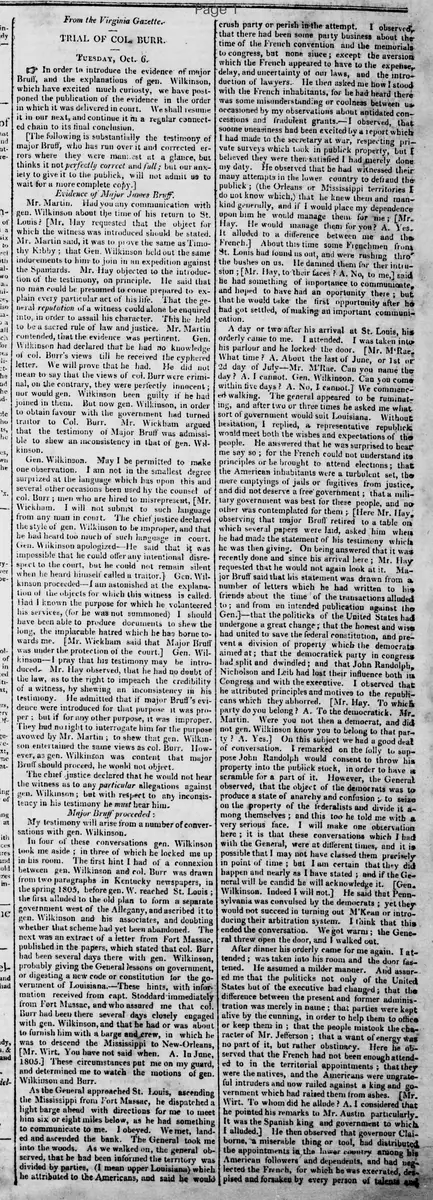
TRIAL OF COL. BURR.
Tuesday, Oct. 6.
In order to introduce the evidence of major Bruff, and the explanations of gen. Wilkinson, which have excited much curiosity, we have postponed the publication of the evidence in the order in which it was delivered in court. We shall resume it in our next, and continue it in a regular connected chain to its final conclusion.
[The following is substantially the testimony of major Bruff, who has run over it and corrected errors where they were manifest at a glance, but thinks it not perfectly correct and full; but our anxiety to give it to the publick, will not admit us to wait for a more complete copy.]
Evidence of Major James Bruff.
Mr. Martin. Had you any communication with gen. Wilkinson about the time of his return to St. Louis? [Mr. Hay requested that the object for which the witness was introduced should be stated. Mr. Martin said, it was to prove the same as Timothy Kibby; that Gen. Wilkinson held out the same inducements to him to join in an expedition against the Spaniards. Mr. Hay objected to the introduction of the testimony, on principle. He said that no man could be presumed to come prepared to explain every particular act of his life. That the general reputation of a witness could alone be enquired into, in order to assail his character. This he held to be a sacred rule of law and justice. Mr. Martin contended, that the evidence was pertinent. Gen. Wilkinson had declared that he had no knowledge of col. Burr's views till he received the cyphered letter. We will prove that he had. He did not mean to say that the views of col. Burr were criminal, on the contrary, they were perfectly innocent; nor would gen. Wilkinson have been guilty if he had joined in them. But now gen. Wilkinson, in order to obtain favour with the government had turned traitor to Col. Burr. Mr. Wickham argued that the testimony of Major Bruff was admissible to shew an inconsistency in that of gen. Wilkinson.
Gen. Wilkinson. May I be permitted to make one observation. I am not in the smallest degree surprized at the language which has upon this and several other occasions been used by the counsel of col. Burr; men who are hired to misrepresent, [Mr. Wickham. I will not submit to such language from any man in court. The chief justice declared the style of gen. Wilkinson to be improper, and that he had heard too much of such language in court. Gen. Wilkinson apologized—He said that it was impossible that he could offer any intentional disrespect to the court, but he could not remain silent when he heard himself called a traitor. Gen. Wilkinson proceeded—I am astonished at the explanation of the objects for which this witness is called. Had I known the purpose for which he volunteered his services, (for he was not summoned) I should have been able to produce documents to shew the long, the implacable hatred which he has borne towards me. Mr. Wickham said that Major Bruff was under the protection of the court.] Gen. Wilkinson—I pray that his testimony may be introduced— Mr. Hay observed, that he had no doubt of the law, as to the right to impeach the credibility of a witness, by shewing an inconsistency in his testimony. He admitted that if major Bruff's evidence were introduced for that purpose it was proper; but if for any other purpose, it was improper. They had no right to interrogate him for the purpose avowed by Mr. Martin; to shew that gen. Wilkinson entertained the same views as col. Burr. However, as gen. Wilkinson was content that major Bruff should proceed, he would not object. The chief justice declared that he would not hear the witness as to any particular allegations against gen. Wilkinson; but with respect to any inconsistency in his testimony he must hear him.
Major Bruff proceeded:
My testimony will arise from a number of conversations with gen. Wilkinson.
In four of these conversations gen. Wilkinson took me aside; in three of which he locked me up in his room. The first hint I had of a connexion between gen. Wilkinson and col. Burr was drawn from two paragraphs in Kentucky newspapers, in the spring 1805, before gen. W. reached St. Louis; the first alluded to the old plan to form a separate government west of the Allegany, and ascribed it to gen. Wilkinson and his associates, and doubting whether that scheme had yet been abandoned. The next was an extract of a letter from Fort Massac, published in the papers, which stated that col. Burr had been several days there with gen. Wilkinson, probably giving the General lessons on government, or digesting a new code or constitution for the government of Louisiana.—These hints, with information received from capt. Stoddard—immediately from Fort Massac, and who assured me that col. Burr had been there several days closely engaged with gen. Wilkinson, and that he had or was about to furnish him with a barge and crew, in which he was to descend the Mississippi to New-Orleans, Mr. Wirt. You have not said when. A. In June, 1805.] These circumstances put me on my guard, and determined me to watch the motions of gen. Wilkinson and Burr.
As the General approached St. Louis, ascending the Mississippi from Fort Massac, he dispatched a light barge ahead with directions for me to meet him six or eight miles below, as he had something to communicate to me. I obeyed. We met, landed and ascended the bank. The General took me into the woods. As we walked on, the general observed, that he had been informed the territory was divided by parties, (I mean upper Louisiana) which he attributed to the Americans, and said he would crush party or perish in the attempt. I observed that there had been some party business about the time of the French convention and the memorials to congress, but none since; except the aversion which the French appeared to have to the expense, delay, and uncertainty of our laws, and the introduction of lawyers. He then asked me how I stood with the French inhabitants, or he had heard there was some misunderstanding or coolness between us occasioned by my observations about antidated concessions and fraudulent grants.—I observed, that some uneasiness had been excited by a report which I had made to the secretary at war, respecting private surveys which took in publick property, but I believed they were then satisfied I had merely done my duty. He observed that he had witnessed their many attempts in the lower country to defraud the publick; (the Orleans or Mississippi territories I do not know which,) that he knew them and mankind generally, and if I would place my dependence upon him he would manage them for me; [Mr. Hay. He would manage them for you? A. Yes. It alluded to a difference between me and the French.] About this time some Frenchmen from St. Louis had found us out, and were rushing thro the bushes on us. He damned them or their intrusion; [Mr. Hay, to their faces? A. No, to me,] said he had something of importance to communicate, and hoped to have had an opportunity there; but that he would take the first opportunity after he had got settled, of making an important communication.
A day or two after his arrival at St. Louis, his orderly came to me. I attended. I was taken into his parlour and he locked the door. [Mr. M'Rae What time? A. About the last of June, or 1st or 2d day of July—Mr. M'Rae. Can you name the day? A. I cannot. Gen. Wilkinson. Can you come within five days? A. No, I cannot.] We commenced walking. The general appeared to be ruminating, and after two or three times he asked me what sort of government would suit Louisiana. Without hesitation, I replied, a representative republick would meet both the wishes and expectations of the people. He answered that he was surprised to hear me say so; for the French could not understand its principles or be brought to attend elections; that the American inhabitants were a turbulent set, the mere emptyings of jails or fugitives from justice, and did not deserve a free government; that a military government was best for these people, and no other was contemplated for them; [Here Mr. Hay, observing that major Bruff retired to a table on which several papers were laid, asked him when he had made the statement of his testimony which he was then giving. On being answered that it was recently done and since his arrival here; Mr. Hay requested that he would not again look at it. Major Bruff said that his statement was drawn from a number of letters which he had written to his friends about the time of the transactions alluded to: and from an intended publication against the Gen.]—that the politicks of the United States had undergone a great change; that the honest and wise had united to save the federal constitution, and prevent a division of property which the democrats aimed at; that the democratick party in congress had split and dwindled; and that John Randolph, Nicholson and Leib had lost their influence both in Congress and with the executive. I observed that he attributed principles and motives to the republicans which they abhorred. [Mr. Hay. To which party do you belong? A. To the democratick. Mr. Martin. Were you not then a democrat, and did not gen. Wilkinson know you to belong to that party? A. Yes.] On this subject we had a good deal of conversation. I remarked on the folly to suppose John Randolph would consent to throw his property into the publick stock, in order to have a scramble for a part of it. However, the General observed, that the object of the democrats was to produce a state of anarchy and confusion; to seize on the property of the federalists and divide it among themselves; and this too he told me with a very serious face. I will make one observation here; it is that these conversations which I had with the General, were at different times, and it is possible that I may not have classed them precisely in point of time; but I am certain that they did happen and nearly as I have stated; and if the General will be candid he will acknowledge it. [Gen. Wilkinson. Indeed I will not.] He said that Pennsylvania was convulsed by the democrats; yet they would not succeed in turning out M'Kean or introducing their arbitration system. I think that this ended the conversation. We got warm; the General threw open the door, and I walked out.
After dinner his orderly came for me again. I attended; was taken into his room and the door fastened. He assumed a milder manner. And assured me that the politicks not only of the United States but of the executive had changed; that the difference between the present and former administration was merely in name; that parties were kept alive by the cunning, in order to help them to office or keep them in; that the people mistook the character of Mr. Jefferson; that a want of energy was no part of it, but rather obstinacy. Here he observed that the French had not been enough attended to in the territorial appointments; that they were the natives, and the Americans were ungrateful intruders and now railed against a king and government which had raised them from ashes. Mr. Wirt. To whom did he allude? A. I considered that he pointed his remarks to Mr. Austin particularly. It was the Spanish king and government to which I alluded.] He then observed that governor Claiborne, a miserable thing or tool, had distributed the appointments in the lower country among his American followers and dependents, and had neglected the French, for which he was execrated, despised and forsaken by every person of talents. honour, except by a Dr. Watkins, who no doubt had some personal views. I observed that in the lower country the great body of the people were French; but that in the upper country there were more than two Americans to one Frenchman, and that the disproportion increased daily by emigration, and would soon entitle us to elections. He replied, God forbid that you should ever see an election in Louisiana; and then observed that it was the intention of the government to depopulate that country, except the villages of St. Louis, St. Genevva and St. Charles, and a small district of coun-try around each, merely sufficient to support them; that land would be offered to the inhabitants on the East side of the Mississippi, which if they refused to move to, they would be pushed over at the point of the bayonet, and that I should be employed in that business. As I found that my replies only ir-ritated the General, and kept back the important communications, I therefore determined that when I could not acquiesce in sentiment with the Gene-ral, I would endeavour to be silent till I got the im-portant secret. But I found I had already gone too far. The General appeared to be vexed and disap-pointed; threw open the door and I walked out. The next morning his orderly came for me again. I attended: and we had another parlour conver-sa-tion with closed doors. He assumed a friendly man-ner, and begged me to recollect that it was some time since I had left the Atlantic States; and assur-ed me that publick opinion had undergone a great change in favour of energetick governments and measures; that if I persisted in exploded notions, they would injure me with my government; that democratick notions produced licentiousness; and that the very existence of an army and democracy were incompatible; that republicks were ungrate-ful; jealous of armies and military merit; and made no provision for the superannuated and worn out officers, but who were left to starve. In these latter opinions I agreed with him. The General seemed pleased that I should assent to any of his o-pinions. He was now silent. While we walked the floor one or two turns, with his eyes down on the floor and seemed to be musing, he then observ-ed that he was fertile in schemes, had made fortunes for many who did not then thank him for it. I smiled. He said perhaps you think I had better made my own fortune--True. But I have now a good scheme in contemplation, that will not only make my fortune, but the fortunes of all concerned; he paused as if waiting for my answer; I was si-lent--had nothing to say; but wanted him to ex-plain and go into the detail; and walking the floor several times, during which he appeared much agi-tated and vexed, he threw open the door and I walk-ed out; with only this glimpse of the secret which he had so long been preparing me for.
As I attended daily for orders until the arrival of col. Cushing; the next morning I found the gene-ral rather distant and reserved. He observed that he had yet enemies in the army; and among them some from his own state; that he either hated or loved Marylanders more than others; presuming this intended for me, I replied, I suppose you take me for a Marylander; why, are you not? I an-swered no, I was born in Jersey, but had the good luck to be brought young to Maryland, of which state my father, grand father, and great grand fa-ther were natives--born in Jersey! (replied the ge-neral,) a second cousin to a yankee, a damned cun-ning fellow I suspect--This was the first rude thing he had said to me; for before this, I was treated with respect, and had received many friendly letters from him; I therefore attributed this to my declining to join him in his scheme to make fortunes: some time after the troops moved to Cold Water, an officer informed me that they were encamped "on a low damp bottom, subject to be overflowed." [Mr. Hay objected to the course of the testimony pursued by the witness; col. Burr said that he did not know the whole extent of his testimony, but that he had been introduced to shew palpable contradictions in the evidence of general Wilkinson.] The Missouri on the one side and a marsh or bog on the other, and the whole cantonment commanded by a high second bank or hill in its rear; I observed the situation was not only unmilitary, but would probably be-come the grave of the troops if they were not re-moved. At that time I did not know the general had contracted for the ground as private property, "a snug fixture where he might hang up his sword." The morning after this conversation I was sent for by the general and severely and rudely reprimanded before two strangers; forbid to interfere with his plans and measures; I replied it was my duty and incli-nation to obey his military arrangements, but should I discover any plan or measures which put to hazard the peace and safety of the United States, I would not keep silence be the consequences what they might; he understood me. And from that moment I believe my ruin was determined on.
Colonel Burr arrived a little time after this at St. Louis. [Mr. Wirt. At what time? A. I believe in August 1805.] A judge Easton who appeared to think very highly of col. Burr and boasted of pos-sessing a part of his confidence, informed me that col. Burr had enquired of him, whether there was any officer of experience and enterprise who could be trusted with the command of an expedition to Santa Fe, and gave me a very inquisitive look.-- I demanded by what authority col. Burr made the inquiry, or in what light I was to view it. He re-plied that col. Burr at that time held no publick of-fice, but that he had powerful friends and would pro-bably be in a very exalted situation before long; that I had been well spoken of to col. Burr (I sup-pose by himself) and he advised me to make him my friend. I answered that the inquiry was a suspicious one; for if government chose to employ me in that or any other way, it had a right to com-mand my services--(for I was in service at that time.) We dropt the subject. [Mr. Martin--Was Easton at St. Louis? A. Yes. Mr. Martin. Was he in habits of great intimacy with general Wilkin-son. A. Yes, there appeared to be a good under-standing between the three.] But as general Wil.kieson some time before had wrote me that "every information of the route to Santa Fe would be highly acceptable," and recently sounded my incli-nation towards energetick governments and his grand scheme to make fortunes, I no longer doubt-ed of their connexion. [Mr. Martin. How long was col. Burr at St. Louis, how was he treated by general Wilkinson, and how was he sent across the river? A. When he arrived I was not in town, but understood that the general had rode out with him to the cantonment to view his troops. I saw the co-lonel on the evening he returned. The colonel stric-tured the situation and laughed at the general's mili-tary notions: Mr. Wirt. At Cold Water? A. Yes, at Cold Water and christened after Belle Fontaine. Mr. Wirt. How far from St. Louis? A. Twelve or fourteen miles. Mr. Martin. When col. Burr was there how was he treated? A. The general made a dinner, it was understood for col. Burr--was in-vited, the colonel did not attend; but was said to be sick--when col. Burr was leaving St. Louis, I was about to cross the river to my plantation on the op-posite side, his baggage was brought to the ferry boat, when I saw the general's barge getting ready with colours and a complete crew in uniform. I af-terwards saw the colonel pass my farm on his jour-ney, in company with Dr. Browne only; Easton was not with him.
Some time after col. Burr left St. Louis, general Wilkinson and Mr. Easton fell out. And often talk-ed in a dark mysterious manner about a Western empire. Captain Stoddard also hinted to me after his return from Fort Massac, that some great scheme was in agitation between col. Burr and ge-neral Wilkinson, but did not say what. Eaton po-sitively stated that there was a connection between gen. Wilkinson and col. Burr. He complained that the General persecuted him, I observed that it was very strange that he should be the common friend of col. Burr and gen. Wilkinson, and yet they should misunderstand one another about him; that I rather suspected the General finding him unpopu-lar with the French, and that he would not answer their purpose, had persuaded col. Burr to shake him off. Easton replied, that col. Burr was in his power and that he dared not treat him in a deceit-ful manner. I replied that I did not know col. Burr, but that his enemies represented him as an artful intriguer. Some time afterwards Mr. Easton came to me and observed that he believed my conjectures about col. Burr were true--and that he was to be made a sacrifice of; that he should go on to the seat of government and try what he could do for himself. Easton was then a judge appointed by the president, but not confirmed by the Senate and he was apprehensive it would not, that gen. Wil-kieson was using his influence to prevent the com-firmation. But observed, col. Burr was much in his power, for that he had made him proposals which made the hair rise upon his head, astonished and confounded him so that he was struck dumb. [Gen. Wilkinson. Were these his very words? A. Yes.] That col. Burr observing this would have retracted but it was too late. I urged him to explain the na-ture of the proposals. He said he was under an ob-ligations of secrecy; but no obligation should hold him if he found col. Burr false to him. I observed that he well knew that any obligation which lead him to conceal or commit a crime could not be binding. He observed he was going to the seat of government and should see col. Burr, and then he should take his measures. I saw Easton after his return. I urged him to explain the business which he had mentioned before; but he pretended to have forgot that such a conversation had ever passed be-tween us. [Mr. Hay. Was his appointment con-firmed? A. No. He had lost his appointment and had seen col. Burr.] About this time a paper called the Western World made its appearance, one of which was I believe directed to the General weekly. [Mr. Hay. After the return of Easton? A. Yes. It roundly accused gen. Wilkinson of the old plan, of being concerned with Miranda and connected with col. Burr. I observed to Easton that I believed I should get the whole story from the Western World without being under any obligations to him; that if he had done his duty he might have saved him-self and his country and perhaps prevented the ef-fusion of blood. He observed that he had once at-tempted to make a disclosure to government, but instead of being countenanced he got a reprimand. I demanded the instance, he said he had wrote to a senator in congress either from Vermont or New York, that he could prove gen. Wilkinson to be the projector of Miranda's expedition. The gentleman acknowledged the receipt of his letter, but inform-ed him he had burnt it, advised him to mind his own business and take care how he meddled with men high in power and office. Mr. Martin. Had gen. Wilkinson any conversation with you with re-spect to the appointment of a certain John Smith of Louisiana. A. I had a conversation with him about John Smith. I remember going into the Ge-neral's office when he handed me two letters, one from major Hunt the civil and military comman-dant, and the other from Smith who complained that the commandant had ordered him off the mi-neral lands--The General censured the order and asked me if I knew who John Smith was. I repli-ed no, but had been informed he had been one of Cox's captains--so major Hunt insidiously ob-serves, replies the General--but that does not lessen him in my esteem. He added that Smith was bro-ther in-law to Mr. Early a member of congress who had bro't forward a resolution to reduce the army and dispense with his services as General; that there were many of his stamp in congress--there-fore they must be attended to and kept in good hu-mour, or we shall be turned to the right about. Mr. Martin. Did you appear before the Secretary at war in order to make a statement as to the conduct of gen. Wilkinson which you considered endangered the United States, and what was his reply? Mr. Hay objected to the question as it had no relation to the subject. Mr. Wickham said that gen. Wil-kieson had been interrogated by them and required to say whether his conduct was approved or disap-proved by the government; that the government had taken the most active part in this prosecution and it was right and proper that the sentiments of the government should be known. The Chief Jus-tice said the difference is this. The evidence of gen. Wilkinson arose from communications officially made directly from the government. This is a dif-ferent case--The evidence here offered consists of conversations with the officers of the government. Mr. Martin said that the Secretary at War was ap-plied to in his official character; and in his official character he said that gen. Wilkinson must and would be supported; that he stood low in the esti-mation of government before his energetick mea-sures at New-Orleans, but now he stood very high. Mr. Hay was about to make some observations in opposition to the introduction of such evidence, when general Wilkinson consented that the witness should go on.]
In March 1807, a few days before the rising of congress, I was in the city of Washington, and waited on the secretary of war, and the subject which gave rise to this visit and conversation be-tween the secretary at war, the attorney general and myself, was an appeal from the sentence of a general court martial, whose proceedings I contend-ed had been arbitrary and oppressive, and sentence illegal and unjust. (Mr. Wirt. Against whom -- A. Myself, and that I was not arrested until after general Wilkinson had sounded and found I would not answer his purpose; and I believed or fear I might penetrate his plans and be a spy on his ac-tions he determined to put me aside. The secreta-ry at war replied that there had been a time when general Wilkinson did not stand well in the execu-tive, but his energetick measures at New-Orleans had regained him his confidence and he would sup-port him. Mr. Wirt. Who? A. I mean the presi-dent. (I asked if an inquiry into the conduct of gen. Wilkinson, his oppressions and illegal acts, and his connection with col. Burr might be expected. He answered there might be an inquiry after the pre-sent bustle was over; but at present he must and would be supported. I then observed that if an in-quiry might be expected in a reasonable time I would ask a furlough and wait; but if not I should resign immediately. He observed that I must not calcu-late on a speedy inquiry; but if I was determined not to serve under general Wilkinson, my only re-sort was to resign immediately. (Mr. Martin. Who said so, Gen. Dearborn? Yes, Gen Dearborn.)- He however recommended me to draw up a short statement of acts for the president, respecting my trial and sentence. I replied that if I did I should certainly charge gen. Wilkinson with having been connected with col. Burr, and with having made attempts to bring me over to his grand scheme of making fortunes. He replied if these are your im-pressions you will be correct in stating them. This was the first conversation I had with the secretary of war.
I had a second conversation with the secretary at war, in which I insisted that gen. Wilkinson was ac-quainted with Burr's plans; that I would produce proof that he had been concerned and did not secede 'till he found that col. Burr had commenced the en-terprize with a handful of men, that the country, was alarmed and the project was a desperate one. I then had a conversation with the Attorney General on the legality of restoring my pay and emolu-ments, which had been suspended by the sentence of the court martial. I informed him that a con-nexion between gen. Wilkinson and col. Burr could certainly be proved. He observed that the General had been low with the president, but at that time stood high and would be supported. He observed however, that there was a great deal of mystery in the allusions of col. Burr's letter to gen. Wilkinson, as well as their making use of a cypher. He ad-vised me not to resign, but to wait events, for the se-cretary at war had informed him that I was the on-ly republican field officer in the service, and that publick opinion was very fluctuating and whimsical.
After this I had a conversation with the secretary at war and the attorney general together. I think that capt. Clark, the companion of Lewis, was also present. The secretary at war shut the doors. We had some previous conversation, as after the attor-ney general came in, the secretary at war introduced it again, by observing, that he had been informed col. Burr had accompanied gen. Wilkinson to the western country, spent several days with him at Massac, and then furnished the Colonel with a barge and men to descend the Mississippi to New-Orleans; I replied that this was one among many reasons to suspect a good understanding, connection and co-operation between the General and Colonel --That I imagined both of them were well informed of the old plan attributed to the general and his associates, to form a separate government west of the Allegany under the auspices of Spain or England; of his famous memorial, which it is said procured him exclusive privileges from the Spanish govern-ment, and the extraordinary visit col. Connolly from Canada paid him in Kentucky; but that there were recent events which were not without suspici-on. Such as his having spent the last winter of col. Burr's vice-presidency at Washington; their great intimacy, the interest made to get gen. Wil-kieson appointed and confirmed governor of upper Louisiana, with Burr's brother-in-law, Secretary to the Territory, and many of his friends, to places of trust and influence. Gen. Wilkinson's drawing se-veral hundred troops into a cantonment near the mouth of the Missouri; his connections with col. Burr, gen. Adair, John Brown of Kentucky, John Smith of Ohio, and several others, since implicated or suspected of being concerned with col. Burr, to procure a charter for cutting a canal on the Indiana side of Ohio, on which charter a bank was ingrafted, and would have produced those funds, the want of which seems first to have made the General to hesi-tate--alluding to a paragraph in the cyphered let-ter. I then stated col. Burr's visit to New Orleans in a barge furnished by general Wilkinson; and that after visiting the lower country, he came to St. Louis. I then stated the conversation with judge Easton as before mentioned, and the intimacy of those three persons, and that when col. Burr was a-bout leaving St. Louis, the general had a barge got ready with much parade to put him over the Missis-sippi; that some time after col. Burr's return to the Atlantick States, Miranda's expedition got ready and sailed, which a gentleman promised, if called on, to come forward and prove gen. Wilkinson to be the projector of; (that gentleman is judge Eas-ton.) I then observed that it was not easy to sup-pose, that col. Burr, who knew Wilkinson's charac-ter, his former attempts and desperate fortune should spend so much time with him at Washington, where the scheme seems to have been first project-ed; pass through the country where colonel Burr must commence his enterprize, where Wilkinson was well acquainted, and where Burr wanted agents (alluding to the Ohio,) and partizans; yet never found him to make proposals, but wait till all was ready, and then make his first overtures by letter; and before he knew the success of that letter in converting a patriot general into a traitor, should throw himself and his best friends, his choice spirits, into the power of a general he had so much insult-ed; that the general's measures in upper Louisiana certainly had a tendency to disgust the people with the change of government, and to prepare them for a revolt; that I did not know the general's at-tempts upon other officers, but he certainly had tried me; but if on the contrary col. Burr did communi-cate his plans to the general either at Washington, at Massac, or St. Louis, and the general did not im-mediately inform his government, he has not only grossly imposed on them, and the publick at large; but has been guilty of misprision of treason and perjury: The attorney general after I had gone through my statement and information, in substance and order nearly as related, asked me what would be the result if all this should be proven;--why just what the federalists and the enemies of the pre-sent administration wish--it would turn the indig-nation of the people from Burr on Wilkinson; Burr would escape and Wilkinson take his place. I ob-served that it possibly might be the event, but jus-tice and honour required that the whole truth should be known, let it operate as it might.
I then left the attorney general and secretary at war together, and stepping down to the post office, found letters from St. Louis, detailing the operations of col. Burr; and of a party from St. Louis and St. Genevieve, the common friends of gen. Wilkinson and col. Burr, who attempted to join him with 12,000 weight of lead. [Mr. Wirt. Who was the letter from? A. Samuel Hammond.] That letter offered proof that the party sent by gen. Wilkinson to Santa Fe, was connected with, and a part of col. Burr's plans. As that letter related to the subject which we had been talking on, I sent it to the se-cretary of war, and the attorney general; and ano-ther letter which came on with it to the same point from judge Easton. They wrote that major Wes-cott and Dr. Steele had left St. Louis and were joined by a Mr. Smith, Dodge, &c. from St. Genevieve, who attempted to join col. Burr near the mouth of the Ohio. The secretary at war returned the letters and thanked me: but I have been surprised after offering proof, and naming gentlemen who knew that a connexion existed between Wilkinson & Burr, that none of them were summoned to the G. Jury. Major Bruff was here asked who those gentlemen were, and he mentioned gen. Adair, Judge Easton, and major Kibby, who would prove the object of the expedition to Santa Fe, also Mr. Provenchere. He then stated that he had seen a letter from gen. Wilkinson to gen. Adair, in which, gen. Wilkinson urged him to come on, said that he could not go on without him, and then asked if he was ashamed to serve under a Spanish conspirator. [General Wil-kieson. When was this letter dated? A. I do not recollect when. Gen. Adair read it to me, he of-fered me a copy, which made me the less particular about its date. Q. Where was the letter received? was it at Washington in March last? A. It was the letter which induced gen. Adair to go to Orleans, as he said.] Gen. Wilkinson pressed him to come on; said that thirty thousand troops would be suf-ficient to effect their purpose; as they would have little more to do than to take possession of the coun-try; that they were to divide them into three co-lumns, and gen. Adair was to have the command of one of them. [Mr. McRae. What country were they to take possession of? A. I cannot say; but my impression was the Spanish country.] The ge-neral then chid him for the caution he used in writing; asked him if he was afraid to trust his friend or ashamed to serve under a Spanish conspi-rator--At the bottom of the letter were these words - "We shall certainly have a Spanish war." Chief Justice. Do you know the hand writing of gen. Wilkinson? A. I do, very well. I sat by him when he read the letter: and it appeared to be the hand writing of gen. Wilkinson; but I did not take it up to compare it. Mr. Martin Do you remem-ber the date? A. I cannot tell the date or the place from which it was written. Mr. Hay. Did it ap-pear as if it was of ancient date or modern? A. Recent--Gen. Adair complained bitterly; he said that this letter had induced him to go to New Or-leans, where he was seized by gen. Wilkinson. Mr. Wirt. Will you name all the witnesses, who could give evidence of the connection between col. Burr and gen. Wilkinson? A. Judge Easton, to prove that gen. Wilkinson was the projector of Miranda's expedition, and to prove his connection with col. Burr; major Timothy Kibby the person whose de-position has been circulated, and Pierre Proven-chere who could prove the connection between gen. Wilkinson and col. Burr, and who was the common friend of both; col. Samuel Hammond with whom gen. Wilkinson had a conversation nearly similar with the one held with me, and Samuel Hammond, jun. I believe I did not mention col. De Piester, to prove the designs of the party, as to the establish-ment of a Western empire. I think col. De Piester was mentioned as the friend of col Burr, and as I am informed, came to St. Louis, as his agent, and brought with him commissions and proclamations. Mr. McRae. Did you see him at St. Louis? A. Yes. A colonel's commission it is said was offered to col. Chouteau, who attempted to throw it into the fire. Mr. Hay. From whom did the proclama-tions and commissions come? A. They were said to be from col. Burr. Mr. Hay. Who was to have commanded the horse? A. Mr. Delony, who had been an officer of the horse in the French service, it was said, was offered command in col. Burr's ar-my. A col. De Piester, it was said, brought on letters, one to Provenchere and another to Timothy Kibby, the common friend of col. Burr and gen. Wilkinson. Chief Justice. Did you see these let-ters? A. We had a little democratick club intend-ed to counteract those gentlemen. A Mr. Wharry to whom Provenchere showed the letter, took a co-py of it, and brought it down to us. Mr. Wirt. What was in the letter? A. Something to this pur-port: "He was ready; hoped they were ready; and, that the expedition would begin to move a-bout the 15th of November" Mr. Martin. How long have you been in the American service? A. I bore arms in 1775 against the tories, had a 2d Lieutenant's place in 1776, and continued in ser-vice throughout the war. Q. Have you been in the service ever since? A. I entered the service again in 1794, under an expectation of bearing arms a-gainst the British; for I had been taken a pri-soner during the war, and had not been well treated by them. Q. What was your grade when you left the army? A. major of Artillery.- Mr. Wickham. Did you see such a deposition as that of Timothy Kibby in the hands of the attorney general, or secretary at war? A. No. I gave them the letter already spoken of; I expected that all the gentlemen whose names I have mentioned would have been summoned. It has been said that I came on here as a volunteer. I certainly should have come on in any event; but I was surprised that those gentlemen should not have been summoned, and that the inquiry should be on one side only.- Mr. Wirt. Is the Samuel Hammond you have men-tioned, the same person who had a commission in the time of Genet? A. The very same. Mr. Hay. I think you said it was in June 1805, that general Wilkinson disclosed to you this important secret. A. Not in June; sometime in the summer. I think in July. Q. What was the impression on your mind at the time: did you suppose that it was some project hostile to the United States? A. I did suspect that he had some grand project in view. I expected that he would have made the disclosure without my saying that I wished him to make my fortune. I did not intend to come under any obligation or to commit myself. (Q. When was the first time that you made any communications to the government or any of its officers, with respect to those projects? A. I have a letter here dated January 8, 1806, in which I say: "I have no confidence in the patriotism of general Wilkinson, and as a man I think of him with horror." Mr. Wirt. To whom is that letter addressed? A. To the secretary at war. Gen. Wilkinson. Were you under arrest at that time? A. No. I was not-(looking at his papers.) It does not appear on this letter that I was under arrest at that time. Mr. Hay. I want to know the fact, whether you were under arrest or not. A. I was not. Q. What was the interval between your arrest and the trial by the court martial? A. I believe 8 or 10 days, but I am not certain. Mr. McRae. Had you not been in expectation of an arrest? A. I had expected it for some time. In a conversation with the general, about my saying that he would not be in service six months, he got very warm, and said "this is sedition." I replied then arrest me. Mr. Hay. At what time did this conversation take place about Cold Water, when you stated in your evidence, your ruin was decided on? A. I think in September 1805. Then commenced a system of persecution, which terminated in my arrest. I was charged among other things with contempt to the general; that I never denied. I was not guilty of all the other charges except that one. Major Bruff then said that the sentence of the court martial had been disapproved by the president of the United States, and his pay and emoluments, which had been suspended by the sentence, restored. Gen. Wilkinson. I understood that was by stipulation: what is the date of the president's reversal? A. I believe it was on the 12th March last, and my pay and emoluments being restored, is equivalent to a reversal. Maj. Bruff proceeded-the secretary at war observed that the president was disposed to do me justice; but it was a delicate point, and there was no precedent where a sentence had been confirmed by the commander in chief, and afterwards reversed by the president. I answered that I thought it was not very delicate in General Wilkinson to approve a sentence when it was a mere personal thing between us. I understood that it was about the 15th November when the expedition was to have commenced, and the Mexican standard, (an emblem of the sun), to have been raised. This delayed my departure from St. Louis. I expected to have seen knights of the sun, and lords of Mexico, among the chiefs of those chosen spirits.
Mr. Martin. Whose property is the place called Cold water? A. I understand the greater part belongs to gen. Wilkinson. About four acres of which is deeded to the United States for a factory. He wrote on to me to purchase such a place. It was about this place, that gen. Wilkinson made the rude attack upon me which I have before mentioned: but I believe the true source was, that I had said to an officer in the confidence of gen. Wilkinson, that he would not be in office six months. I knew that congress was about to meet, and that it was contrary to the genius of our government that he should hold two offices of General and Governor of Louisiana.
General Wilkinson. When did you receive the first intimation of my intention to retire from service? A. This is intimated in a letter from the General, dated April 5, 1805. Did I not reiterate this intention after I came to St. Louis? A. I believe you did. Gen. Wilkinson. Do you recollect at what period after I got to St. Louis, whether late or early? A. I cannot recollect. You often mentioned the subject. Gen. Wilkinson. Were you subpoenaed to attend this place? A. I was. I saw a subpoena in the hands of a gentleman for me; and Mr. Martin had told me in Baltimore that there was one ordered, and therefore I considered myself as subpoenaed from Queen Anne's county, in Maryland. Gen. Wilkinson. Then you had a conference with Mr. Martin? A. I had. Gen. Wilkinson. Do you recollect to have said that you were reluctant to come, but Mr. Martin had promised to lash me into tortures? A. I have said that from a conversation with Mr. Martin, I had reason to believe that your letter to col. Burr "post marked 13th of May," would be produced: but that I should have come in any event. The first intimation I had of this letter was from a letter written by a gentleman of the grand jury to a friend of mine, stricturing the testimony of Gen. Wilkinson given before that body. That part of the letter was confidently read to me.
[Major Bruff was about to state a conversation with Mr. Martin, when he was interrupted by col. Burr, who said that he could not consent to a narration of the conversations which might have been held with his counsel.] Gen. Wilkinson. Did you not say that you thought Burr was guilty; but that I had done you a serious injury, and you thought this a good time to seek redress? A. I have said that I believed col. Burr concerned in that expedition with you. I have said so, and I think so still. Mr. McRae. Will you state the character of Judge Easton? A. I have accused him of an endeavour to swindle me out of half the land we purchased in common, on which an arbitration is now depending. Gen. Wilkinson. Had you no land speculations with Easton? A. No. I had no speculations; but we made a purchase of a single tract of land together. Perhaps you call that land speculations. Gen. Wilkinson. You said that when col. Burr arrived at St. Louis, Easton and myself were intimate?--Major Bruff. I thought so. Gen. Wilkinson. Did you not know that about that time I did not suffer him to come into my house? A. I heard him say after col. Burr had left St. Louis some little time, that you were persecuting him.
What sub-type of article is it?
What themes does it cover?
What keywords are associated?
What entities or persons were involved?
Where did it happen?
Story Details
Key Persons
Location
St. Louis
Event Date
Tuesday, Oct. 6
Story Details
Major James Bruff testifies about multiple private conversations with Gen. Wilkinson in summer 1805, where Wilkinson discussed military government for Louisiana, hinted at schemes to make fortunes, expressed anti-democratic views, and showed connections to Col. Burr's plans including an expedition to Santa Fe and potential Western empire. Bruff recounts suspicions from newspaper hints and Capt. Stoddard's info, Wilkinson's treatment of Burr's visit, fallout with Easton, and later discussions with government officials in 1807 about Wilkinson's involvement in Burr's conspiracy.