Thank you for visiting SNEWPapers!
Sign up free
Editorial
July 28, 1830
Morning Star
Limerick, York County, Maine
What is this article about?
This editorial critiques inadequate views of faith among believers, contrasting self-assured confidence in prosperity with despondency in adversity. It emphasizes true faith as recognizing personal weakness and dependence on God's grace, drawing on biblical examples to promote humility and trust in divine mercy.
Clipping
OCR Quality
95%
Excellent
Full Text
INADEQUATE VIEWS OF FAITH.
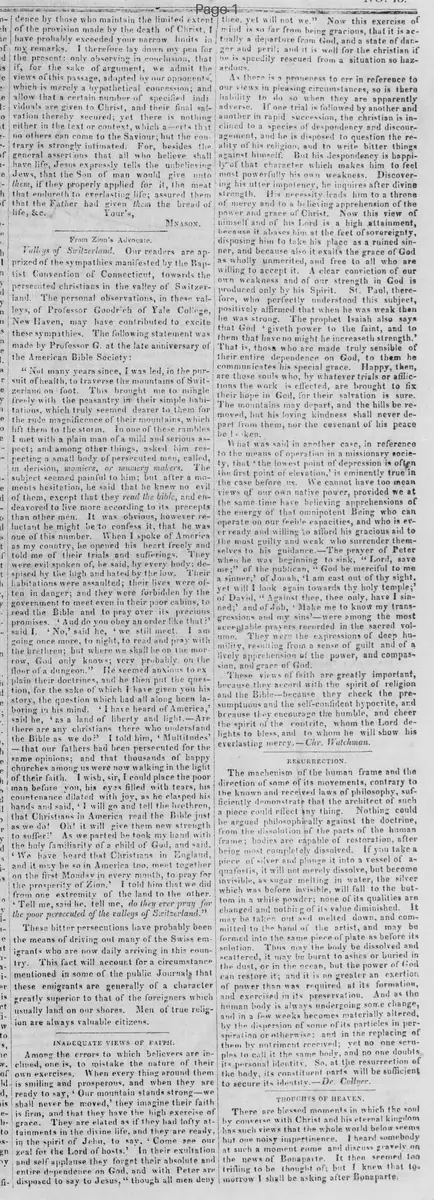
Among the errors to which believers are inclined, one is, to mistake the nature of their own exercises. When every thing around them is smiling and prosperous, and when they are ready to say, 'Our mountain stands strong—we shall never be moved,' they imagine their faith is firm, and that they have the high exercise of grace. They are elated as if they had lofty attainments in the divine life, and they are ready, in the spirit of Jehu, to say, 'Come see our zeal for the Lord of hosts.' In their exultation and self applause they forget their absolute and entire dependence on God, and with Peter are disposed to say to Jesus, "though all men deny thee, yet will not we."
Now this exercise of mind is so far from being gracious, that it is actually a departure from God, and a state of danger and peril; and it is well for the christian if he is speedily rescued from a situation so hazardous.
As there is a proneness to err in reference to our views in pleasing circumstances, so is there liability to do so when they are apparently adverse. If one trial is followed by another and another in rapid succession, the christian is inclined to a species of despondency and discouragement, and he is disposed to question the reality of his religion, and to write bitter things against himself. But his despondency is happily of that character which makes him to feel most powerfully his own weakness. Discovering his utter impotency, he inquires after divine strength. His necessity leads him to a throne of mercy and to a believing apprehension of the power and grace of Christ. Now this view of himself and of his Lord is a high attainment, because it abases him at the feet of sovereignty, disposing him to take his place as a ruined sinner, and because also it exalts the grace of God as wholly unmerited, and free to all who are willing to accept it. A clear conviction of our own weakness and of our strength in God is produced only by his Spirit. St. Paul, therefore, who perfectly understood this subject, positively affirmed that when he was weak then he was strong. The prophet Isaiah also says that God giveth power to the faint, and to them that have no might he increaseth strength. That is, those who are made truly sensible of their entire dependence on God, to them he communicates his special grace. Happy, then, are those souls who, by whatever trials or afflictions the work is effected, are brought to fix their hope in God, for their salvation is sure. The mountains may depart, and the hills be removed, but his loving kindness shall never depart from them, nor the covenant of his peace be broken.
What was said in another case, in reference to the means of operation in a missionary society, that 'the lowest point of depression is often the first point of elevation,' is eminently true in the case before us. We cannot have too mean views of our own native power, provided we at the same time have believing apprehensions of the energy of that omnipotent Being who can operate on our feeble capacities, and who is ever ready and willing to afford his gracious aid to the most guilty and weak who surrender themselves to his guidance. The prayer of Peter when he was beginning to sink, "Lord, save me;" of the publican, "God be merciful to me a sinner;" of Jonah, 'I am cast out of thy sight, yet will I look again towards thy holy temple;' of David, "Against thee, thee only, have I sinned;" and of Job, 'Make me to know my transgressions and my sins'—were among the most acceptable prayers recorded in the sacred volume. They were the expressions of deep humility, resulting from a sense of guilt and of a lively apprehension of the power, and compassion, and grace of God.
These views of faith are greatly important, because they accord with the spirit of religion and the Bible—because they check the presumptuous and the self-confident hypocrite, and because they encourage the humble, and cheer the spirit of the contrite, whom the Lord delights to bless, and to whom he will show his everlasting mercy.—Chr. Watchman.
Among the errors to which believers are inclined, one is, to mistake the nature of their own exercises. When every thing around them is smiling and prosperous, and when they are ready to say, 'Our mountain stands strong—we shall never be moved,' they imagine their faith is firm, and that they have the high exercise of grace. They are elated as if they had lofty attainments in the divine life, and they are ready, in the spirit of Jehu, to say, 'Come see our zeal for the Lord of hosts.' In their exultation and self applause they forget their absolute and entire dependence on God, and with Peter are disposed to say to Jesus, "though all men deny thee, yet will not we."
Now this exercise of mind is so far from being gracious, that it is actually a departure from God, and a state of danger and peril; and it is well for the christian if he is speedily rescued from a situation so hazardous.
As there is a proneness to err in reference to our views in pleasing circumstances, so is there liability to do so when they are apparently adverse. If one trial is followed by another and another in rapid succession, the christian is inclined to a species of despondency and discouragement, and he is disposed to question the reality of his religion, and to write bitter things against himself. But his despondency is happily of that character which makes him to feel most powerfully his own weakness. Discovering his utter impotency, he inquires after divine strength. His necessity leads him to a throne of mercy and to a believing apprehension of the power and grace of Christ. Now this view of himself and of his Lord is a high attainment, because it abases him at the feet of sovereignty, disposing him to take his place as a ruined sinner, and because also it exalts the grace of God as wholly unmerited, and free to all who are willing to accept it. A clear conviction of our own weakness and of our strength in God is produced only by his Spirit. St. Paul, therefore, who perfectly understood this subject, positively affirmed that when he was weak then he was strong. The prophet Isaiah also says that God giveth power to the faint, and to them that have no might he increaseth strength. That is, those who are made truly sensible of their entire dependence on God, to them he communicates his special grace. Happy, then, are those souls who, by whatever trials or afflictions the work is effected, are brought to fix their hope in God, for their salvation is sure. The mountains may depart, and the hills be removed, but his loving kindness shall never depart from them, nor the covenant of his peace be broken.
What was said in another case, in reference to the means of operation in a missionary society, that 'the lowest point of depression is often the first point of elevation,' is eminently true in the case before us. We cannot have too mean views of our own native power, provided we at the same time have believing apprehensions of the energy of that omnipotent Being who can operate on our feeble capacities, and who is ever ready and willing to afford his gracious aid to the most guilty and weak who surrender themselves to his guidance. The prayer of Peter when he was beginning to sink, "Lord, save me;" of the publican, "God be merciful to me a sinner;" of Jonah, 'I am cast out of thy sight, yet will I look again towards thy holy temple;' of David, "Against thee, thee only, have I sinned;" and of Job, 'Make me to know my transgressions and my sins'—were among the most acceptable prayers recorded in the sacred volume. They were the expressions of deep humility, resulting from a sense of guilt and of a lively apprehension of the power, and compassion, and grace of God.
These views of faith are greatly important, because they accord with the spirit of religion and the Bible—because they check the presumptuous and the self-confident hypocrite, and because they encourage the humble, and cheer the spirit of the contrite, whom the Lord delights to bless, and to whom he will show his everlasting mercy.—Chr. Watchman.
What sub-type of article is it?
Moral Or Religious
What keywords are associated?
Faith
Humility
Dependence On God
Biblical Examples
Christian Trials
Grace
Weakness
Salvation
What entities or persons were involved?
St. Paul
Prophet Isaiah
Peter
Jehu
Publican
Jonah
David
Job
Chr. Watchman
Editorial Details
Primary Topic
Inadequate Views Of Faith In Prosperity And Adversity
Stance / Tone
Encouraging Humility And Dependence On God's Grace
Key Figures
St. Paul
Prophet Isaiah
Peter
Jehu
Publican
Jonah
David
Job
Chr. Watchman
Key Arguments
Believers Mistake Self Assurance In Prosperity For True Faith, Leading To Peril.
Despondency In Adversity Can Lead To Recognizing Weakness And Seeking God's Strength.
True Faith Involves Abasing Oneself And Exalting God's Unmerited Grace.
Biblical Examples Show Humility In Prayer As Acceptable To God.
Such Views Check Hypocrites And Encourage The Contrite.