Thank you for visiting SNEWPapers!
Sign up free
The Daily Gate City
Keokuk, Lee County, Iowa
What is this article about?
Correspondence from Chambersburg, PA, on June 18, 1863, details the Confederate invasion: panic from Union supply train stampede, citizens hiding valuables and horses, rebels under Gen. Jenkins entering town, capturing negroes, destroying arms, and behaving relatively orderly while foraging.
Merged-components note: These components form a continuous narrative about the rebel invasion of Pennsylvania and related events in Chambersburg, including private/public arms and discussions at the Franklin House.
Clipping
OCR Quality
Full Text
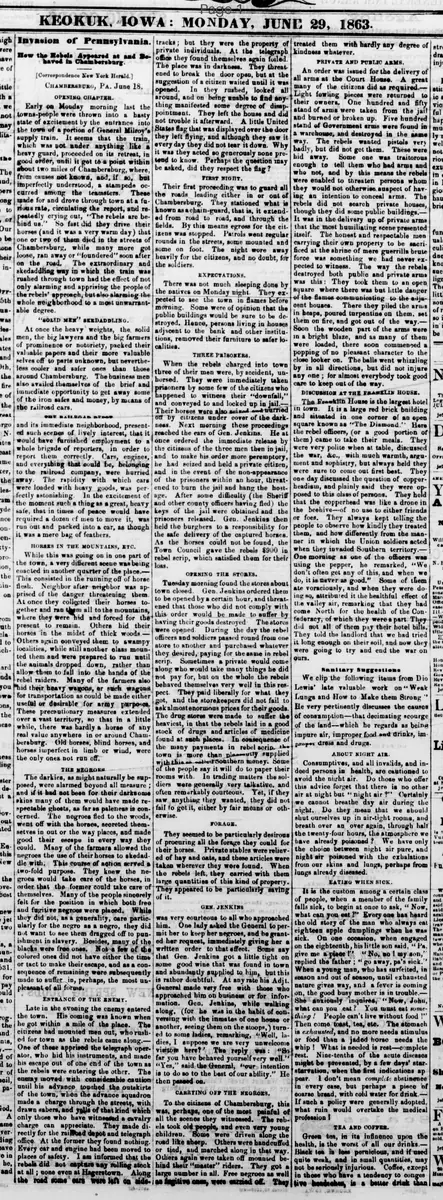
Invasion of Pennsylvania.
How the Rebels Appeared at and Behaved in Chambersburg.
[Correspondence New York Herald.]
CHAMBERSBURG, PA. June 18.
OPENING CHAPTER.
Early on Monday morning last the towns-people were thrown into a hasty state of excitement by the entrance into the town of a portion of General Milroy's supply train. It seems that the train, which was not under anything like heavy guard, proceeded on its retreat, in good order, until it got to a point within about two miles of Chambersburg, where, from causes not known, and, if so, but imperfectly understood, a stampede occurred among the teamsters. These made for and drove through town at a furious rate, circulating the report, and repeatedly crying out, "The rebels are behind us." So fast did they drive their horses (and it was a very warm day) that one or two of them died in the streets of Chambersburg, while many more got loose, ran away or "foundered" soon after on the road. The extraordinary and skedaddling way in which the train was rushed through town had the effect of not only alarming and apprising the people of the rebels' approach, but also alarming the whole neighborhood to a most unwarrantable degree.
"SOLID MEN" SKEDADDLING.
At once the heavy-weights, the solid men, the big lawyers and the big farmers of prominence or notoriety, packed their valuable papers and their more valuable selves off to parts unknown, but nevertheless cooler and safer ones than those around Chambersburg. The business men also availed themselves of the brief and immediate opportunity to get away some of the iron safes and money, by means of the railroad cars. and its immediate neighborhood, presented such scenes of lively interest, that it would have furnished employment to a whole brigade of reporters, in order to report them correctly. Cars, engines, and everything that could be, belonging to the railroad company, were hurried away. The rapidity with which cars were loaded with heavy goods, was perfectly astonishing. In the excitement of the moment such a thing as a great, heavy safe, that in times of peace would have required a dozen men to move it, was run out and packed into a car, as though it was a mere bag of feathers.
HORSES IN THE MOUNTAINS, ETC.
While this was going on in one part of the town, a very different scene was being enacted in another quarter of the place. This consisted in the running off of horse flesh. Neighbor after neighbor was apprised of the danger threatening them. At once they collected their horses together and ran them all to the mountains, where they were hid and forced for the present to remain. Others hid their horses in the midst of thick woods.— Others again conveyed them to swampy localities, while still another class mounted them and were prepared to run until the animals dropped down, rather than allow them to fall into the hands of the rebel raiders. Many of the farmers also hid their heavy wagons, or such wagons for transportation as could be made either useful or desirable for army purposes. These precautionary measures extended over a vast territory, so that in a little while, there was hardly a horse of any real value anywhere in or around Chambersburg. Old horses, blind horses, and horses imperfect in limb or wind, were the only ones not run off.
THE NEGROES
The darkies, as might naturally be supposed, were alarmed beyond all measure; and if it had not been for their darksome skins many of them would have made respectable ghosts, as far as paleness is concerned. The negroes fled to the woods, went off with the horses, secreted themselves in out of the way places, and made good their escape in every way they could. Many of the farmers allowed the negroes the use of their horses to skedaddle with. This course of action served a two-fold purpose. They knew the negroes would take care of the horses, in order that the former could take care of themselves. Many of the people sincerely felt for the position in which both free and fugitive negroes were placed. While they did not, as a generality, care particularly for the negro as a negro, they did not want to see them dragged off to punishment in slavery. Besides, many of the blacks were free ones. Not a few of the colored ones did not have either the time or tact to make their escape, and as a consequence of remaining were subsequently made to suffer in, perhaps, the most unpleasant of all forms,
ENTRANCE OF THE ENEMY.
Late in the evening the enemy entered the town. His coming was known when he got within a mile of the place. The citizens had mounted men out, who rushed for town as the rebels came along.— One of these apprised the telegraph operator, who hid his instruments, and made his escape out of one end of the town as the rebels were entering the other. The enemy moved with considerable caution until his advance touched the outskirts of the town, when the advance squadron made a charge through the streets, with drawn sabers, and yells of that kind which only those who have witnessed a cavalry charge can appreciate. They made directly for the railroad depot and telegraph office. At the former they found nothing. Every car and engine had been moved to places of safety. I am informed that the rebels did not capture any rolling stock at all; none even at Hagerstown. Along the road some cars were left on side tracks; but they were the property of private individuals. At the telegraph office they found themselves again foiled. The place was in darkness. They threatened to break the door open, but at the suggestion of a citizen waited until it was opened. In they rushed, looked all around, and on being unable to find anything manifested some degree of disappointment. They left the house and did not trouble it afterward. A little United States flag that was displayed over the door they left flying, and although they saw it every day they did not tear it down. Why it was they acted so generously none pretend to know. Perhaps the question may be asked, did they respect the flag?
FIRST NIGHT.
Their first proceeding was to guard all the roads leading either in or out of Chambersburg. They stationed what is known as a chain-guard, that is, it extended from road to road, and through the fields. By this means egress for the citizens was stopped. Patrols went regular rounds in the streets, some mounted and some on foot. The night wore away heavily for the citizens, and no doubt, for the soldiers.
EXPECTATIONS.
There was not much sleeping done by the natives on Monday night. They expected to see the town in flames before morning. Some were of opinion that the public buildings would be sure to be destroyed. Hence, persons living in houses adjacent to the bank and other institutions, removed their furniture to safer localities.
THREE PRISONERS.
When the rebels charged into town three of their men were, by accident, unhorsed. They were immediately taken prisoners by some few of the citizens who happened to witness their "downfall." and conveyed to and locked up in jail.— Their horses were also gained and hurried off by citizens under cover of the dark. ness. Next morning these proceedings reached the ears of Gen. Jenkins. He at once ordered the immediate release by the citizens of the three men then in jail, and to make his order more peremptory, he had seized and held a private citizen, and in the event of the non-appearance of the prisoners within an hour, threatened to burn the jail and hang the hostage. After some difficulty (the Sheriff and other county officers having fled) the keys of the jail were obtained and the prisoners released. Gen. Jenkins then held the burgesses to a responsibility for the safe delivery of the captured horses. As the horses could not be found, the Town Council gave the rebels $900 in rebel scrip, which satisfied them for their loss.
OPENING THE STORES.
Tuesday morning found the stores about town closed. Gen. Jenkins ordered them to be opened by a certain hour, and threatened that those who did not comply with this order would be made to suffer by having their goods destroyed The stores were opened. During the day the rebel officers and soldiers passed round from one store to another and purchased whatever they desired, paying for the same in rebel scrip. Sometimes a private would come along who would take many things he did not pay for, but on the whole the rebels behaved themselves very well in this respect. They paid liberally for what they got, and the storekeepers did not fail to ask almost enormous prices for their goods. The drug stores were made to suffer the heaviest, in that the rebels laid in a good stock of drugs and articles of medicine found at such places. In consequence of the many payments in rebel scrip. the town is more than pleasantly supplied with this so-called Southern money. Some of the people say it will do to paper their rooms with. In trading matters the soldiers were generally very talkative, and often remarkably courteous. Yet, if they saw anything they wanted, they did not fail to get it, either by fair means or otherwise.
FORAGE.
They seemed to be particularly desirous of procuring all the forage they could for their horses. Private stables were relieved of hay and oats, and these articles were taken wherever they were found. When the rebels left, they carried with them large quantities of this kind of property. They appeared to be particularly saving of it.
GEN. JENKINS
was very courteous to all who approached him. One lady asked the General to permit her to keep her negroes, and he granted her request, immediately giving her a written order to that effect. Some say that Gen. Jenkins got a little tight on some good wine that was found in town and abundantly supplied to him, but this is rather doubtful. At any rate his Adjt. General made very free with those who approached him on business or for information. Gen. Jenkins, while walking along. (for he was in the habit of conversing with the inmates of one house or another, seeing them on the stoops,) turned to some ladies, remarking, "Well, ladies, I suppose we are very unwelcome visitors here?' The reply was: "So far you have behaved yourself very well." "Yes," said the General, "our intention is to do so to the best of our ability." He then passed on.
CARRYING OFF THE NEGROES.
To the citizens of Chambersburg, this was, perhaps, one of the most painful of all the scenes they witnessed. The rebels took old people, and even very young children. Some were driven along the road like sheep. Others were handcuffed or tied, and marched along in that way. Others again were taken off mounted behind their "master" riders. They got a large number in all. Free negroes as well as fugitive ones, were carried off. They treated them with hardly any degree of kindness whatever.
PRIVATE AND PUBLIC ARMS.
An order was issued for the delivery of all arms at the Court House. A great many of the citizens did as required.— Light fowling pieces were returned to their owners. One hundred and fifty stand of arms were taken from the jail and burned or broken up. Five hundred stand of Government arms were found in a warehouse, and destroyed in the same way. The rebels wanted pistols very badly, but did not get them. These were hid away. Some one was traitorous enough to tell them who had arms and who not, and by this means the rebels were enabled to threaten persons whom they would not otherwise suspect of having an intention to conceal arms. The rebels did not search private houses, though they did some public buildings.— It was in the delivery up of private arms that the most humiliating scene presented itself. The honest and respectable men carrying their own property to be sacrificed at the shrine of mere guerrilla brute force was something we had never expected to witness. The way the rebels destroyed both public and private arms was this: They took them to an open square where there was but little danger of the flames communicating to the adjacent houses. There they piled the arms in heaps, poured turpentine on them, set them on fire, and got out of the way.— Soon the wooden part of the arms were in a bright blaze, and as many of them were loaded, there soon commenced a popping of no pleasant character to the close looker on. The balls went whizzing by in all directions, but did not injure any one; for almost everybody took good care to keep out of the way.
DISCUSSION AT THE FRANKLIN HOUSE.
The Franklin House is the largest hotel in town. It is a large red brick building and situated in one corner of an open square known as "The Diamond." Here the rebel officers, (or a good portion of them) came to take their meals. They were very polite when at table, discussed the war, &c., with much warmth, argument and sophistry, but always held they were sure to come out first best. They one day discussed the question of copperheadism, and plainly said they were opposed to this class of persons. They held that the copperhead was like a drone in the beehive—of no use to either friends or foes. They always kept telling the people to observe how kindly they treated them, and how differently from the manner in which the Union soldiers acted when they invaded Southern territory. One morning as one of the officers was using the pepper, he remarked, "We don't often get any of this, and when we do, it is never as good." Some of them ate voraciously, and when they were doing so, attributed it the healthful effect of the valley air, remarking that they had come North for the health of the Confederacy, of which they were a part. They did not all of them pay their hotel bills. They told the landlord that we had tried it long enough on their soil, and now they were going to try and end the war on ours.
What sub-type of article is it?
What themes does it cover?
What keywords are associated?
What entities or persons were involved?
Where did it happen?
Story Details
Key Persons
Location
Chambersburg, Pa
Event Date
June 18, 1863
Story Details
Union supply train stampede alerts town to rebel approach; citizens hide horses, valuables, and aid negroes' escape; Confederates under Gen. Jenkins enter, guard town, force stores open, forage supplies, capture and mistreat negroes, destroy arms, and discuss war at hotel while behaving orderly.