Thank you for visiting SNEWPapers!
Sign up free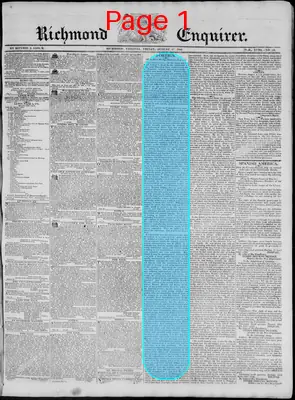
Richmond Enquirer
Richmond, Richmond County, Virginia
What is this article about?
Debate in Bell's Weekly Messenger on the expense of the upcoming July 19 coronation, weighing its cost against economic distress and potential benefits to manufactures and national unity under the King.
Clipping

OCR Quality
Full Text
[From Bell's Weekly Messenger, June 24.]
The Coronation.--As this royal and national festival is fixed for the nineteenth of July, next Thursday three weeks, it may not be altogether without interest to consider a question now much agitated. Whether there is any such national object and possible utility in this expensive festival, as may indemnify the public for its enormous expense; whether, in short, it is really a national object, or little better than a frivolity, in no degree suited to the actual difficulties of the times, and to the spirit of an age now becoming manly and sober? In all questions of the comparative good or ill of any proposed measure, the natural process is to consider the cost and the worth, apart and distinct from each other, and then, by the collation of the two results together, to determine which should prevail with the judgment; or, in other words, whether the thing is worth its cost, and the good preponderates over the ill.
Now, as regards the Coronation, the objections to it are these. That the country, and particularly the agricultural interest, are in circumstances of great difficulty and distress, and cannot very well afford such an augmentation of the annual expenditure, for the current year, as will result from this expensive show. That the agriculturists have collected all their possible strength to procure the abolition of the Agricultural Horse Tax, the weight of which upon this interest did not exceed five hundred thousand pounds, though ministers will lose nearly seven by its removal. But that this show,--this Mayday holiday, will of itself exceed five hundred thousand pounds in cost, --that is to say, will render this victory of the landed interest nugatory, and will at once add as much as the abolition of the tax removed.
And (it is demanded) for what useful purpose? If a million be voted for the building of churches, the churches remain, and the capital is embellished and dignified to future times.-- But the furs and the lace the drums and the trumpets--the ribbons and the strewed flowers --the cups and the basins--the ewers and the napkins--the towels, and all the paraphernalia of this show, will expire with the day. It is not to be denied, the objectors add, that even a show for a day is worth something. But is it worth five hundred thousand pounds? And what do the public get by this expense beyond the passing show? They get the oath of the king to observe the laws. But do they not possess that already, and do the people require this security for the Constitution? Are we not protected by something (with respect be it spoken) perfectly as satisfactory in the necessary English feeling,--by the good faith and royal honour of a British King; and let us add, on our own parts, in our own resolute will and strength to defend our own rights under the Law and Constitution? Is not this, to speak candidly, a mere artificial argument, and totally without any worth or even serious meaning in those who use it? Will any one venture to assert, that there truly can be any public good or purpose in this expensive festival, and that the constitution will derive any additional strength and security from any thing which will pass on that day. But if there be nothing to oppose to its cost, will it be contended that this is a reason to throw away half a million of money upon a show, which, like a fire work, blazes and bursts in the same moment and after the day which it occupies, leaves nothing behind but the regret of the money expended. This we believe, is the sum of the objection. Let us now see the answer.
It is perfectly true, the ministers reply, that the festival, or as you call it the show, is but the holiday of a day, and that it is attended with an expense which the country, under its present circumstances, can ill afford. It is perfectly true, that the money might be more wisely and better spent; and that its result, in adding to our constitutional security, is not very manifest, nor very substantial. But, though it may be accompanied, and actually is so, with a large public expense, is it not equally accompanied with a large private expenditure amongst the noble and the rich, and therein with the circulation of a large amount of money in aid of the manufactures of the country? How many fur manufacturers, muff makers, robe tailors, men and women milliners, haberdashers and lace makers --to say nothing of Astley's, the circus, the theatre, the plumasiers, and the confectioners --will be assisted by the expenditure upon this occasion? And is not this a public benefit?
We say nothing of the money which is to be paid to Messrs. Rundle and Bridge for the loan of the jewels which are to be added to the imperial crown; we say nothing of the satisfaction of so many young nobility and gentry, who are assembling from all parts of the country to see this fine festival. And is it possible, Lord Londonderry adds, in this part of the argument, for a noble, a generous, a magnanimous people, like the people of England, Scotland, and the well disposed part of Ireland, to consider, without a loyal sympathy, how much satisfaction their Sovereign will feel upon this occasion, when a loyal and grateful people, habited in all the manufactures of the united empire, and raising them from the condition into which they were sunk by the sudden transition from war to peace, shall hail him as the worthy successor of the House of Brunswick? Is it nothing that his Majesty and his people will become better acquainted with each other, and that each shall see the other with all that advantage which a general festival and splendid array confer? Under the laws of this country, it is his Majesty's unquestionable right to be thus crowned: his Majesty desires it; and we must concede it.
As far as we understand the question, this is the fair statement of it on both sides, and we shall leave it in this condition. We have certainly no objection, there can be none in any quarter, to a more liberal circulation of the money of the rich in aid of manufactures and internal trade; and if it can be made to appear that the expenditure of half a million of the national money forces out about four times as much from the private purse of the rich and great, we shall think the half million not so ill expended. At the same time we cannot forget, that the furs, the feathers, and, in great portion, the lace, and the robes, are not of British manufacture: and that the whole expenditure is too much of a description which, being attached rather to finery and frippery than to the substantial produce of British industry, can see assisted.
What sub-type of article is it?
What keywords are associated?
What entities or persons were involved?
Where did it happen?
Foreign News Details
Primary Location
England
Event Date
Nineteenth Of July
Key Persons
Event Details
Article debates the utility and expense of the upcoming coronation festival, estimated at over 500,000 pounds, amid agricultural distress following the abolition of the Horse Tax. Objections highlight its transience compared to lasting public works, questioning added constitutional security. Ministers counter with benefits to private expenditure on manufactures, national unity, and the King's right to be crowned.