Thank you for visiting SNEWPapers!
Sign up free
Literary
March 21, 1820
Elizabeth Town Gazette
Elizabeth, Union County, New Jersey
What is this article about?
A physician writes to a friend about failing eyesight, sharing an extract from a 1805 letter by Edgerton Smith describing Mr. Baldwin's innovative use of concave spectacles to counteract eye flatness and improve vision through habit.
Clipping
OCR Quality
95%
Excellent
Full Text
From the National Intelligencer.
ON EYE SIGHT.
Extract of a letter from a physician to a gentleman in Washington.
My dear Friend:
I lament to be apprised, by your letter, that your eye-sight is failing. I sympathize with you sincerely, having experienced the same infirmity.
In the use of spectacles. which. I feel. you will have to resort to. injury will be done to the eyes, unless judiciously chosen. A friend has furnished me with an old newspaper, from which I have extracted the following, which, I hope, may contain hints useful to you :
" To the editor of the Monthly Magazine.
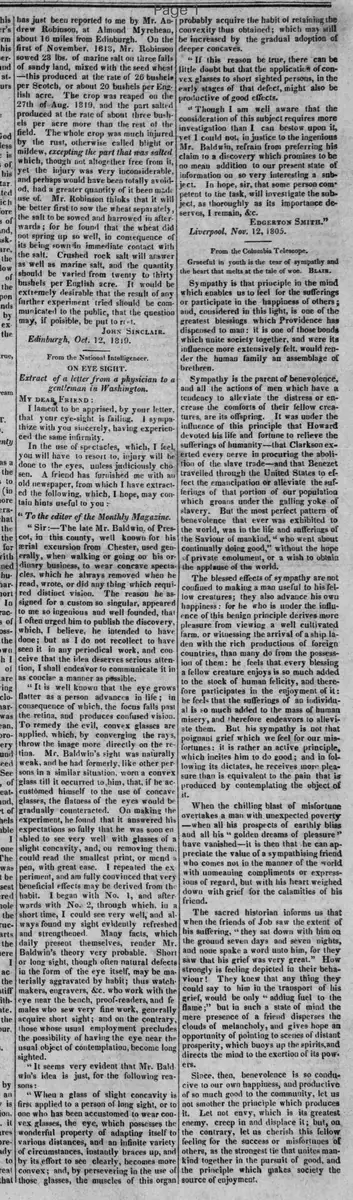
" Sir:-The late Mr. Baldwin, of Prescot, in this county, well known for his ærial excursion from Chester, used generally, when walking or going on his ordinary business, to wear concave spectacles, which he always removed when he read, wrote, or did any thing which required distinct vision. The reason he assigned for a custom so singular, appeared to me so ingenious and well founded, that I often urged him to publish the discovery. which, I believe. he intended to have done; but as I do not recollect to have seen it in any periodical work, and conceive that the idea deserves serious attention, I shall endeavor to communicate it in as concise a manner as possible.
" It is well known that the eye grows flatter as a person advances in life; in consequence of which, the focus falls past the retina, and produces confused vision. To remedy the evil, convex glasses are applied, which, by converging the rays. throw the image more directly on the retina. Mr. Baldwin's sight was naturally weak, and he had formerly, like other persons in a similar situation, worn a convex glass till it occurred to him, that, if he accustomed himself to the use of concave glasses, the flatness of the eyes would be gradually counteracted. On making the experiment, he found that it answered his expectations so fully that he was soon enabled to see very well with glasses of a slight concavity, and, on removing them, could read the smallest print, or mend a pen, with great ease. I repeated the experiment, and am fully convinced that very beneficial effects may be derived from the habit. I began with No. 1, and afterwards with No. 2, through which, in a short time, I could see very well, and always found my sight evidently refreshed and strengthened.Many facts, which daily present themselves, render Mr. Baldwin's theory very probable. Short or long sight, though often natural defects in the form of the eye itself, may be materially aggravated by habit; thus watch makers, engravers, &c. who work with the eye near the bench, proof-readers, and females who sew very fine work, generally acquire short sight; and on the contrary, those whose usual employment precludes the possibility of having the eye near the usual object of contemplation, become long sighted.
" It seems very evident that Mr. Baldwin's idea is just, for the following reasons:
" When a glass of slight concavity is first applied to a person of long sight, or to one who has been accustomed to wear convex glasses, the eye, which possesses the wonderful property of adapting itself to various distances, and an infinite variety of circumstances, instantly braces up, and by its effort to see clearly, becomes more convex; and, by persevering in the use of those glasses, the muscles of this organ probably acquire the habit of retaining the convexity thus obtained; which may still be increased by the gradual adoption of deeper concaves.
" If this reason be true, there can be little doubt but that the application of convex glasses to short sighted persons, in the early stages of that defect, might also be productive of good effects.
" Though I am well aware that the consideration of this subject requires more investigation than I can bestow upon it yet I could not. in justice to the ingenious Mr. Baldwin, refrain from preferring his claim to a discovery which promises to be no mean addition to our present state of information on so very interesting a subject. In hope, sir, that some person competent to the task, will investigate the subject, as thoroughly as its importance deserves, I remain, &c.
EDGERTON SMITH."
Liverpool, Nov. 12, 1805.
ON EYE SIGHT.
Extract of a letter from a physician to a gentleman in Washington.
My dear Friend:
I lament to be apprised, by your letter, that your eye-sight is failing. I sympathize with you sincerely, having experienced the same infirmity.
In the use of spectacles. which. I feel. you will have to resort to. injury will be done to the eyes, unless judiciously chosen. A friend has furnished me with an old newspaper, from which I have extracted the following, which, I hope, may contain hints useful to you :
" To the editor of the Monthly Magazine.
" Sir:-The late Mr. Baldwin, of Prescot, in this county, well known for his ærial excursion from Chester, used generally, when walking or going on his ordinary business, to wear concave spectacles, which he always removed when he read, wrote, or did any thing which required distinct vision. The reason he assigned for a custom so singular, appeared to me so ingenious and well founded, that I often urged him to publish the discovery. which, I believe. he intended to have done; but as I do not recollect to have seen it in any periodical work, and conceive that the idea deserves serious attention, I shall endeavor to communicate it in as concise a manner as possible.
" It is well known that the eye grows flatter as a person advances in life; in consequence of which, the focus falls past the retina, and produces confused vision. To remedy the evil, convex glasses are applied, which, by converging the rays. throw the image more directly on the retina. Mr. Baldwin's sight was naturally weak, and he had formerly, like other persons in a similar situation, worn a convex glass till it occurred to him, that, if he accustomed himself to the use of concave glasses, the flatness of the eyes would be gradually counteracted. On making the experiment, he found that it answered his expectations so fully that he was soon enabled to see very well with glasses of a slight concavity, and, on removing them, could read the smallest print, or mend a pen, with great ease. I repeated the experiment, and am fully convinced that very beneficial effects may be derived from the habit. I began with No. 1, and afterwards with No. 2, through which, in a short time, I could see very well, and always found my sight evidently refreshed and strengthened.Many facts, which daily present themselves, render Mr. Baldwin's theory very probable. Short or long sight, though often natural defects in the form of the eye itself, may be materially aggravated by habit; thus watch makers, engravers, &c. who work with the eye near the bench, proof-readers, and females who sew very fine work, generally acquire short sight; and on the contrary, those whose usual employment precludes the possibility of having the eye near the usual object of contemplation, become long sighted.
" It seems very evident that Mr. Baldwin's idea is just, for the following reasons:
" When a glass of slight concavity is first applied to a person of long sight, or to one who has been accustomed to wear convex glasses, the eye, which possesses the wonderful property of adapting itself to various distances, and an infinite variety of circumstances, instantly braces up, and by its effort to see clearly, becomes more convex; and, by persevering in the use of those glasses, the muscles of this organ probably acquire the habit of retaining the convexity thus obtained; which may still be increased by the gradual adoption of deeper concaves.
" If this reason be true, there can be little doubt but that the application of convex glasses to short sighted persons, in the early stages of that defect, might also be productive of good effects.
" Though I am well aware that the consideration of this subject requires more investigation than I can bestow upon it yet I could not. in justice to the ingenious Mr. Baldwin, refrain from preferring his claim to a discovery which promises to be no mean addition to our present state of information on so very interesting a subject. In hope, sir, that some person competent to the task, will investigate the subject, as thoroughly as its importance deserves, I remain, &c.
EDGERTON SMITH."
Liverpool, Nov. 12, 1805.
What sub-type of article is it?
Epistolary
Essay
What keywords are associated?
Eyesight
Spectacles
Concave Glasses
Vision Improvement
Mr Baldwin
Medical Habit
What entities or persons were involved?
Extract Of A Letter From A Physician; Edgerton Smith
Literary Details
Title
On Eye Sight.
Author
Extract Of A Letter From A Physician; Edgerton Smith
Subject
Failing Eyesight And Use Of Concave Spectacles
Form / Style
Letters Discussing Medical Theory On Vision Improvement
Key Lines
It Is Well Known That The Eye Grows Flatter As A Person Advances In Life; In Consequence Of Which, The Focus Falls Past The Retina, And Produces Confused Vision.
Mr. Baldwin's Sight Was Naturally Weak, And He Had Formerly, Like Other Persons In A Similar Situation, Worn A Convex Glass Till It Occurred To Him, That, If He Accustomed Himself To The Use Of Concave Glasses, The Flatness Of The Eyes Would Be Gradually Counteracted.
I Repeated The Experiment, And Am Fully Convinced That Very Beneficial Effects May Be Derived From The Habit.