Thank you for visiting SNEWPapers!
Sign up free
The Nome Nugget
Nome, Nome County, Alaska
What is this article about?
Unusual migration of Australian Mutton Birds (Shearwaters) observed skirting California's western coast northward, deviating from their typical 20,000-mile route from Australia and New Zealand to the Arctic. Dr. Robert T. Orr notes the cause is unknown; birds known for salt-removing nasal gland.
Clipping
OCR Quality
Full Text
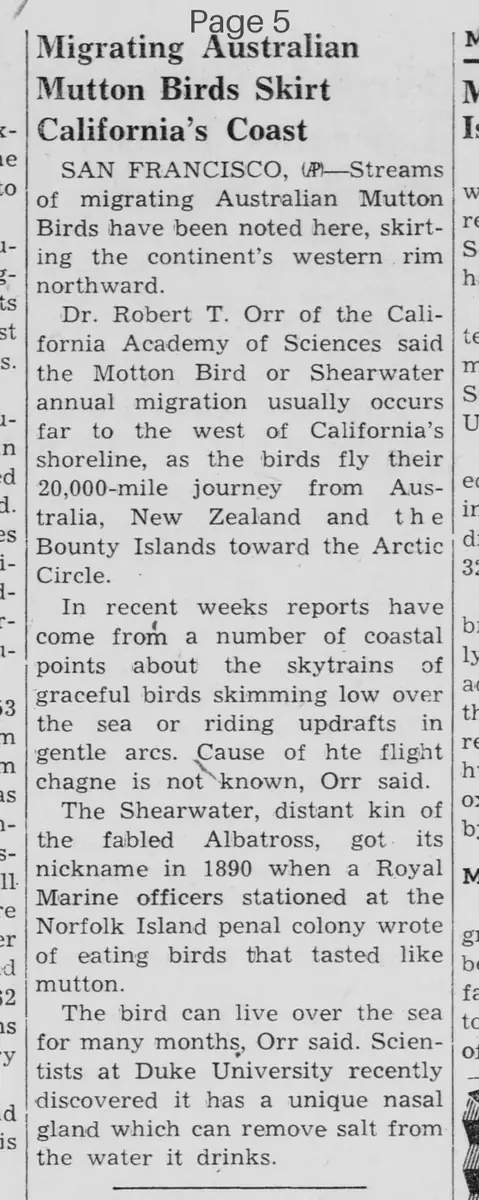
Mutton Birds Skirt
California's Coast
SAN FRANCISCO, (AP) Streams of migrating Australian Mutton Birds have been noted here, skirting the continent's western rim northward.
Dr. Robert T. Orr of the California Academy of Sciences said the Mutton Bird or Shearwater annual migration usually occurs far to the west of California's shoreline, as the birds fly their 20,000-mile journey from Australia, New Zealand and the Bounty Islands toward the Arctic Circle.
In recent weeks reports have come from a number of coastal points about the skytrains of graceful birds skimming low over the sea or riding updrafts in gentle arcs. Cause of the flight change is not known, Orr said.
The Shearwater, distant kin of the fabled Albatross, got its nickname in 1890 when a Royal Marine officer stationed at the Norfolk Island penal colony wrote of eating birds that tasted like mutton.
The bird can live over the sea for many months, Orr said. Scientists at Duke University recently discovered it has a unique nasal gland which can remove salt from the water it drinks.
What sub-type of article is it?
What themes does it cover?
What keywords are associated?
What entities or persons were involved?
Where did it happen?
Story Details
Key Persons
Location
California's Coast
Event Date
Recent Weeks
Story Details
Streams of Australian Mutton Birds (Shearwaters) observed migrating unusually close to California's western shoreline northward, deviating from their standard path west of the coast on a 20,000-mile journey from Australia, New Zealand, and Bounty Islands to the Arctic Circle. Reports from coastal points describe birds skimming sea or riding updrafts; cause unknown. Background on bird's nickname origin in 1890 and unique salt-removing nasal gland discovered recently.