Thank you for visiting SNEWPapers!
Sign up free
Poem
November 8, 1823
Edwardsville Spectator
Edwardsville, Madison County, Illinois
What is this article about?
Lord Byron's extract from the 8th canto of Don Juan celebrates Daniel Boon as the happiest man, living a solitary, vigorous life in Kentucky's wilderness into old age, free from crime, surrounded by nature and a simple forest tribe, contrasting with civilization's corruptions.
Clipping
OCR Quality
95%
Excellent
Full Text
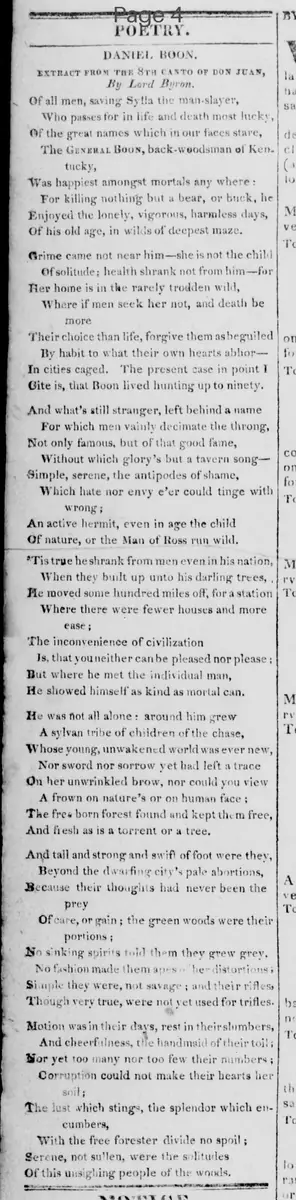
POETRY.
DANIEL BOON,
EXTRACT FROM THE 8TH CANTO OF DON JUAN,
By Lord Byron.
Of all men, saving Sylla the man-slayer,
Who passes for in life and death most lucky,
Of the great names which in our faces stare,
The General Boon, back-woodsman of Kentucky,
Was happiest amongst mortals any where :
For killing nothing but a bear, or buck, he
Enjoyed the lonely, vigorous, harmless days,
Of his old age, in wilds of deepest maze.
Crime came not near him—she is not the child
Of solitude: health shrank not from him—for
Her home is in the rarely trodden wild,
Where if men seek her not, and death be
Their choice than life, forgive them as beguiled
By habit to what their own hearts abhor—
In cities caged. The present case in point I
Give is, that Boon lived hunting up to ninety.
And what's still stranger, left behind a name
For which men vainly decimate the throng,
Not only famous, but of that good fame,
Without which glory's but a tavern song—
Simple, serene, the antipodes of shame,
Which hate nor envy e'er could tinge with wrong;
An active hermit, even in age the child
Of nature, or the Man of Ross run wild.
'Tis true he shrank from men even in his nation.
When they built up unto his darling trees,
He moved some hundred miles off, for a station
Where there were fewer houses and more ease;
The inconvenience of civilization
Is, that you neither can be pleased nor please;
But where he met the individual man,
He showed himself as kind as mortal can.
He was not all alone: around him grew
A sylvan tribe of children of the chase,
Whose young, unwakened world was ever new,
Nor sword nor sorrow yet had left a trace
On her unwrinkled brow, nor could you view
A frown on nature's or on human face ;
The free born forest found and kept them free,
And fresh as is a torrent or a tree.
And tall and strong and swift of foot were they,
Beyond the dwarfing city's pale abortions,
Because their thoughts had never been the prey
Of care, or gain; the green woods were their portions;
No sinking spirits told them they grew grey.
No fashion made them apes of her distortions;
Simple they were, not savage ; and their rifles;
Though very true, were not yet used for trifles.
Motion was in their days, rest in their slumbers,
And cheerfulness, the handmaid of their toil;
Nor yet too many nor too few their numbers;
Corruption could not make their hearts her soil;
The lust which stings, the splendor which encumbers,
With the free forester divide no spoil;
Serene, not sullen, were the solitudes
Of this unsighing people of the woods.
DANIEL BOON,
EXTRACT FROM THE 8TH CANTO OF DON JUAN,
By Lord Byron.
Of all men, saving Sylla the man-slayer,
Who passes for in life and death most lucky,
Of the great names which in our faces stare,
The General Boon, back-woodsman of Kentucky,
Was happiest amongst mortals any where :
For killing nothing but a bear, or buck, he
Enjoyed the lonely, vigorous, harmless days,
Of his old age, in wilds of deepest maze.
Crime came not near him—she is not the child
Of solitude: health shrank not from him—for
Her home is in the rarely trodden wild,
Where if men seek her not, and death be
Their choice than life, forgive them as beguiled
By habit to what their own hearts abhor—
In cities caged. The present case in point I
Give is, that Boon lived hunting up to ninety.
And what's still stranger, left behind a name
For which men vainly decimate the throng,
Not only famous, but of that good fame,
Without which glory's but a tavern song—
Simple, serene, the antipodes of shame,
Which hate nor envy e'er could tinge with wrong;
An active hermit, even in age the child
Of nature, or the Man of Ross run wild.
'Tis true he shrank from men even in his nation.
When they built up unto his darling trees,
He moved some hundred miles off, for a station
Where there were fewer houses and more ease;
The inconvenience of civilization
Is, that you neither can be pleased nor please;
But where he met the individual man,
He showed himself as kind as mortal can.
He was not all alone: around him grew
A sylvan tribe of children of the chase,
Whose young, unwakened world was ever new,
Nor sword nor sorrow yet had left a trace
On her unwrinkled brow, nor could you view
A frown on nature's or on human face ;
The free born forest found and kept them free,
And fresh as is a torrent or a tree.
And tall and strong and swift of foot were they,
Beyond the dwarfing city's pale abortions,
Because their thoughts had never been the prey
Of care, or gain; the green woods were their portions;
No sinking spirits told them they grew grey.
No fashion made them apes of her distortions;
Simple they were, not savage ; and their rifles;
Though very true, were not yet used for trifles.
Motion was in their days, rest in their slumbers,
And cheerfulness, the handmaid of their toil;
Nor yet too many nor too few their numbers;
Corruption could not make their hearts her soil;
The lust which stings, the splendor which encumbers,
With the free forester divide no spoil;
Serene, not sullen, were the solitudes
Of this unsighing people of the woods.
What sub-type of article is it?
Satire
What themes does it cover?
Nature Seasons
Moral Virtue
Satire Society
What keywords are associated?
Daniel Boon
Kentucky
Wilderness
Solitude
Civilization Critique
Byron
Don Juan
Nature Life
What entities or persons were involved?
By Lord Byron
Poem Details
Title
Daniel Boon, Extract From The 8th Canto Of Don Juan
Author
By Lord Byron
Subject
On Daniel Boon, Back Woodsman Of Kentucky
Form / Style
Ottava Rima
Key Lines
Of All Men, Saving Sylla The Man Slayer,
The General Boon, Back Woodsman Of Kentucky,
Crime Came Not Near Him—She Is Not The Child Of Solitude: Health Shrank Not From Him—For
Simple, Serene, The Antipodes Of Shame,
The Free Born Forest Found And Kept Them Free,