Thank you for visiting SNEWPapers!
Sign up free
The Augusta Courier
Augusta, Richmond County, Georgia
What is this article about?
A 1960 article by John J. Synon argues that the South's bloc vote gives it 'high trump cards' in the upcoming presidential election, as 14 of the past 25 races were decided by less than 1% of the major-party vote, potentially allowing Southern defection to throw the election to the House.
Clipping
OCR Quality
Full Text
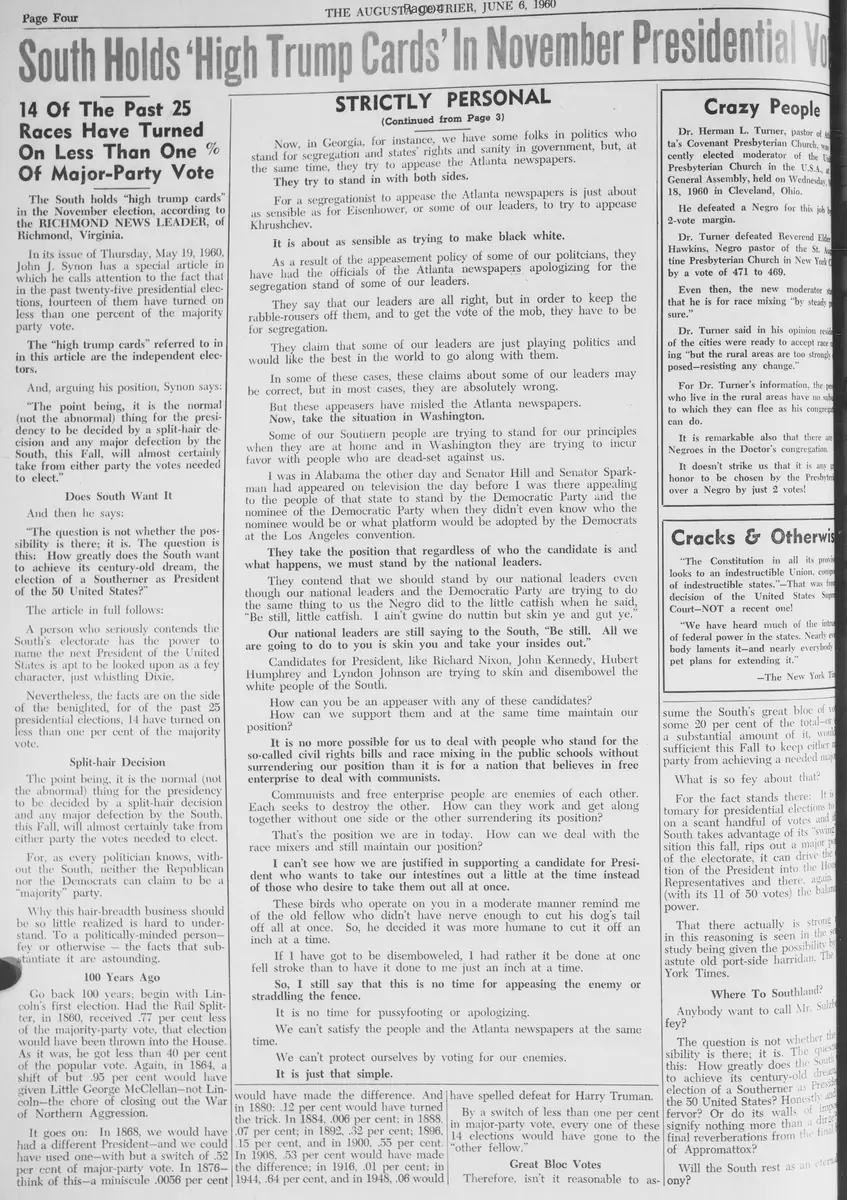
South Holds 'High Trump Cards' In November Presidential Vote
14 Of The Past 25 Races Have Turned On Less Than One Of Major-Party Vote
The South holds "high trump cards" in the November election, according to the RICHMOND NEWS LEADER, of Richmond, Virginia.
In its issue of Thursday, May 19, 1960, John J. Synon has a special article in which he calls attention to the fact that in the past twenty-five presidential elections, fourteen of them have turned on less than one percent of the majority party vote.
The "high trump cards" referred to in this article are the independent electors.
And, arguing his position, Synon says:
The point being, it is the normal (not the abnormal) thing for the presidency to be decided by a split-hair decision and any major defection by the South, this Fall, will almost certainly take from either party the votes needed to elect."
Does South Want It
And then he says:
"The question is not whether the possibility is there; it is. The question is this: How greatly does the South want to achieve its century-old dream, the election of a Southerner as President of the 50 United States?"
The article in full follows:
A person who seriously contends the South's electorate has the power to name the next President of the United States is apt to be looked upon as a fey character, just whistling Dixie.
Nevertheless, the facts are on the side of the benighted, for of the past 25 presidential elections, 14 have turned on less than one per cent of the majority vote.
Split-hair Decision
The point being, it is the normal (not the abnormal) thing for the presidency to be decided by a split-hair decision and any major defection by the South, this Fall, will almost certainly take from either party the votes needed to elect.
For, as every politician knows, without the South, neither the Republican nor the Democrats can claim to be a "majority" party.
Why this hair-breadth business should be so little realized is hard to understand. To a politically-minded person—fey or otherwise—the facts that substantiate it are astounding.
100 Years Ago
Go back 100 years: begin with Lincoln's first election. Had the Rail Splitter, in 1860, received .77 per cent less of the majority-party vote, that election would have been thrown into the House.
As it was, he got less than 40 per cent of the popular vote. Again, in 1864, a shift of but .95 per cent would have given Little George McClellan—not Lincoln—the chore of closing out the War of Northern Aggression.
It goes on: In 1868, we would have had a different President—and we could have used one—with but a switch of .52 per cent of major-party vote. In 1876—think of this—a miniscule .0056 per cent
would have made the difference. And in 1880: .12 per cent would have turned the trick. In 1884, .006 per cent; in 1888, .07 per cent; in 1892, .32 per cent; 1896, .15 per cent, and in 1900, .55 per cent.
In 1908, .53 per cent would have made the difference; in 1916, .01 per cent; in 1944, .64 per cent, and in 1948, .06 would have spelled defeat for Harry Truman.
By a switch of less than one per cent in major-party vote, every one of these 14 elections would have gone to the "other fellow."
Great Bloc Votes
Therefore, isn't it reasonable to assume the South's great bloc of votes—some 20 per cent of the total—or a substantial amount of it, would be sufficient this Fall to keep either major party from achieving a needed majority?
What is so fey about that?
For the fact stands there: It is customary for presidential elections to turn on a scant handful of votes and if the South takes advantage of its "swing" position this fall, rips out a major portion of the electorate, it can drive the election of the President into the House of Representatives and there, again, (with its 11 of 50 votes) the balance of power.
That there actually is strong substance in this reasoning is seen in the serious study being given the possibility by that astute old port-side harridan, The New York Times.
Where To Southland?
Anybody want to call Mr. Sulzberger fey?
The question is not whether the possibility is there; it is. The question is this: How greatly does the South want to achieve its century-old dream, the election of a Southerner as President of the 50 United States? Honestly and finally, is the fervor? Or do the final reverberations from the final signify nothing more than a dirge? its walls of impotence of Appomattox?
Will the South rest as an eternal colony?
What sub-type of article is it?
What themes does it cover?
What keywords are associated?
What entities or persons were involved?
Where did it happen?
Story Details
Key Persons
Location
South, Richmond, Virginia
Event Date
May 19, 1960; November 1960
Story Details
John J. Synon argues that the South's electoral bloc can influence the 1960 presidential election by defecting, as 14 of the past 25 elections were decided by less than 1% of the major-party vote, potentially forcing the outcome to the House of Representatives where the South holds balance.