Thank you for visiting SNEWPapers!
Sign up free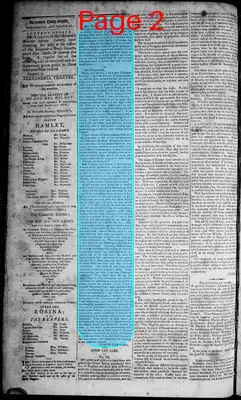
Letter to Editor
September 1, 1808
Alexandria Daily Gazette, Commercial & Political
Alexandria, Virginia
What is this article about?
An Irish immigrant writes to the President via the printer, urging the removal of the embargo due to its severe economic effects on urban trade and rural farming, illustrated by personal stories of joblessness in Baltimore and crop ruin in the countryside.
Clipping

OCR Quality
98%
Excellent
Full Text
From the North American.
Mr. PRINTER,
AS my father was a poor sort of a man, I was forced, instead of going to school for learning, like other boys, to spend most of my leisure hours at work in a potatoe field, for the support of our family; of course, you know it could not be expected of me to write either a very good hand or good grammar; for which reason I have to ask the favor of you just to print the small bit of a letter below, to the President, and to put straight any blunders, so that his Honor may be able to read and understand it better than my own confused scrawl.
MR. PRESIDENT,
Please your Honor, I am a poor Irishman, it is true; but I am not one of those blathering fellows, that, as soon as they set foot on your turf, and feel their tongues free to wag, begin to prate about politics, and pretend to know better what is right or wrong in your government, than those who have been bred and born in the land. No, by my soul I scorn such conduct. Since I came to America, I have considered myself as in the house of a strange gentleman, where I am civilly treated. Then to be sure, would not it be very bad manners in me to be meddling with the management of his family concerns? What I wish to speak to your Honor about is only a little in the way of advice, concerning the embargo. I think now your Honor had better take it off; for I fear, from all I see, feel and hear of it, that it will be after working more harm than good both for your Honor and the country.
If your Honor will have patience with me I will just state a few of the circumstances which occasion my fears. Should your Honor have ever been in Baltimore before the embargo, you may recollect to have seen, at almost every warehouse door, a knot of sturdy fellows hoisting up and lowering down every kind of merchandize, and at the same time singing cheerily the song of--"Now with a will boy, yo heave O!"
May it please your Honor, I was then one of those merry gentlemen; but since the embargo has come amongst us, it has quite put an end to our music, and your Honor now may make almanacs on the busiest wharf in the city, without being bothered by any such noise, to put you out of your calculations.
As for myself, after being out of employ until I had only a six-pence left in my pocket, I said to the Embargo, one morning, by my soul I'll be after taking leave of you; so I resolved to push out into the country, to see a countryman of mine, who had often wished me to come out: and work for him on his farm. I thought, may be, he could now give me a bit of a job of ditching, or something to keep soul and body together, until better times; but how was I disappointed when I came in presence of my old friend, to find that he had just as much of the embargo-countenance as any I left in the city. After I was seated a while, and had taken a sup of whiskey, I mentioned to him what had brought me to see him. Arrah, Dennis, says he, you have come too late; had you applied to me before the embargo, I should have been glad to have employed you. The Embargo! said I, and what has the Embargo to do with you here in the woods? Sure you have no ships for it to be meddling with.--Just go with me to my barn, replied he, and I will shew you what it has to do with me. So away we trudged to the barn, and when he had opened the door of it, there came out such a swarm of small flies, that they had like to have choaked us. And what do you keep those creatures housed up here for? said I. They, answered he, are what I call my Embargo-customers.: They have taken off my last year's crop at their own price, and yonder, continued he, pointing to a number of wheat stacks, stands the present year's, which I suppose will come to the same market--Bad luck to the Embargo and all that were concerned in imposing it! As I found the old fellow was getting angry, I thought I would try to soften him a little--so I told him, that I had understood, that your honor by way of encouraging manufactories, had appeared at the seat of government dressed in a suit of home-made clothes: and as farming had turned out to be so bad a business, I thought he had better try to establish some sort of a manufactory. Your honor, he said, might as well have put on your old red breeches--that the people would just follow the fashion as soon. I had much more conversation with my old friend; but as your honor I suppose is beginning to grow tired, I shall not trouble you with any more of it, and shall conclude; like your honor, with tendering the homage of my profound respect.
DENNIS O'GRABME.
Mr. PRINTER,
AS my father was a poor sort of a man, I was forced, instead of going to school for learning, like other boys, to spend most of my leisure hours at work in a potatoe field, for the support of our family; of course, you know it could not be expected of me to write either a very good hand or good grammar; for which reason I have to ask the favor of you just to print the small bit of a letter below, to the President, and to put straight any blunders, so that his Honor may be able to read and understand it better than my own confused scrawl.
MR. PRESIDENT,
Please your Honor, I am a poor Irishman, it is true; but I am not one of those blathering fellows, that, as soon as they set foot on your turf, and feel their tongues free to wag, begin to prate about politics, and pretend to know better what is right or wrong in your government, than those who have been bred and born in the land. No, by my soul I scorn such conduct. Since I came to America, I have considered myself as in the house of a strange gentleman, where I am civilly treated. Then to be sure, would not it be very bad manners in me to be meddling with the management of his family concerns? What I wish to speak to your Honor about is only a little in the way of advice, concerning the embargo. I think now your Honor had better take it off; for I fear, from all I see, feel and hear of it, that it will be after working more harm than good both for your Honor and the country.
If your Honor will have patience with me I will just state a few of the circumstances which occasion my fears. Should your Honor have ever been in Baltimore before the embargo, you may recollect to have seen, at almost every warehouse door, a knot of sturdy fellows hoisting up and lowering down every kind of merchandize, and at the same time singing cheerily the song of--"Now with a will boy, yo heave O!"
May it please your Honor, I was then one of those merry gentlemen; but since the embargo has come amongst us, it has quite put an end to our music, and your Honor now may make almanacs on the busiest wharf in the city, without being bothered by any such noise, to put you out of your calculations.
As for myself, after being out of employ until I had only a six-pence left in my pocket, I said to the Embargo, one morning, by my soul I'll be after taking leave of you; so I resolved to push out into the country, to see a countryman of mine, who had often wished me to come out: and work for him on his farm. I thought, may be, he could now give me a bit of a job of ditching, or something to keep soul and body together, until better times; but how was I disappointed when I came in presence of my old friend, to find that he had just as much of the embargo-countenance as any I left in the city. After I was seated a while, and had taken a sup of whiskey, I mentioned to him what had brought me to see him. Arrah, Dennis, says he, you have come too late; had you applied to me before the embargo, I should have been glad to have employed you. The Embargo! said I, and what has the Embargo to do with you here in the woods? Sure you have no ships for it to be meddling with.--Just go with me to my barn, replied he, and I will shew you what it has to do with me. So away we trudged to the barn, and when he had opened the door of it, there came out such a swarm of small flies, that they had like to have choaked us. And what do you keep those creatures housed up here for? said I. They, answered he, are what I call my Embargo-customers.: They have taken off my last year's crop at their own price, and yonder, continued he, pointing to a number of wheat stacks, stands the present year's, which I suppose will come to the same market--Bad luck to the Embargo and all that were concerned in imposing it! As I found the old fellow was getting angry, I thought I would try to soften him a little--so I told him, that I had understood, that your honor by way of encouraging manufactories, had appeared at the seat of government dressed in a suit of home-made clothes: and as farming had turned out to be so bad a business, I thought he had better try to establish some sort of a manufactory. Your honor, he said, might as well have put on your old red breeches--that the people would just follow the fashion as soon. I had much more conversation with my old friend; but as your honor I suppose is beginning to grow tired, I shall not trouble you with any more of it, and shall conclude; like your honor, with tendering the homage of my profound respect.
DENNIS O'GRABME.
What sub-type of article is it?
Persuasive
Social Critique
What themes does it cover?
Economic Policy
Commerce Trade
Agriculture
What keywords are associated?
Embargo
Irish Immigrant
Economic Hardship
Baltimore Trade
Agriculture Impact
Unemployment
Home Manufactories
What entities or persons were involved?
Dennis O'grabme
Mr. Printer
Letter to Editor Details
Author
Dennis O'grabme
Recipient
Mr. Printer
Main Argument
an irish laborer advises the president to lift the embargo, arguing it causes widespread economic harm by halting trade in cities like baltimore and devastating agriculture in the countryside, based on personal experiences of unemployment and lost markets.
Notable Details
Personal Anecdote Of Job Loss As A Dock Worker In Baltimore
Description Of Farmer's Barn Filled With Weevils Due To Unsold Grain
Reference To President's Home Made Clothes As Futile Encouragement For Manufactories