Thank you for visiting SNEWPapers!
Sign up free
The New Hampshire Gazette
Portsmouth, Rockingham County, New Hampshire
What is this article about?
The Brigantine Betsey, owned by American citizens, was captured by British privateer Agenoria near Guadaloupe in 1794 while trading provisions. Condemned as prize in Bermuda for violating blockade, the appeal was heard and affirmed by Lords Commissioners in London on July 25, 1795.
Merged-components note: Continuation of the report on the American appeals court case.
Clippings
1 of 2
OCR Quality
Full Text
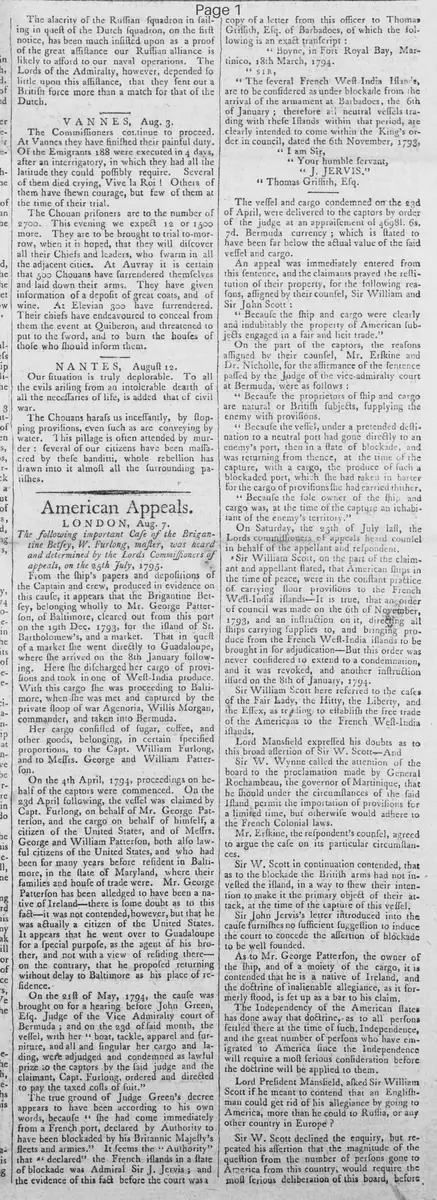
LONDON, Aug. 7.
The following important Case of the Brigantine Betsey, W. Furlong, master, was heard and determined by the Lords Commissioners of appeals, on the 25th July, 1795.
From the ship's papers and depositions of the Captain and crew, produced in evidence on this cause, it appears that the Brigantine Betsey, belonging wholly to Mr. George Patterson, of Baltimore, cleared out from this port on the 19th Dec. 1793, for the island of St. Bartholomew's, and a market. That in quest of a market she went directly to Guadaloupe, where she arrived on the 8th January following. Here she discharged her cargo of provisions and took in one of West-India produce. With this cargo she was proceeding to Baltimore, when she was met and captured by the private sloop of war Agenoria, Willis Morgan, commander, and taken into Bermuda.
Her cargo consisted of sugar, coffee, and other goods, belonging, in certain specified proportions, to the Capt. William Furlong, and to Messrs. George and William Patterson.
On the 4th April, 1794, proceedings on behalf of the captors were commenced. On the 23d April following, the vessel was claimed by Capt. Furlong, on behalf of Mr. George Patterson, and the cargo on behalf of himself, a citizen of the United States, and of Messrs. George and William Patterson, both also lawful citizens of the United States, and who had been for many years before resident in Baltimore, in the state of Maryland, where their families and house of trade were. Mr. George Patterson has been alleged to have been a native of Ireland—there is some doubt as to this fact—but it was not contended, however, but that he was actually a citizen of the United States.
It appears that he went over to Guadaloupe for a special purpose, as the agent of his brother, and not with a view of residing there— on the contrary, that he proposed returning without delay to Baltimore as his place of residence.
On the 21st of May, 1794, the cause was brought on for a hearing before John Green, Esq. Judge of the Vice Admiralty court of Bermuda; and on the 23d of said month, the vessel, with her "boat, tackle, apparel and furniture, and all and singular her cargo and lading, were adjudged and condemned as lawful prize to the captors by the said judge and the claimant, Capt. Furlong, ordered and directed to pay the taxed costs of suit."
The true ground of Judge Green's decree appears to have been according to his own words, because "she had come immediately from a French port, declared by Authority to have been blockaded by his Britannic Majesty's fleets and armies." It seems the "Authority" that "declared" the French islands in a state of blockade was Admiral Sir J. Jervis; and the evidence of this fact before the court was a copy of a letter from this officer to Thomas Griffith, Esq. of Barbadoes. of which the following is an exact transcript:
"Boyne, in Fort Royal Bay, Martinico, 18th March, 1794.
SIR,
The several French West India Islands, are to be considered as under blockade from the arrival of the armament at Barbadoes, the 6th of January; therefore all neutral vessels trading with these Islands within that period, are clearly intended to come within the King's order in council, dated the 6th November, 1793,
I am Sir,
Your humble servant,
J. JERVIS."
"Thomas Griffith, Esq."
The vessel and cargo condemned on the 23d of April, were delivered to the captors by order of the judge at an appraisement of 4698l. 6s. 7d. Bermuda currency: which is stated to have been far below the actual value of the said vessel and cargo.
An appeal was immediately entered from this sentence, and the claimants prayed the restitution of their property, for the following reasons, assigned by their counsel, Sir William and Sir John Scott:
"Because the ship and cargo were clearly and indubitably the property of American subjects engaged in a fair and licit trade."
On the part of the captors, the reasons assigned by their counsel, Mr. Erskine and Dr. Nicholl, for the affirmance of the sentence passed by the Judge of the vice-admiralty court at Bermuda, were as follows:
"Because the proprietors of ship and cargo are natural or British subjects, supplying the enemy with provisions.
Because the vessel, under a pretended destination to a neutral port had gone directly to an enemy's port, then in a state of blockade, and was returning from thence, at the time of the capture, with a cargo, the produce of such a blockaded port, which she had taken in barter for the cargo of provisions she had carried thither.
Because the sole owner of the ship and cargo was, at the time of the capture an inhabitant of the enemy's territory."
On Saturday, the 25th of July last, the Lords commissioners of appeals heard counsel in behalf of the appellant and respondent.
Sir William Scott, on the part of the claimant and appellant stated, that American ships in the time of peace, were in the constant practice of carrying flour provisions to the French West-India islands—It is true, that an order of council was made on the 6th of November, 1793, and an instruction on it, directing all ships carrying supplies to, and bringing produce from the French West-India islands to be brought in for adjudication—But this order was never considered to extend to a condemnation, and it was revoked, and another instruction issued on the 8th of January, 1794.
Sir William Scott here referred to the cases of the Fair Lady, the Hitty, the Liberty, and the Essex, as tending to establish the free trade of the Americans to the French West-India islands.
Lord Mansfield expressed his doubts as to this broad assertion of Sir W. Scott—And Sir W. Wynne called the attention of the board to the proclamation made by General Rochambeau, the governor of Martinique, that he should under the circumstances of the said Island permit the importation of provisions for a limited time, but otherwise would adhere to the French Colonial laws.
Mr. Erskine, the respondent's counsel, agreed to argue the case on its particular circumstances.
Sir W. Scott in continuation contended, that as to the blockade the British arms had not invested the island, in a way to shew their intention to make it the primary object of their attack, at the time of the capture of this vessel.
Sir John Jervis's letter introduced into the cause furnishes no sufficient suggestion to induce the court to concede the assertion of blockade to be well founded.
As to Mr. George Patterson, the owner of the ship, and of a moiety of the cargo, it is contended that he is a native of Ireland, and the doctrine of inalienable allegiance, as it formerly stood, is set up as a bar to his claim.
The Independency of the American states has done away that doctrine, as to all persons settled there at the time of such Independence, and the great number of persons who have emigrated to America since the Independence will require a most serious consideration before the doctrine will be applied to them.
Lord President Mansfield, asked Sir William Scott if he meant to contend that an Englishman could get rid of his allegiance by going to America, more than he could to Russia, or any other country in Europe?
Sir W. Scott declined the enquiry, but repeated his assertion that the magnitude of the question from the number of persons gone to America from this country, would require the most serious deliberation of this board, before...
The doctrine alluded to was enforced to their prejudice.
The Masters of the Rolls observed, that the question would probably require some understanding between the two countries.
Sir W. Scott proceeded: he remarked that as to M. G. Patterson's birth and residence, the third witness contradicts the other two, and says he believes Mr. Patterson was born in America; so that the fact is not proved, and as to his residence, he appears to have gone to Guadaloupe on the present occasion only, and to have had no residence there: and as to the clearing out for St. Bartholomews upon which much stress is laid—the fact is, the ship was cleared out for that island (which is Danish) and for a market.
Mr. Erskine in reply declared he was more convinced than ever that he was founded in asking for confirmation of the sentence of condemnation, as it is evident that the urgent want of provisions was the sole inducement to let the ship take back the cargo of sugar and coffee, without which she could only have taken molasses.
He contended that the voyage may strictly be considered as masked, the island of St. Bartholomews being a kind of emporium, and the words 'for a market' a mere cover, and as to the seizure of the cargo by the French, it is evident that the owner was so well reconciled to it as to talk of sending a further cargo.
He did not ask for condemnation of the letter of Sir J. Jervis: he admitted the assertion of Sir W. Scott, as to its want of logical accuracy, self-preservation however was essential, and as much a principle with nations as with individuals, and the political existence of this country justified his expectation of condemnation.
Martinique was then reduced, and Mr. Patterson must have known it, and been well assured that Guadaloupe was an immediate object of the British arms.
America, he contended was entitled to no more and no less than other nations, and he had no doubt but that if Mr. Patterson should, on further enquiry, (if it should be thought necessary to make it) appear to be a British subject by birth, his property would be liable to condemnation.
The council having closed their arguments, the Lords, viz. the Earl of Mansfield, Lord President of the Council; Sir R. P. Arden, Knight, Master of the Rolls; Sir W. Wynne, Knight; Sylvester Douglas, Esq. and Charles Greville, Esq. took the same into consideration and made and declared their decree in the following words:
'The Lords having heard the proofs read, and advocates and proctors on both sides, under all the special circumstances of the case, by their interlocutory decree, pronounced against the appeal, affirmed the sentence appealed from and remitted the cause.'
(Signed) ARDEN,
Register of his Majesty's High Court of Appeals for Prizes.
What sub-type of article is it?
What themes does it cover?
What keywords are associated?
What entities or persons were involved?
Where did it happen?
Story Details
Key Persons
Location
Guadaloupe, Bermuda, London
Event Date
1793 1795
Story Details
The American-owned Brigantine Betsey was captured by British privateer Agenoria while returning from Guadaloupe with West India produce after delivering provisions. Condemned in Bermuda Vice Admiralty Court for blockade violation, the appeal was affirmed by the Lords Commissioners in London, upholding the prize due to the ship's trade with a blockaded French port and questions over the owner's citizenship.